

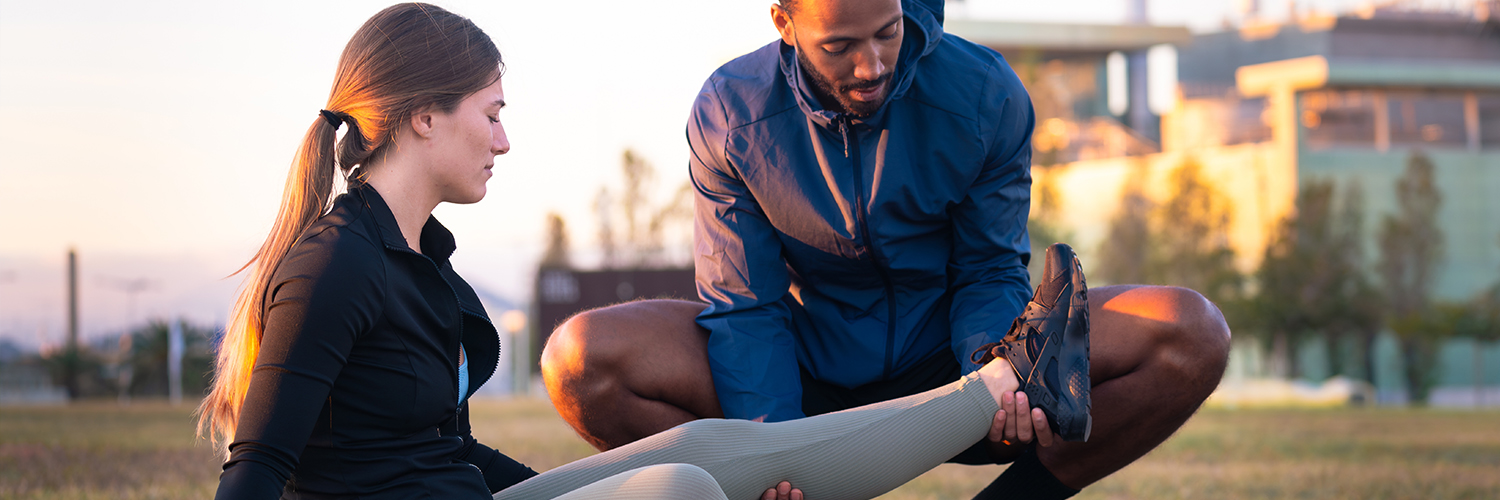
This episode explores the vital role of sports medicine, breaking down how it differs from orthopedics and highlighting common injuries such as sprains, shin splints, and overuse conditions like tennis elbow and runner’s knee.
Experts from Stony Brook Orthopaedic Associates cover how injury risks and prevention strategies vary by age, gender and seasonal activity, with a special focus on youth athletes and non-surgical treatment options. Experts also provide practical guidance on when to seek care, everyday injury management tips and insights into emerging trends like pickleball-related injuries — along with advice tailored for young female athletes.
The Experts
- Chief, Sports Medicine, Stony Brook Orthopaedic Associates
- Sports Medicine Physician, Stony Brook Orthopaedic Associates
- Director, Women’s Sports Medicine Center, Sports Medicine Physician, Stony Brook Orthopaedic Associates
What You’ll Hear in This Episode
- 00:00 Opening and Introductions
- 1:38 The importance of sports medicine
- 2:30 The difference between sports medicine and orthopedics
- 3:22 What are some of the more common sports injuries?
- 4:55 Do sports injuries and injury prevention differ by age?
- 9:09 What should I do when I have a sprained ankle?
- 10:35 Causes and treatment for shin splints
- 11:59 Tennis elbow v. golfer’s elbow
- 13:28 Youth sports injuries
- 15:12 Non-operative solutions for youth sports injuries
- 17:25 What sports or activities cause the most injuries?
- 17:58 Do we see a spike in sports injuries around the new year?
- 18:37 Are sports injuries more prevalent among women?
- 20:32 Pickleball injuries
- 22:07 Do we see a spike in sports injuries over the summer?
- 22:48 Advice for young female athletes
- 24:30 Our team of female sports medicine professionals at Stony Brook Medicine
- 25:07 Runner’s knee
- 26:44 Hip pain
- 27:40 When is it time to visit a sports medicine provider?
- 28:27 Closing Remarks
Full Podcast Transcript
00:00 Opening and Introductions
This episode is hosted by Tim Brown, Chief Communications and Marketing Officer at Stony Brook Medicine.
Disclaimer: The information provided in this podcast is for educational and informational purposes only, and is not intended as a substitute for professional medical advice, diagnosis or treatment. If you think you may be having a medical emergency, call your doctor or emergency services immediately.
Description of Video Studio: News desk with Stony Brook Medicine logo on the front. A big screen is behind seated experts with the HEALTH Yeah! logo (red uppercase lettering with a microphone at the top of the “L”). Music plays as the announcer introduces the episode.
Announcer
Welcome to HEALTH Yeah!, where experts from Stony Brook Medicine come together to discuss topics ranging from the complex inner workings of an infectious disease to tips and tricks for staying safe and healthy all year long.
Tim Brown
Welcome to HEALTH Yeah! Many of us have experienced one or two, or maybe even more, physical injuries in our lifetimes, or we at least know someone who has. And when those happen, we visited a healthcare professional and even done physical therapy possibly to help us get better.
Today, we’re going to take a deeper dive into this topic and speak with our experts in the field of sports medicine, and we’ll learn how they work with patients to prevent injuries, enhance athletic performance and accelerate recovery for athletes and active individuals. Now, before we get started, I would love to have each one of you introduce yourselves to our audience and tell us a little bit about what you do here at Stonybrook Medicine.
Stuart Cherney, MD
So, I’m Dr. Stuart Cherney. I’m the Chief of Sports Medicine at Stony Brook University, and currently serve as one of the team physicians, and have been a team physician at Stony Brook since 1983. So that’s when our sports medicine program started on campus, and I’ve been involved with the teams ever since.
Tim Brown
Fantastic, and Dr. Cruickshank.
Brian Cruickshank, MD
So, my name is Dr. Brian Cruickshank. I’m a primary care sports medicine physician with Stony Brook University, kind of do non-operative orthopedics. I’m also the medical director of the university. (This is) my 13th year here. Grew up in Long Island, from Long Island, trained out of state for a while, but came back.
1:38 The Importance of Sports Medicine
Tim Brown
Great. So, Dr. Cherney, I want to start with you if we can. You said you were here from the very start, 83 so we said.
Stuart Cherney, MD
Yes.
Tim Brown
So you’ve been doing this for a while, correct? Why is sports medicine so important?
Stuart Cherney, MD
Well, to me personally, almost every doctor who goes into sports medicine was an athlete at one time, and one of the things that kind of hooks us is our own injuries and how our own injuries were treated, and our teammates and how their injuries were treated. So that’s from a personal perspective. And then when you get into medicine you sort of veer into the areas that you enjoy doing, and so, yeah, just for me, it was just sort of a natural fit, and I kind of felt like I related to athletes, I was an athlete, so yeah, it was just kind of a good fit,
2:30 The Difference Between Sports Medicine and Orthopedics
Tim Brown
And when you think about sports medicine, I think a lot of folks think of orthopedics, but there is a little bit of a difference.
Stuart Cherney, MD
Correct. So today sports medicine is kind of a team concept, especially if you’re looking at a university where we take care of a lot of different teams, but even for everybody out in the public or recreational athletes. So it’s not just orthopedic surgeons, although that’s the doctor that you see running out on the football field, taking care of an injured shoulder, but it’s also athletic trainers, physical therapists, nutritionists, internal medicine and family doctor physicians. So there’s a really broad base of medical specialists who deal with athletes.
3:22 What Are Some of the More Common Sports Injuries?
Tim Brown
Interesting, and Dr. Cruickshank, I’m curious: What are some of the more common injuries that you see? I imagine that’s probably changed over the years, just with how people are active nowadays and some of the things maybe they do, or new sports even.
Brian Cruickshank, MD
Yeah, I think it depends on sort of, you know, the injury you’re looking at and kind of who’s come into the office or on the sideline.
On the sidelines, you’ll see more acute injuries. In the office, maybe you’ll see an acute injury — somebody that was seen in the ER, potentially, or something that happened over the weekend and kind of popped into the office on a Monday or Tuesday — versus a chronic injury that’s kind of been around for a while and sort of nagging people. You know, it’s been going on for a couple of months, so it kind of varies.
For the acute injuries, maybe we’ll occasionally see some fractures, or fractures we’re seeing in the ER for a follow-up, maybe some dislocations. Often, they’ll see a shoulder dislocation follow-up, or some more chronic injuries, including tendinitis, patellar tendonitis, or patella dislocations, and things like that.
4:55 Do Sports Injuries and Injury Prevention Differ By Age?
Tim Brown
Have you seen that change much as people have become either more or less active over the years, and you know, we see new sports like pickleball introduced, and I don’t know how many injuries you get from pickleball, but maybe you do see some.
Brian Cruickshank, MD
I think you kind of hit the nail on the head right there. So, I think that’s one of the, you know, things kind of vary and change. I mean, even the last, you know, 10 years that I’ve been here, like you’re saying, pickleball — the sort of newest, latest and greatest sport and craze — and, you know, kind of seeing a little bit of an older population play those games and those sports. And so, you’ll see different injuries when it comes to that. So, yeah, that’s something to think about too.
Tim Brown
And when you deal with the athletes on the sidelines of Stony Brook here, and these are obviously younger folks, so they’re probably a little bit more pliable as opposed to when somebody like me tries to do those things, what kind of differences do you see, and what would you, what kind of advice would you give to maybe the older person trying to get in shape and gets a little crazy with doing things?
Stuart Cherney, MD
So as I picked up a few gray hairs along the way, I saw some of my patients, and yeah, there is a big difference. Younger athletes are going to play different sports. You know, they’re going to be playing contact sports. Older athletes rarely play contact sports, and as you get older, you have a lifetime of previous injuries and things that sort of come back and haunt you, such as early osteoarthritis, wear-and-tear arthritis, and I see that a lot.
Older athletes — so I have given a talk for years on how to stay in the game, you know, sports and fitness forever — and the concept is, and the driving point is: Why are you doing what you’re doing? Because not every 60-year-old athlete is the same, and so some are doing their exercise or their sports because their cardiologist said, “You have to do cardiac things.” Some are going back to their college and high school days when they played on competitive teams, and they love competitive sports. They want to get into competitive sports. Some just want to look good on the beach in the summertime.
So you have to find out what the reason is. People are doing these sports—why are they doing the activities? And that kind of guides us, as the treating physician, as to how they can get back into those activities safely.
Tim Brown
Yeah, you know, it’s interesting, and, you know, we talked about pickleball a second ago, and you see some of these other sports, like CrossFit but different ways of staying in shape. The combat sports are pretty big, and I don’t know if Brian is listening to me right now in the booth, but I know he gets into that. So, you know, these are folks that do things that maybe, you know, 20–30 years ago we wouldn’t have done, and it does impact your body differently. And, you know, I gotta admit, you get a little older, you think you’re still young. We’re not.
Stuart Cherney, MD
No ligaments get a little more brittle as you get older. Dealing with arthritis, dealing with medical issues, gout. You know, maybe you didn’t have gout when you were younger, but you do have it now, and so you deal with that. So yeah, you were dealing with very often medical problems superimposed on orthopedic issues, and you have to take everything into consideration.
Brian Cruickshank, MD
And then I also think, you know, we kind of jokingly say, “Lose the point, save your joint,” you know, if you’re making that extra effort, maybe it’s not worth it. You know, if you’re not playing for money, you’re not a professional. So, you know, I’ve seen a bunch of Achilles tendon ruptures, patellar tendon ruptures, from injuries like that.
Tim Brown
Exact same thing happened to my brother — little older, playing basketball, was trying to keep up with the young guys — and an Achilles tendon injury. It’s sometimes a difficult thing to accept in life that you are getting a little bit older, and you do have to maybe watch at least the impact portion of it.
Brian Cruickshank, MD
Yeah, I think part of our job is to kind of again figure out what that limit is, and you know, kind of realize who we’re treating, and figure out, you know, how what the best way to treat them is, and kind of keep them in the game, so to speak.
Stuart Cherney, MD
Well, that’s human nature, really, to think that you could do the things that you did when you were a kid. And a piece of advice that I give to my patients routinely is when they’re out of shape, or they’ve been away from a sport, or they’ve been out of the gym for a while, I tell them: whatever you think you should be doing on day one, cut it in half (when you) start out, because you’re not starting where you were five years ago or 10 years ago.
9:09 What Should I Do When I Have a Sprained Ankle?
Tim Brown
So, let’s kind of go through some of the basics. I’m curious, like sprained ankle, for example. When does somebody need to come and see somebody like you? When can they treat that at home, and what do they need to do?
Brian Cruickshank, MD
One of the big things is sort of their weight-bearing status immediately after the injury. So, you know, if you can’t stand up and put some weight on it, put some pressure on it and walk immediately after the injury for a couple steps, that’s one of the signs that we say, hey, you know, maybe you should see somebody, where obviously there’s some sort of obvious deformity that you notice, and this it just doesn’t look right. Yeah, I think those are kind of the two big things that we notice.
Stuart Cherney, MD
Yes, sprained ankles, there’s a bunch of ligaments around your ankle, and depending on which ones or combination of ligaments are injured determines the severity of the injury.
So the simple ankle sprains on the outer side of the ankle, you know, they sometimes you don’t even need an X-ray, as Brian said, if you can weight-bear immediately, chances are it’s going to resolve. But those serious ankle sprains, where the ankle swells up like a balloon, it’s very painful, you can’t weight-bear — those are the ones that we would actually start with an X-ray, just to make sure that we’re not missing a fracture, and sometimes even an MRI to look for the more complicated type of ligament injuries around the ankle.
10:35 Causes and Treatment for Shin Splints
Tim Brown
Shin splints. So, whether it’s getting nicer, people are walking, jogging, running. What exactly causes shin splints, and what can you do for them?
Brian Cruickshank, MD
I think it’s one of the common things that we’ll kind of see, especially around this time of year, when people are … getting outside a little bit more.
And it’s usually, it’s more of an overuse, and you know, too much too soon kind of thing again. Those muscles and tendons aren’t used to kind of getting used and stretched like they’re supposed to. It’s kind of been a long winter, maybe hibernating, so to speak. And again, it’s just kind of getting into the activity too much, too soon.
So you start developing this pain in the front of your shin, and it can kind of progress. So initially, maybe you don’t even notice it at rest you’ll just notice it when walking, and then it can kind of progress where just normal everyday activities will start bothering you, and eventually you can even just feel it when you’re done for your day, just sort of sitting there.
Tim Brown
So, how do you treat it?
Brian Cruickshank, MD
Again, you’ve got to kind of modify some of your activities. So, some of the things you’re going to do, sort of back off whatever you’ve been doing, if maybe overdoing it, and then the simple stuff: icing it down, some over-the-counter anti-inflammatories, kind of take it easy.
If it doesn’t get better from there, and you end up kind of seeing one of us or somebody else, maybe potentially recommend some orthotics, depending on sort of how your foot is, or maybe even if it’s severe, maybe some sort of boot, like a walking boot, or something like that.
11:59 Tennis Elbow vs. Golfer’s Elbow
Tim Brown
So, we’ve heard of tennis elbow and golfer’s elbow. Is there any difference, other than the sport you play?
Stuart Cherney, MD
Yes. Okay, so tennis elbow is pain on the outer side of the elbow, and classically that’s caused by getting a backhand with poor mechanics, but there are lots of other things that can contribute to that. So, in inexperienced tennis players, they’re susceptible because their backhand technique is not too good. In high-level tennis players, they can develop tennis elbow from hitting forehand shots, where they try and put topspin on the ball, and they’re coming over the ball really hard.
So there’s like two different reasons. Also, when they hit certain types of serves, they can stretch those tendons where they attach above the elbow joint. So that’s tennis elbow.
Golfer’s elbow is a tendonitis on the inside of the elbow, and that’s going to be on your down hand, and that usually is from catching big divots or spending a lot of time in sand traps.
Tim Brown
Well that describes my game.
Stuart Cherney, MD
And that’s actually what leads to that, but it really stops golfers from playing. I have to admit.
13:28 Youth Sports Injuries
Tim Brown
All right, so real quickly, before we wrap up this segment, I had a couple more questions for you. First of all, I want to talk about youth sports injuries, and some of the more serious ones, and I would imagine concussions are right up there. What are your thoughts on youth sports injuries? What do parents need to be worried about?
Stuart Cherney, MD
So you may not know, we just put on a symposium a week ago on youth sports injuries, and we do a sports symposium every year, trying to hit on topics of interest and where there’s changing ideas about treatment and evaluation. So we’ve done mental health, we’ve done game day coverage, we’ve done female athletes and this year we did the young athlete.
So young athletes, right off the bat, their susceptibility to injuries is largely related to the fact that they’re still growing, and the growth areas in the bones around the joints are made of cartilage, and that area is weaker than the surrounding bones. And so damage to those areas can lead to things like Little League shoulder, Little League elbow.
Tim Brown
And is that something that sticks with the player then for a long time?
Stuart Cherney, MD
Not if they get treated early, they have a good diagnosis, and they rest and let things heal up before they try to go back. The mistakes that a lot of young athletes, and their parents, make is that once they start feeling better, maybe in a week or two, because these areas tend to heal up quickly, they go right back to doing the same thing that they were doing, and then re-injured, re-injured. Those turn out to be problems.
15:12 Non-Operative Solutions for Youth Sports Injuries
Tim Brown
Final question, Dr. Cruickshank, non-operative options, what does that look like for people with these injuries?
Brian Cruickshank, MD
So, in terms of youth sports, the typical non-op stuff that I’ll see is, concussion, head injuries, and I think the big distinguishing factor that a lot of parents need to realize is that medicine concussion is a functional injury, not a structural injury. So a lot of parents will go to the emergency rooms, expecting to get a CT scan or MRI or X-rays or something. In reality, that’s not going to show us the concussion that you’re looking for; you’re looking for, is there a bleed, is there a fracture, maybe something potentially a little more serious.
So there’s no specific test, unfortunately, that we have right now looking for concussion. A lot of it’s based off the signs and symptoms and what the athlete’s experiencing. So that’s a big thing in my practice that I see now, something I train for, and again, we make sure that an athlete is taken care of in terms of both sport-wise and then also academically. That’s a big thing, because these kids aren’t working, they’re in school, and just like I said, if somebody sprains their ankle and they’re not going to play sports, unfortunately, concussion is going to affect their mental capacity, their concentration, so you don’t want a kid to suffer in school because of an injury.
Tim Brown
Good point. All right, we’re going to take a break right now, and when we come back, we’ll have another physician on to discuss more about sports injuries and what can be done.
And welcome back, we are fortunate enough to have Dr. Hopkins joining us now. And before we get started on this segment of the program, if you will, just introduce yourself to our audience and tell us a little bit about what you do here at Stony Brook.
17:25 What Sports or Activities Cause the Most Injuries?
Kristin Hopkins, MD
Thanks for having me. I’m really excited to be here. I’m Dr. Kristen Hopkins. I’m a sports medicine specialist and orthopedist. I serve as a team physician for Stony Brook University, and I’m also the director of our Women’s Sports Medicine Center.
Tim Brown
So, you’ve seen it all.
Kristin Hopkins, MD
I’ve seen a lot, getting more under my belt with each year, but yeah.
Tim Brown
So, what sport or activities would you say cause the most injuries?
Kristin Hopkins, MD
I think it’s very seasonal, especially with the Long Island environment. We’re easing our way now into spring sports. We call lacrosse a spring sport, but I think February and March are pretty brutally cold. We’re just starting to get to the good part. But any preseason really lends itself to some increased injuries. If people don’t train well in the off season, especially kids, and then they go out there and they’re competing for starting positions and stuff, we tend to see muscle pulls, strains, and then there’s always the occasional broken bone from kids playing sports.
17:58 Do We See a Spike in Sports Injuries Around the New Year?
Tim Brown
Yeah, and I’ve always kind of wondered, people make their New Year’s resolutions in January, and it’s always to exercise more. You see a spike in injuries then?
Kristin Hopkins, MD
For sure. I think also a good thing for our community, and just for general well-being, is there’s a lot more push for weightlifting and for lifting weights and promoting that as a healthy way to increase bone density for young, for middle-aged females, and also just to maintain cardiovascular health. But without the proper technique and without the proper training, it definitely leads to overuse injuries and a lot of shoulder and knee injuries that show up in my office.
18:37 Are Sports Injuries More Prevalent Among Women?
Tim Brown
Interesting. So obviously you deal with men and women and children. With female athletes, do you see injuries that tend to be — you see more in female athletes than male athletes?
Kristin Hopkins, MD
I do. There are definitely some patterns that are valid, and some are for physiologic reasons. There’s also components of hormonal components to things, but our adolescent female athletes, ACL tears are definitely more common in females than in males, up to like even five times more common in age-match studies.
Tim Brown
So why is that?
Kristin Hopkins, MD
We think it’s multifactorial. It has to do with there’s a hormonal component, there’s also a structural component that will actually follow females into their middle age as well. You know, as females and women, we have a wider pelvis that’s meant to carry the babies, but then our knees need to still line up over our ankles, so we get more of a valgus, or a knock-knee perspective on our knees, and that actually predisposes to different landing mechanics that put them at risk for ACL tears. It also can lead to anterior knee pain, things like that.
So some of it’s how we’re built, some of it is the proprioception and musculoskeletal components. We tend to be more quad dominant. Our quads are stronger than our hamstrings. This also lends itself to injury, things like that. But it’s stuff that we’re starting to get a grip on how we can make adjustments in training and prevention programs to hopefully start to bring down that number.
Tim Brown
Interesting. So, is technique more important?
Kristin Hopkins, MD
Technique is definitely important. Some of these ACL prevention programs are starting to gain some traction, where we’re talking about different strengthening, different muscle groups in more effective ways, landing mechanics, avoiding that valgus knock-knee position when kids are landing and cutting and pivoting. But also, I mean, some of it is also just unfortunately luck.
20:32 Pickleball Injuries
Tim Brown
Yeah, so I’ve got to bring up pickleball again. I mentioned it earlier, it’s kind of the hot thing now, and you know it’s funny when pickleball first started getting popular, I thought it was kind of an easy thing to do, but then you see some of these people who play pickleball, and they are playing for blood, so do you see those kinds of (injuries)?
Kristin Hopkins, MD
And all ages. Yeah, it’s really an equalizer, right? If you have hand-eye coordination, you can be good at pickleball, and if you learn the strategy, you can be really good at pickleball, and it doesn’t matter how old you are. But, you know, I think it definitely lends itself to specific injuries. I’m seeing a lot of hamstring pulls, unfortunately, Achilles ruptures. Falls tend to lend themselves to broken wrists, dislocated shoulders, that sort of thing. And also it really aggravates knee arthritis.
So the court’s not that big, but the surface is really sticky, and it’s pretty fast-acting in terms of change in direction. So, you know, two hours on a pickleball court, that’s a lot of pounding. And then they say, “I don’t move that much,” but it’s still enough where your knee swells up afterwards, and maybe you’ve got some achy pain the next day, you’re really paying for it. But I’m a sports doctor, I want to keep you doing the things that you enjoy. So what can I, what tools can I give you so that you keep playing?
Tim Brown
Well, and it’s a great point. You know, you’re not moving huge distances, but you are changing direction a lot.
Kristin Hopkins, MD
And you’re doing it quickly. Yeah, and when you’re into it, you don’t want to miss the point.
Tim Brown
And I imagine, you know, when somebody throws that paddle at you and hits you, that’s another injury right there.
Some people get really serious about this.
Kristin Hopkins, MD
It’s, I mean, it is cutthroat.
22:07 Do We See a Spike In Sports Injuries Over The Summer?
Tim Brown
So is there … I already asked you about January, but I’m assuming, and again, I may be wrong on this, but you probably see more injuries in the summer?
Kristin Hopkins, MD
Different injuries. You let the kids loose on the playgrounds and stuff. I think my pediatric colleagues will tell you that’s where they see more fractures and stuff. Summer for me, it tends to be more like shoulder injuries, and then things where people get outside and they increase their activity, like patellar tendonitis, they increase their running, like shin splint-type stuff from that sort of thing. But I don’t think summer is particularly any worse off than any other season; it just tends to change with each season.
22:48 Advice for Young Female Athletes
Tim Brown
Now, I know you treat everybody, but you do specialize also in women’s sports medicine, and we were talking a little bit about it a moment ago, but that’s important because injuries are different, as you mentioned earlier. If a young woman is starting out with an activity, maybe in middle school, whatever, what kind of advice would you give parents and that athlete?
Kristin Hopkins, MD
I think starting with the foundational technique is really important. I think understanding that this is connected to that, is connected to this, and that you need a strong core, and you need strong glutes, and both your hamstrings and your quads need to be paid attention to. It’s not just necessarily the fun exercises, but you have to make sure that there’s muscle balance in order to prevent injury.
I think also understanding positions of vulnerability are really important, especially in these adolescent females who can be really lax if you have hypermobility, and maybe you’re really flexible, and you were a dancer and a gymnast, and now you want to go play lacrosse. It’s just understanding the foundations of building appropriate muscle strength and appropriate training, especially now in the culture that so many of these kids are doing extra, right? It’s not just their team practice and their school practice; they’re also doing shooting clinics and strength training and all this other stuff. And you just want to make sure that there’s good technique and balance, right? We tell the parents you don’t want to be playing one sport for more hours a week than their child’s age.
24:30 Our Team of Female Sports Medicine Professionals at Stony Brook Medicine
Tim Brown
Yeah that has changed substantially over the years, and you have the club sports and that sort of thing, and people travel, and they spend a lot of time, a lot of money, on these various sports. And we have a whole team of female sports physicians, right? Well, that’s kind of neat.
Kristin Hopkins, MD
Yeah, so actually, 94 percent of the country’s licensed orthopedic surgeons are male, and we have six (women physicians) in starting from orthopedics, which is awesome. I mean, that’s saying something right there.
Tim Brown
It really is. How did we get to be the mecca here?
Kristin Hopkins, MD
You know, I guess we just attract each other, but I work with a great group of female surgeons, and I’m really lucky to have them as my partners.
Tim Brown
Well, and I would imagine if you are a woman and you have a sports injury, you’d much rather come and see somebody that knows you know exactly what you’re talking about.
Kristin Hopkins, MD
I think there’s some truth to that.
25:07 Runner’s Knee
Tim Brown
Yeah, that’s great. So you mentioned the ACL issues, which I thought was interesting. What are some of the other things you know we talked about? Runner’s knee, is that specific to that, or is there something more?
Kristin Hopkins, MD
If I see 30 patients in a day, I would say at least six of them are going to come in with the main complaint of anterior knee pain. And it’s more common in women and females, even adolescent females and kids too.
But really, what I see is this middle-aged 30s to 40s (woman) complaining of anterior knee pain — pain when they go up and down the stairs, pain after they sit for a long time. They’re driving kids to all their various carpools. When they get out of the car, they’re in so much pain. And it really comes back to a lot of the same stuff. It comes back to our mechanical build. It comes back to glute weakness. You don’t realize it until someone asks you to stand on one leg, and you’re like, how can I not do this? And it’s because focused strengthening can make a huge difference, but anterior knee pain in females is so common.
Tim Brown
Is weight training really important to help with this?
Kristin Hopkins, MD
It is hugely important, but again, with proper technique, right? Physical therapy, I know it takes time out of your day, it takes time out of your schedule, but learning the proper technique and learning the steps in order to build the muscle is really important.
When you first tell people you’ve got to go to PT, they say, “But I go to the gym.” But there’s nothing more humbling than when someone gives you like a five-pound weight and you can’t get through it, because with proper instruction you realize it can be humbling, but it’s super helpful.
Tim Brown
Well, and I think you make a great point there. You shouldn’t be embarrassed by that. You’ve got to start somewhere, and it will help you down the road.
Kristin Hopkins, MD
I’ve been there.
26:44 Hip Pain
Tim Brown
How about the hips? How about the hip pain. That’s pretty common.
Kristin Hopkins, MD
Again, that mechanical build, the wider pelvis. Women tend to get more lateral hip pain, which is attributed to glute tendinitis or trochanteric bursitis. A common complaint: people come in, “I can’t sleep on my left side, it’s driving me crazy. I used to be able to walk on a treadmill on an incline, now it’s killing me.” So you’ve got this band of tissue on the outside of your hip called the IT band, and then underneath that is something called a bursa, and it’s meant to be a cushion, and if that gets inflamed, oh my goodness, it’s painful, right? And women are more predisposed to it again because of the wider pelvis with that more lateral pull on their knees, and it can be treated with physical therapy. Sometimes people need injections, but even just learning a stretching technique and learning a warm-up and a cool-down can make a difference, and hopefully it doesn’t come back. But yeah, that lateral hip pain in women is definitely up there with the anterior knee pain.
27:40 When Is It Time To Visit a Sports Medicine Provider?
Tim Brown
So, final question for you, when is it time to visit a sports medicine provider? Because some, I think a lot of people suffer at home and they’re just going to power through it, which may be the worst thing you could do, I would imagine. But there is help available.
Kristin Hopkins, MD
Yeah, my general rule of thumb is something that doesn’t respond to a couple days of conservative management, so that means stopping whatever may have brought on your symptoms. So, if it was pickleball, take three, four or five days off, maybe try a consistent regimen of anti-inflammatories. If you can take those medications, ice, heat and then if it doesn’t go away, if it’s affecting your sleep, if it’s affecting your ability to complete your daily tasks, whether that’s work or childcare-related stuff, then you come see us. I mean, what’s the harm in it?
28:27 Closing Remarks
Tim Brown
Yeah, absolutely, you can only feel better. Thank you so much for being on the program, it was great.
Kristin Hopkins, MD
Thank you for having me.
Tim Brown
Really appreciate it.
And thank you to our viewers and listeners. If you found this conversation interesting, don’t forget to like and subscribe for more informative health-related content.
Announcer
Stony Brook Medicine is Long Island’s premier academic medical center. We transform lives through scientific discovery, education and care, and we bring together innovative research, advanced education and extraordinary healthcare expertise to set the standard for how healthy communities thrive. For more information, visit stonybrookmedicine.edu or follow us on social media: Stony Brook Medicine on Instagram, Threads, Facebook, YouTube, and LinkedIn, and Stony Brook Med on X.