
According to the Centers for Disease Control (CDC), nearly 30 percent of Americans over the age of 65 experience a fall annually. And more than three million older Americans require an emergency room visit every year because of fall-related injuries. And these falls can also lead to or cause reduced mobility, lack of independence, and death. Stony Brook’s Jeannette Mahoney, PhD, has taken steps to address and prevent falls, developing a smartphone solution that gauges someone’s likelihood to fall.
This episode will dive into the app, which is called CatchU® …Before You Fall, as well as discuss assessing falls risk, and explore the important research being done at Stony Brook.
Experts in the Studio
Timothy Brown
- Chief Communications and Marketing Officer
- Stony Brook Medicine
- Chief, Division of Cognitive and Sensorimotor Aging
- Stony Brook Medicine
What You’ll Hear in This Episode
- 00:00 Opening and Introductions
- 1:38 What inspired CatchU®?
- 2:36 Assessing for falls risk
- 4:10 How does CatchU® work?
- 7:21 The benefit of an academic medical center
- 8:20 Research and cross-department collaboration at Stony Brook
- 10:50 The danger of falls in aging populations
- 11:50 The future of falls prevention and CatchU®
- 12:58 Closing Remarks
Full Podcast Transcript
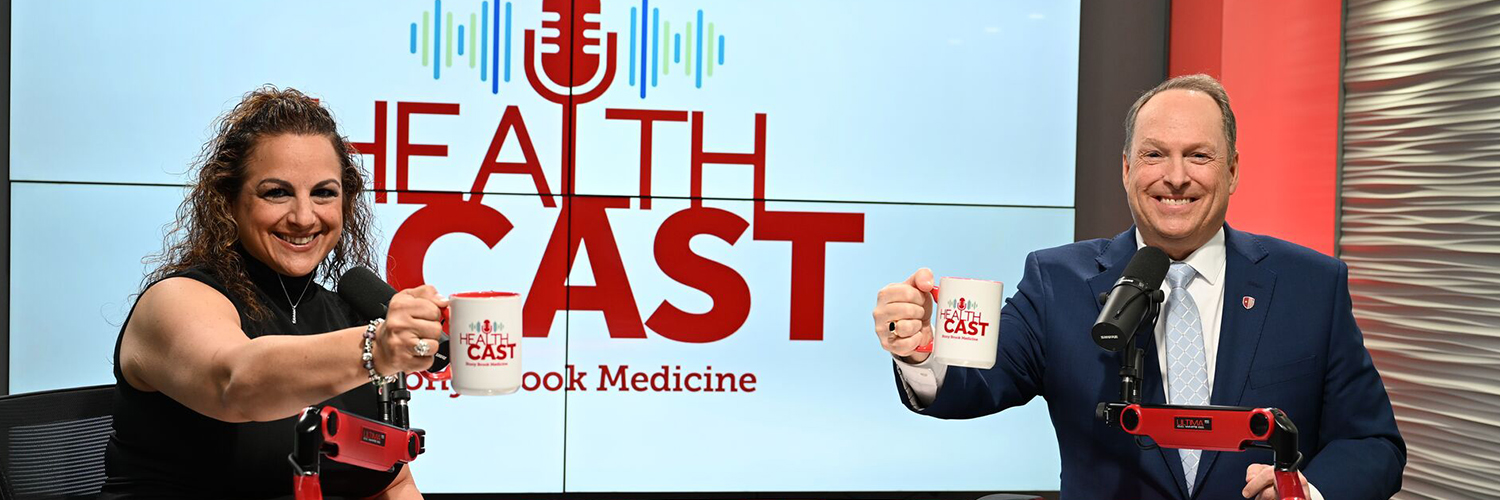
Description of Video Studio: News desk with Stony Brook Medicine logo on the front. Big screen is behind experts with Healthcast logo.
00:00 Opening and Introductions
Announcer
Welcome to Healthcast, where leaders and experts from Stony Brook Medicine come together to discuss a range of topics, from leadership and strategic planning to patient care and the inner workings of a successful healthcare system.
Timothy Brown
Hello and welcome to Healthcast. Falls are one of the biggest health risks facing older adults. In fact, one in four adults over the age of 65 falls each year in the United States and in Suffolk County, hospitalization rates for falls remain significantly higher than the New York State average.
Traditionally, fall risk has been assessed through self-reporting and clinical observation. But new technology is changing that. A smartphone app called CatchU…Before You Fall is helping measure fall risk more objectively, and has been recognized by the National Institute on Aging as an important innovation in addressing the growing healthcare challenge.
Joining us today is the app’s developer, Dr. Jeannette Mahoney. Dr. Mahoney, thank you so much for being on the program today. We appreciate that.
Jeannette R. Mahoney, PhD
Thank you for having me. Happy to be here.
Timothy Brown
Yeah, could you introduce yourself to our audience and tell us a little bit about what you do here at Stony Brook?
Jeannette R. Mahoney, PhD
Sure, love to. Thank you so much.
I’m a neuroscientist. I work in the Department of Neurology here at the Renaissance School of Medicine, and I’m also the founder of Jet Worldwide Enterprises Inc. which is the developer of CatchU, the product name.
Timothy Brown
So we were talking a little bit before you came on the program, and I just think this is a great story. You’re a native Long Islander, and you were talking about your grandmother, and she was kind of what started you thinking about this. Is that correct?
1:38 What Inspired CatchU®?
Jeannette R. Mahoney, PhD
It was a culmination of things, actually. So my research at the time when I was back at Einstein was showing the importance of what I measure, which is multisensory integration, how we respond to various sensory stimulations, like things we see, things we feel. And we were finding that people who couldn’t integrate this information were the people who were having more problems with balance, slow and unsteady gait, and you know both of those are consequences for falls.
So when we did our study, we found that people who couldn’t integrate well were the ones who were at heightened fall risk. In fact, those who could not integrate were at a 24 percent increased chance of having a fall within the next two to three years, and concurrently, while I was doing this research, my grandma had suffered a fall, and it actually it’s a really sad story. It led to the downward spiral of her health and actually her demise. So, I couldn’t leave what we had in the lab. I knew that I had to get it to the people who needed it most, and I do it all in her name.
Timothy Brown
That’s great. That’s a wonderful story and a wonderful way to honor her and and and really just kind of honor that legacy.
Jeannette R. Mahoney, PhD
Yeah, thank you.
2:36 Assessing for Falls Risk
Timothy Brown
So, you know, in the introduction, we talked a little bit about the numbers of people who suffer from falls, older folks, and the numbers are huge, when you talk about a quarter of the population of age 65 plus. And you know we do have an aging population here in Suffolk. I think we actually have, as far as New York State is concerned, the oldest population, so this is particularly important.
Jeannette R. Mahoney, PhD
Yes, this is very timely. There are measures, like people are assessing for fall risk. Usually at an annual wellness visit, doctors are asking, do you have a fear of falling? Do you have a history of falls? But sometimes answers to those questions don’t really move on through anything like an important treatment plan.
Another thing that’s really important is that we do falls counseling, and doctors know that that’s helpful. But sometimes they don’t have the time to actually follow through with all of that because, you know, they’re checking 15 other other systems.
So what we’re trying to do in taking our research out of the lab and bringing it to the people is use something novel, which is a quantitative app, to actually show that sensory performance can be related to falls. And then once people don’t do well on this test, we are directing the physician and the providers using the test to the CDC study recommendations that could be used to come up with a treatment plan so that we could avoid these potential falls.
We currently spend 50 billion dollars a year on falls, and falls, as I said, lead to death and really bad outcomes. So if we could reduce that, it’ll be huge because in about four years’ time, 2030, that estimate’s projected to be over one hundred billion dollars. It’s huge.
4:10 How Does CatchU® Work?
Timothy Brown
Yeah, that is huge. So let’s talk about the app a little bit. It’s called CatchU. And just explain it. How does it work? And what do we see with it?
Jeannette R. Mahoney, PhD
Would love to. So it’s like if you were to hold your phone, your iPhone or your Android phone, it’s available on both platforms, and you’d be looking at a center of fixation, like a cross, and you’d be asked just to keep your eyes fixated on the cross and as soon as you feel something, see something, or feel and see, that’s the multisensory. That’s like the magic condition. As soon as it happens, all I want you to do is hit the gray response area of the phone, which is like the bottom quarter of the phone, as fast as possible.
So I’m not asking you to do something like a heavy cognitive load. I’m not asking you like if it does this, then you do that. It’s more like as soon as you feel something, see something, just go. And the hope is because our brains are sort of hardwired to process double information faster than single. The hope is that you’ll respond faster to when the phone vibrates and lights up than it just than either one of the other.
Timothy Brown
So tell us a little bit about what kind of data you get out of CatchU.
Jeannette R. Mahoney, PhD
Sure, we’re measuring reaction time. So every time somebody takes a test, there’s three blocks of about 45 stimuli, and every person is responding as soon as possible to these stimuli. So we get an average reaction time. All that raw data per condition, so we have the visual alone, the somatosensory alone, and then the combined multisensory, visual, somatosensory.
All of that data gets run through our proprietary algorithms. And what we can see is we can measure the magnitude of one’s multisensory integration. So we’re looking for a nice positive peak on this distribution probability model that I won’t bore you with the details of. But a lot of older adults don’t have it. They have this large negative dip and also longer reaction times than we would hope for. And those are warning signs for us.
Timothy Brown
I see, and so the physician will then get the data, and they can work with the person?
Jeannette R. Mahoney, PhD
Yeah. So if somebody is considered a non-integrator, they likely have these longer response times and this negative dip in a behavioral reaction time waveform that we’re looking at. And so they will have tailored recommendations based on both their performance on CatchU as well as their medical background to the provider. And what’s really good there is the provider sort of has the background history about the patient’s file, so they know what they can and can’t do.
The number one recommendation is physical therapy, along with core exercises like tai chi to help you balance and be upright. But more than just the recommendation is sort of like wanting to raise awareness about fall prevention because you can’t tell who’s going to fall just by looking at them. So our test is literally providing a window to the brain.
So people who are like 65 and physically fit and say I have nothing to worry about. Well, okay, great. Let me just prove that on this simple 10-minute test. And there have been people. In fact, one of our friends is still delivering babies. She’s like a 65-year-old OB/GYN, and she thought she was fine. She failed the test, and it really brought it to light. Like, oh my God, there is something here. And a week later, she calls us up and was like, you know what? I think I have a balance problem. I realized I’m sitting on my bed to pull up my pants, and I used to be able to just get dressed in the closet. And so she started doing tai chi and going to the doctor regularly, taking her you know her regimen, and sure enough, six months later she took the test and she passed it.
7:21 The Benefit of an Academic Medical Center
Timothy Brown
Wow, that’s a fascinating story.
And you know one of the things I really love about what you’ve told us here today is, and this is something I think is special about Stony Brook. So this is what I love about academic health systems and academic medical centers, you get to see the very start to the very end, and this is a great example. You started with the idea, you’ve worked on it, and now you’re actually bringing it to patients, and the whole process is happening, and you get to be part of that. That’s got to be tremendously rewarding.
Jeannette R. Mahoney, PhD
It is, but it took a while to realize that it could be rewarding. It was really scary. Like I know a lot of people feel nervous to disclose information because they don’t really understand that the school is actually protecting you. They want the IP because it showcases their faculty. So some people think maybe I won’t disclose. It’s too arduous or something I don’t want to get involved in, but I encourage everyone if they have something to really talk to the tech transfer people because they’re really great at helping you realize what you have and pushing it forward.
8:20 Research and Cross-Department Collaboration at Stony Brook
Timothy Brown
Great. So let’s talk a little bit about collaboration because again, it kind of gets to what we’ve been talking about overall with your work across really multiple areas with this. And in my notes, I see Department of Neurology, Department of Family, Population, Preventive Medicine, Office of Research and Innovation at Stony Brook. So all of those things come together, and again, I think that’s kind of what makes Stony Brook special.
Jeannette R. Mahoney, PhD
Yeah, and we also have a collaboration with CWIT. It’s really great because you know we’re at a time when research is being stymied. So if we can find novel ways to get grants that are maybe not just NIH but other things, like PCORI, for instance, we’re working with family population health, and we are trying to figure out a way in which we can take CatchU into new directions that go beyond just fall risk. With CUIT, we’re working on trying to use AI to be able to look at those waveforms and actually say, okay, this is somebody who looks like they have diabetes, or somebody who could have Alzheimer’s. Sort of reverse engineering it because there’s so much data. So to look at it in only one way is really a disservice. You have to be able to take it to other levels and to do that. We’re so blessed to be at Stony Brook because so many people actually want to help and have their own areas of expertise that can help bring it to the next level. So we were really fortunate when we came here to reach out and to get good responses back from faculty across many departments. And those seeds that we planted are finally coming to fruition. So it’s great.
Timothy Brown
You know, I’m constantly amazed when I get to do these programs on occasion. When I talk to people like yourself, and and it’s just it’s so many people coming together to work for the common good, and it’s just exciting to hear what you’re saying about this, and you know people are willing to pitch in across departments, across areas, and help something like this become reality, and ultimately it makes a difference for the patient.
Jeannette R. Mahoney, PhD
100%. And I think that’s where I feel really fortunate. Is that people actually understand what I’m doing, believe in the product, and want to see it succeed. Not everybody has that, right? And I feel blessed that people recognize that we’re on a novel path. I mean, to be able to have a novel predictor of what could be Alzheimer’s is something that not a lot of people have. I mean, we always focus on memory issues, right, or some sort of higher cognitive issues. But my argument is that it’s the sensory stuff that’s really basic, and once that starts deteriorating, now there’s a whole series of things that are unfolding. So, to be able to work with people here at Stony Brook to push new directions is really great.
10:50 The Danger of Falls in Aging Populations
Timothy Brown
So, I am kind of curious. You know, we talk about the elderly population and how debilitating falls can be, and I think there are some obvious reasons. But falls really are a huge problem for folks as they get older. Can you talk just a little bit about that and how dangerous that is?
Jeannette R. Mahoney, PhD
It’s really bad, and a lot of falls actually happen at home. So one of the major other recommendations that we have is make sure home health safety comes to your house. Like have that doctor order that for you. You want to make sure that you don’t have uneven surfaces or or you know thorough rugs that are slippery. Or we actually found out that one of these large nursing homes were using satin sheets, so the combination of satin sheets with silky pajamas was leading everybody to fall.
So having people come in and say like, all right, these are the things we need to change at a place where you’re maybe 80 percent of the time. That’s where fall’s happening. So it’s really important. People don’t understand that just things like poor lighting or grip bars in the shower can make the difference, especially where you are most of the time. But I think it’s important.
11:50 The Future of Falls Prevention and CatchU®
Timothy Brown
So it feels like the future of falls prevention. What is the future for catch you?
Jeannette R. Mahoney, PhD
The future for CatchU is bright. We are not only working on just fall prevention, as I alluded to. We are actually seeing how CatchU can pick up people that are at risk for preclinical AD, Alzheimer’s disease. In our recent paper in Alzheimer’s and dementia, we’ve shown that poor ability to integrate on this multisensory test is actually linked to higher amyloid beta in the brain through plasma.
And so, what we’re hoping to do in a new study, a comparativeness effectiveness trial with Picori, is to be able to see whether or not if doctors can order catch you in combination with MoCA, which is a screening test for cognition, can that lead to better outcomes for patients, like less falls, less hospitalization, less readmissions compared to what they’re typically doing usual of care.
So we’re really working hard to figure out how we can become a novel, non-cognitive, non-invasive way of picking up Alzheimer’s disease earlier.
Timothy Brown
Fantastic, that was really interesting.
Jeannette R. Mahoney, PhD
Thank you very much.
12:58 Closing Remarks
Timothy Brown
I very much appreciate that. That’s all the time we have for today. Our thanks to Dr. Jeanette Mahoney for joining us and also for the important work that you’re doing. This is really great. And thanks to all of you for watching and listening, be sure to like and subscribe for more health-related conversations and insights.
Announcer
Stony Brook Medicine is Long Island’s premier academic medical center. We transform lives through scientific discovery, education and care, and we bring together innovative research, advanced education and extraordinary healthcare expertise to set the standard for how healthy communities thrive. For more information, visit stonybrookmedicine.edu or follow us on social media.