


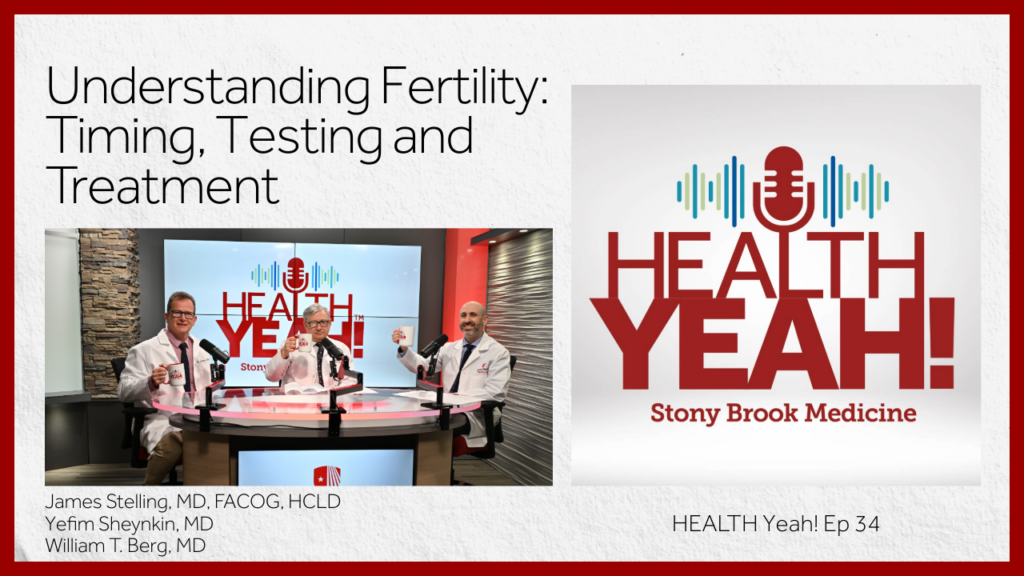
In this episode of HEALTH Yeah!, experts from Stony Brook Medicine dive into the realities of male and female fertility, breaking down common misconceptions and offering clear guidance on when to seek help.
We explore what to expect during a fertility evaluation, how timing and age impact conception and whether you can gauge fertility on your own. The conversation also covers advanced reproductive techniques, medications and supplements and whether environmental factors and stress can also impact fertility.
The Experts
- Male Infertility and Sexual Medicine
- Stony Brook Urology
- Male Infertility
- Stony Brook Urology
James Stelling, MD, FACOG, HCLD
- Reproductive Endocrinology and Infertility Specialist
- Island Fertility
What You’ll Hear in This Episode
- 00:00 Opening and Introductions
- 2:00 Biggest misconceptions about male infertility
- 5:55 When should somebody see a fertility specialist?
- 9:08 What does basic evaluation look like at a fertility clinic?
- 12:19 Is there a way to know if you are fertile prior to seeing a fertility specialist?
- 14:30 How often should couples try to conceive?
- 15:37 How long do sperm live in the reproductive tract?
- 17:05 How accurate are home ovulation kits and apps?
- 18:00 How often is timing the cause of a couple’s fertility?
- 20:00 Advanced Reproductive Techniques (ART)
- 22:50 Are there medications that men can take as part of fertility treatment?
- 25:16 Aging and fertility
- 28:55 Supplements for men and women as part of fertility treatment
- 40:06 Can environmental factors impact fertility?
- 45:25 What kind of effect can stress have on fertility?
- 48:34 What are some things that can be done to improve fertility?
- 52:27 Closing Remarks
Full Podcast Transcript
00:00 Opening and Introductions
Description of Video Studio: News desk with Stony Brook Medicine logo on the front; a big screen is behind three experts with the HEALTH Yeah! logo displayed.
Welcome to HEALTH Yeah!, where experts from Stony Brook Medicine come together to discuss topics ranging from the complex inner workings of an infectious disease to tips and tricks for staying safe and healthy all year long.
William T. Berg, MD
Welcome to HEALTH Yeah!. My name is Dr. William Berg. I’m an assistant professor of urology here at the Renaissance School of Medicine at Stony Brook University, where I serve as the fellowship director in male reproductive medicine and surgery. My practice is dedicated to helping men build a family, as well as managing issues of sexual dysfunction and low testosterone. I have a special interest in helping couples navigate these sensitive topics, and today we’re tackling a topic that affects millions of couples, but is still widely misunderstood: male and female fertility.
Today, I’m joined by two outstanding experts who represent both sides of the fertility equation. First, Dr. James Stelling, a dual board-certified reproductive endocrinologist in OB-GYN, with over 25 years of experience helping individuals and couples build families. Dr. Stelling is a Long Island native, having trained at Cornell, Stony Brook and then Beth Israel Deaconess – Harvard Medical School, and he’s the founder and medical director of Island Fertility, right here on Long Island.
Also joining us is Dr. Yefim Sheynkin, associate professor of urology at Stony Brook, a New York-Presbyterian University Hospital of Columbia and Cornell fellowship-trained specialist in male infertility and microsurgery, and a nationally-recognized expert in real-world risk factors affecting male fertility, and a recognized researcher in sperm biology.
Together, we’re going to break down what determines fertility, when couples should seek evaluation, the biggest myths we hear in clinic and how men and women can approach fertility as a team.
So, let’s dive right in.
2:00 Biggest Misconceptions About Male Infertility
William T. Berg, MD
There tends to be a lot of confusion surrounding fertility. Dr. Sheynkin, what do you think is the biggest misconception about male infertility?
Yefim Sheynkin, MD
So, the main misconception about male infertility that we have known for centuries, actually, is that male infertility does exist. For many years — centuries, decades, even millennia — infertility was always attributed to the female factor, so males were not kind of concerned with infertility at all.
But in the beginning of 20th century or end of 19th century, the male infertility actually developed into a clinical entity with the introduction of semen analysis in urological practice. And for that actually we need to thank our gynecology colleagues, because they pushed for that. Urology initially didn’t really require or decided to use the semen analysis in the practice.
As soon as semen analysis was introduced, the practice, mainly fertility, started forming (as a) clinical entity. (But) the misconception still exists, because many men who come to see us in the clinic, they still very much (are) surprised that they may have a problem that interferes with fertility, conception or pregnancy. So that is getting a little better, obviously, now with informatics, and you know patients are reading all stuff, and then coming more prepared, but still in many cases they’re very much surprised with the presence of male infertility at all, because young men of reproductive age, healthy, physically fit. All of a sudden, they found that they have some problem with the sperm production, or they cannot really impregnate their wife and get her pregnant and have children.
William T. Berg, MD
So, right, frequently an afterthought. Often, it’s my wife told me to come here, and I’m just checking the boxes to be here.
Yefim Sheynkin, MD
Absolutely. Right now our referral base is our GYN colleagues, because they probably see the infertile couple first, and male refer to us.
The important thing is that both male and female needs to be evaluated at the same time, that’s why we’re saving time for the evaluation, and time is very important, probably one of the most important issues in the treatment of infertility in general.
Well, the other thing is that male infertility and female infertility presence in front of a couple, basically, is like 50/50. Statistically, about 33 percent of couples with infertility suffer with male factor infertility, 33 percent with female factor infertility and 33 percent both. So roughly 50 percent of infertile couples may have only male factor infertility or only female factor infertility. That’s why the evaluation needs to be provided as soon as possible, and for both partners.
William T. Berg, MD
Such an important point. Dr. Stelling, what would you say your biggest misconception that you see in your clinic practice?
James Stelling, MD, FACOG, HCLD
I agree, it’s often hard to convince a male to go see the urologist, even if I have an abnormal semen analysis parameter, they are often resistant to going to see appropriate care and evaluation. But I agree, most people just think it’s just going to happen. They spent their whole life trying to not get pregnant, and now they’re going to try to get pregnant, and then it doesn’t happen.
Now it’s normal not to happen any given one month. The normal fertility rate per month is only about 30 percent. But after four months of trying, probably 70-plus percent of people are pregnant, and at the end of the year it’s about 85 percent of people. So, most of the pregnancies do occur in the first three or four months of trying, and people often try too long before seeking help.
5:55 When Should Somebody See a Fertility Specialist?
William T. Berg, MD
How, with that being said, how long would you think or is it appropriate for couples to try before seeing a fertility specialist?
James Stelling, MD, FACOG, HCLD
The definition of infertility, the textbook definition of infertility, is: for women less than 35, they should be trying for a year of unprotected intercourse. For women over 35, it’s more normal not to get pregnant, probably six months, because, you know, their clock is ticking.
However, a mistake I will commonly see around the world is if someone has a real risk factor for infertility, such as PCOS, or polycystic ovary syndrome, where they’re not ovulating, and they’ve been treated for PCOS for years, and now they say they want to get pregnant, and the doctor says, “Okay, go try.” But, in general, most PCOS patients are not ovulating, so you have an easily treatable thing right from the beginning, and there’s no reason to wait a year of them not ovulating and not getting pregnant. Or, if there’s a risk factor for a tubal factor, if they’ve had surgery on their tubes before, or ovaries before, they should probably get evaluated for their tubal function earlier than trying the standard definition of a year or greater.
William T. Berg, MD
Right, come sooner.
James Stelling, MD, FACOG, HCLD
Right, in general sooner is better.
William T. Berg, MD
Yeah, and what about in the male factor space, too? What conditions would you say, “Hey, you should really come see someone sooner rather than later?”
Yefim Sheynkin, MD
That’s actually brings another question with regard to education of the public, with regard to male infertility in particular. That’s my subspecialty. Because we watched previously the huge education campaign about, let’s say, smoking, because smoking is bad for the health, but we don’t really talk about the reproductive sciences, or reproduction at all.
For example, patients who had previous surgeries as a child, or hernia repair will understand the testis, or testicular torsion, or some other disease, maybe a genetic problem that was diagnosed early in life — they need to be aware that potentially male infertility could be a problem for them in the future, and they need to be evaluated as soon as possible when they’re trying to conceive.
That needs to be very well conveyed to maybe the media or some other sources, so couples with fertility problems need to consider being evaluated as soon as possible.
With regard to timing, the recent guidelines actually did not define the exact timing for evaluation. It may be done just because patients decide to do this, at least for male infertility. If they know that they may have potential problems, maybe three months, two months, one month, or six months, time is not really a well-defined factor for them to be evaluated, but they need to know that they should do this.
And that’s really a big problem for us, because sometimes we see patients already when the time is gone for that, or the window of opportunity may be a little bit narrower at that point for them to be treated and succeed in pregnancy.
William T. Berg, MD
Right. So the message is, you know, if you’re thinking about it, or you’re concerned, the easiest thing to do is to come in and see someone and get the basics.
9:08 What Does A Basic Evaluation Look Like at a Fertility Clinic?
William T. Berg, MD
So we’re talking about kind of basic evaluation. What does that look like from a female fertility perspective?
James Stelling, MD, FACOG, HCLD
Pretty much every couple who walks into our office, we are recommending a semen analysis right from the beginning on all of our patients. Women, like I said, also need to make an egg, so do they have regular, predictable cycles, or are they ovulating or not? And if you’re ovulating, is it a good egg or a bad egg? Is it like a 25-year-old healthy egg, or is it a 42-year-old egg that may not be as healthy? So we can do an assessment of what their ovarian reserve is to say whether they are more fertile or less fertile compared to their age.
And then, structurally, the sperm and eggs have to bump into each other, so you need a normal uterus, you need a normal tube, and they can kind of get things together. So you should do some structural assessment to say the uterus and tubes look appropriate.
William T. Berg, MD
and you mentioned the semen analysis kind of being there, the cornerstone, besides doing the semen analysis, what other parts of the male fertility evaluation are there?
Yefim Sheynkin, MD
Well, I may say some unpopular, you know, saying, but we need to understand that semen analysis is not a test for fertility. By looking at semen analysis, in only one situation, basically, we can tell the patient is definitely 100 percent infertile: if there is no sperm there. All other things make it much more difficult to really define infertility as a potential problem.
But semen analysis — yes, well, the evaluation for an infertile male, when we get a patient in our clinic, certainly consists of semen analysis. It needs to be done. One other thing I want to underline is that semen analysis has to be done in a special place, in qualified places, like IVF labs, where Dr. Stelling works, because in regular labs, the quality of the semen analysis is sometimes not optimal, and it’s a very sensitive test.
The World Health Organization tried to standardize it for the last 30 years without any significant success, because, well, different labs do it under different conditions and different standards. But it has to be done in a specialized place. That’s why, if infertility becomes a problem for these patients, they need to see a specialist who can provide all this evaluation for them.
Well, in addition to semen analysis, usually it’s blood work. We need to check hormones, which regulate sperm production by the testes. And again, the evaluation of the infertile male is not just one size fits all, because it may involve additional genetic tests, sonograms, it may be some other tests that need to be done in addition to simple semen analysis and hormonal tests. So the evaluation needs to be very precise and thorough.
And it starts obviously like anything else with history and physical, because that will give us a lot of information about a possible problem and even a possible solution for the problem.
12:19 Is There a Way to Know if You Are Fertile Prior to Seeing a Fertility Specialist?
William T. Berg, MD
Yeah, I think you bring up, you know, an interesting point about the semen analysis, and you know it being an imperfect test. Is there any way for someone to know if they would be fertile ahead of time?
Yefim Sheynkin, MD
Well, I don’t really think so because, well, as we just also talked about this, infertility is defined as the inability to conceive within a year of unprotected intercourse.
If the male is evaluated and semen analysis shows no sperm, well, certainly it’s a fertility problem, but I think the other question is maybe more pertinent, and the question is, “Can I have a child?” And this is different because, with the advances of assisted reproduction, sperm retrieval, in vitro fertilization, especially intracytoplasmic sperm injection, at the beginning of the ’90s, the ability or possibility to achieve pregnancy and have, well, a child — healthy children — definitely expanded significantly.
So the patient needs to know that even with abnormal semen analysis, even if they don’t have any sperm, pregnancy is still possible. It just requires more work. It requires coordination between male infertility and a female infertility specialist, but it’s still possible. So fertility by itself — to know whether the patient is fertile or infertile before they’re trying to conceive — is, to my knowledge…
William T. Berg, MD
There’s no way to really know.
Yefim Sheynkin, MD
And basically that’s the problem with the semen analysis, because for decades the most important thing about semen analysis is to use it to kind of separate fertile and non-fertile male populations, and it was not possible, and still not possible at this point.
James Stelling, MD, FACOG, HCLD
And something that can help on history: if the couple, either male or female, has had a pregnancy before, that’s at least reasonably reassuring that it won’t be no sperm, most likely. Now, things can change medically, like starting testosterone, that can make it no sperm. But if either partner has been pregnant before, that at least is helpful information by history, but you do need the test to further evaluate it.
14:30 How Often Should Couples Try To Conceive?
William T. Berg, MD
Right. Right. So, getting into trying to conceive, is there … I know there’s a lot of information out there about how often couples should try, or what kind of frequency. What do you say to those couples?
James Stelling, MD, FACOG, HCLD
There was a good article in JAMA Internal Medicine in the early 1990s that looked at the frequency of having sex and the frequency of getting pregnant. This was young, healthy, fertile people just starting to try to get pregnant. If they had sex every day around the time of ovulation, there was about a 36 percent chance of getting pregnant.
If they had sex every other day, which is a common medical recommendation that I don’t agree with, there was actually a 33 percent chance of getting pregnant per cycle. If you just have sex once on the day of ovulation, and nothing else around it, there’s a 33 percent chance of getting pregnant. So, I tell patients all the time, 33, 33, 36 — they’re not that different, so we don’t need to mess up their sex lives that much.
Now, I do like home urine ovulation prediction kits to figure out, or the computers and monitors that can do it more fancy, but if you get a positive change on an ovulation prediction kit today, the egg is going to get released tomorrow. Sex tonight and tomorrow is the work sex, the other sex because they felt like it or didn’t feel like it.
Because patients, by the time they come into my office, their sex life is commonly messed up. They’re frustrated, they’re tortured because they haven’t gotten what they want for a year or two, and sex is no longer fun.
15:37 How Long Do Sperm Live in the Reproductive Tract?
William T. Berg, MD
Right. And I think that also speaks to something that I commonly am counseling patients on. You know, how long do the sperm live in the reproductive tract? I don’t know if you know that data.
Yefim Sheynkin, MD
Well, with regard of the frequency of intercourse when the patient is trying to conceive, I usually use the — I wouldn’t call it the rule, but, you know, the thing that I have used for years — if the wife is fertile, I mean, if she’s ovulating normally, so I would recommend to have intercourse every other day of the week of her ovulation. We call it timed intercourse. It may actually cover the ovulation time because, as Dr. Stelling pointed out, ovulation does not really take a second or hour or something like this; it still takes a longer time. So if they do it within this week, they may have a little longer or a little better chance to conceive within the time when the wife is ovulating.
But otherwise, the frequency of intercourse, from my perspective, from male infertility, I don’t think it’s really defined or ever been defined for that.
James Stelling, MD, FACOG, HCLD
Textbooks say the sperm lasts in there for three days, right? This New England Journal of Medicine article says six days — probably lives best the first three days; fresh is probably better.
17:05 How Accurate Are Home Ovulation Kits and Apps?
William T. Berg, MD
How accurate are those home ovulation kits, or is it better to time it out, on like an app or some sort of predictive thing?
James Stelling, MD, FACOG, HCLD
I like the home urine test kits better than the apps. The apps are going by what your history was, which can be reasonable if you have a predictable every-28-day cycle or so, but many women don’t have this cycle. They might be 26 days, and the next cycle might be 30 days, and the calendars might not pinpoint the exact day. There’s still reasonable pinpointing of sex that week, which is helpful. But I find the urine ovulation prediction kits — you know, it’s going to be released in the next day — I find them better.
There’s different brands. Some are probably better than others, and some with smiley faces, some with just lines, but I get patients bringing me the urine pee stick and say, “Well, is this dark enough or not?”
And it’s sometimes hard to tell, so some of the computer ones, I guess, can make it a bit better, but they’re not that much better than just the regular lines. But I do think they are relatively cheap — cheap and simple and easy to use and helpful.
18:00 How Often Is Timing The Cause of a Couple’s Fertility?
William T. Berg, MD
How often do you think an issue of timing is really ultimately the cause of a couple’s fertility? Maybe an estimate.
Yefim Sheynkin, MD
I don’t know, well, from Dr. Stelling’s point of view. Usually, if the wife told me, if I see this couple for the first time, they told me that she ovulates normally, she doesn’t have any problem. I don’t think that using this kit will change much.
One thing on the funny side: maybe some men complain that using this kit makes us a little stressful because they’ve been called by the wife, you know, that, “Oh, my test is positive, so we need to really do something at the same time right now,” and, well, they don’t feel comfortable to do this.
So again, if the wife has normal ovulation, I don’t think that the kit will be very helpful, but if the wife doesn’t have any normal ovulation, so it’s irregular ovulation, then certainly the kit is the only way, actually, for them to find out when the ovulation happened and plan all the intercourse accordingly.
James Stelling, MD, FACOG, HCLD
I don’t think timing is usually the problem, because if they’re trying to get pregnant, they are usually having some reasonable level of sex, whether it’s calendar-based or kit-based. They’re usually having at least a reasonable amount of sex.
Clearly, there are couples who have sexual dysfunction, whether it’s pain or erectile dysfunction, that may or may not be able to complete the sex at the appropriate time, and they should be evaluated earlier. Obviously, it definitely gets hard for the patients with longer cycles, because you have 45-day cycle, one, you probably didn’t have it at all, and if you ovulated, you might have ovated on day 30, and in a year you might ovulate nine times instead of 12 or 13 times, like it should be. So patients with variable erratic cycles should get evaluated early, because they can’t predict what their time is very well.
20:00 Advanced Reproductive Techniques (ART)
William T. Berg, MD
Yeah, and so, right, some of those couples who are struggling often, when we do the evaluation, we’re discussing what we call advanced reproductive techniques, right? ART. What does that typically look like for a couple when they’re coming in?
James Stelling, MD, FACOG, HCLD
Assuming you’ve done the evaluation, the tubes are open, the sperm’s reasonable, and they’re ovulating, we do easier treatments first — things like medications and IUI, or intrauterine insemination, in a normal woman’s cycle. They make one egg per month, but particularly after (after age) 40, a lot of eggs are not as good as they could be or should be. And I don’t have a drug or supplement or medicine that can make a bad egg good, but if I make you release two or three eggs, it’s more likely to be a good one. So, if you take fertility pills, you can have two or three eggs for a better chance of getting pregnant, and we commonly do the IUI insemination.
You can take the sperm sample. In the sperm sample, it’s not dead sperm, funny-looking sperm, or not-moving sperm. You might put 50 million sperm in the vagina, 30 million falls out. Only a couple hundred make it to the ends of the tubes, where fertilization should occur. So, if you do an IUI, even with a lesser count, you can usually get millions closer to the site of fertilization in the tubes to bump into the egg.
So, the generally easy treatments of fertility care are more eggs for a better chance of a good one, more IUI to get more sperm there. More eggs, more sperm is more chance of having a baby, and that’s the easy stuff.
And you can try that in the range of three, four months, or something like that. And when we have to get more advanced, and something like IVF (in vitro fertilization) like if your tubes are blocked, or if you have severe male factor (infertility) from the beginning, an IVF cycle is a long process. Protocols can vary, but pretty much you come with your period. Sometimes you do pills to synchronize that growth, or sometimes we go directly to fertility injections. The fertility injections you’re on — about 10 days is average — and in that time, you might be in my office five, six, seven times, as we’re watching the eggs grow. There are injections to make the eggs; there are shutting-off injections to make sure the eggs don’t get released before we go get them. And when they’re ready, they’ll take what’s called a trigger shot. And then, with the trigger shot, we will time roughly 36 hours later is when we will have the patient go to sleep. It’s under anesthesia, and we’ll suck out the eggs. There’s no incisions, just a needle sucking out the eggs. They only sleep for about 10 minutes, and then we wake them up and tell them how many eggs we have.
And then generally mix them with the sperm, whether regular IVF, or in vitro fertilization, means they have a good sperm sample, and you might mix each egg with 50,000 sperm and let Darwin figure out which one’s going to get in there. Or if you have lesser sperm, you can do the intracytoplasmic sperm injection, where you take a single egg, a single sperm, inject it in there to maximize the chance of fertilizing. But the reason we want to get all these eggs is not all eggs fertilize. So, in an IVF lab, if you have good-looking eggs, good-looking sperm, about 70% of eggs fertilize.
Then, of the ones that fertilize, some will grow well, and some don’t grow well. And routinely, we grow them for five days and put the best one back in. It could freeze other ones for other shots at getting pregnant, but if a woman makes 10 eggs, she’ll probably only have three embryos alive five days later, and a lot of those, age-related, are not even genetically normal, which we do have the ability to do tests on, also.
22:50 Are There Medications That Men Can Take as Part of Fertility Treatment?
William T. Berg, MD
Yeah, you mentioned a lot about different medications that women can take to induce ovulation and egg production. Are there any medications that men can take for fertility, Dr. Sheynkin?
Yefim Sheynkin, MD
Well, if we’re talking about any specific medication, well, sometimes it requires a specific situation, which I think we’ll touch on in a little while. But using supplements — if you’re talking about supplements — is not a drug, so they’re not scrutinized as hard as a drug in terms of efficacy and results. Well, we did a meta-analysis here of supplements available for the infertile couple, and obviously anybody who suffers with infertility, they can go to the pharmacy. It’s a lot of different supplements on the shelf there. The results of the use of these supplements are definitely mixed, to say the best.
I personally always tell patients that the components of these fertility blends or fertility medications they sell, they’re all good, but it was found in the animal studies, in the lab studies, that all these medical — the microelements or amino acids, whatever — they definitely can improve sperm production or quality or quantity of the sperm. But in human studies, which were not actually done, we don’t see that encouraging results.
So it can be used, but the most important thing in patients who do or who start using it is the timing, again. We don’t want to use it for a year or two years in hope that it will improve anything and then decide to do either surgical treatment or assisted reproduction, which definitely depends on the wife’s age.
So if her age is going or being more advanced, then the success of the in vitro fertilization will be much less. So they need to have a very realistic timeline. Whether they use the supplement — they may use it together with some other treatment — but still, the results of this treatment by itself really were not shown to be definitely successful.
25:16 Aging and Fertility
William T. Berg, MD
You touched on a few things, and I kind of want to get Dr. Stelling’s perspective and circle back on a lot of these things. We started talking a little bit about age. Can you speak a little bit about aging and fertility and women?
James Stelling, MD, FACOG, HCLD
Women’s age is probably the single biggest battle I fight every single day. It’s relatively good egg quality at 25, so it’s not hard to necessarily get pregnant at 25 for most couples. Clearly, there are exceptions, but at 20, most eggs are good, and that’s why they get pregnant when they don’t want to be. At 40 years old, most eggs are not as good, and that’s why it’s hard to get pregnant. The miscarriage risk is higher, the Down’s risk is higher. So, there’s nothing in all the testing I can do, there’s nothing that will predict their overall success rate better than their age.
Now, I can get around age sometimes because I can do donor eggs and give a 50-year-old woman 25-year-old eggs, and she’ll have pretty much close to the pregnancy rate of the 25-year-old, but it’s mainly egg quality that decreases with age. Between 25 and 35, the changes are not drastic. Still, better at 25 than 35, but it’s not drastic. Between 35 going to 40 is when it starts going down substantially faster, and over 40 it can be a lot lower. And that’s why getting seen, getting evaluated sooner, and getting to the more aggressive treatment sooner can definitely be helpful for the older couples.
William T. Berg, MD
Yeah, and so we’re talking about age as a female factor. What about age as a male factor?
Yefim Sheynkin, MD
Well, that’s a good question. And although advanced paternal age is not defined, some studies show that after 40 to 45, the sperm quality and quantity sometimes start going down. However, as I mentioned before, the semen analysis does not test for fertility, and the decline in quality and quantity of your sperm may not, may not be definitely that important, so the patient cannot achieve pregnancy. As we all know, sometimes it’s in the news when the man will get his wife pregnant at 70 years old, and 75 and even 80. Men produce sperm constantly and all the time. It cannot be stopped unless it’s any specific disease, so potentially pregnancy could be possible for very significantly old age, let’s put it this way. But whether it’s really achievable, yes, we see the example of that, we cannot really provide any age-related conception.
William T. Berg, MD
Do you think the quality goes down?
Yefim Sheynkin, MD
The quality goes down, but you know that’s a very common situation. Sometimes we see that fertility goes down, the sperm count or sperm concentration goes down. But how far down. The semen analysis at the point that we’re talking right now, the normal sperm count calculated the semen analysis as 39 million. So, for example, if sperm count goes down from 150 million to 120 million, it goes down. We know this, but how does it affects the fertility and pregnancy? Well, it’s still within normal range, so to say, so it may be some other factors that regulate potential ability to conceive at more advanced age, but there is no specific, well, like in female factor, we don’t have any specific age that well we can provide to the patient, and well, it’s impossible.
Obviously, the younger age, the fertility and conception is more achievable than when the patient gets older, but how much older, we don’t know exactly.
28:55 Supplements for men and women as part of fertility treatment
William T. Berg, MD
I wanted to go back to the supplement thing that you brought up in the female world, because I think a lot of people that I see are coming to me either on supplements or someone told them to take some, or they’re just being fed that in their social media.
James Stelling, MD, FACOG, HCLD
I see supplements in my office every single day. I would say, like Dr. Sheynkin had said, I think there is a lot of, there’s reasonable animal evidence that some antioxidants or things can be beneficial. The human studies are really not very good.
The supplement with the most potential in my mind is probably something called CoQ10, also called Ubiquinol. It’s an antioxidant, and I don’t think it’s bad for people, but in reality, say you want to get pregnant today and you start the drug today, you’ve had these eggs since you were born, you had them before you were born, and I don’t know if changing the antioxidant for the next month or two months or three months are really going to have an effect.
There are sometimes doctors who say, “Well, start the supplement, come back in three months.” I view that as you just lost three months, and if they want, if I want to start treatment, say, and start CoQ10, I’m not against it, but the actual evidence is not great. And CoQ10 is probably one with the most potential evidence. There’s some evidence for DHEA, but there’s also some evidence against DHEA, and it can cause oily skin, acne type things.
I like acupuncture. I’ve had acupuncture for musculoskeletal stuff, and every acupuncturist says it will make better eggs, but there’s not a lot of great evidence supporting that.
I think the biggest thing is healthier women. A healthier woman is going to have a relatively better chance of getting pregnant. Now, it’s also true that if you’re 42 and healthy, that’s better than being 42 and unhealthy, but still being 42 is still hard.
So regular diet, exercise, weight control for your whole life is probably what’s going to be best for fertility, and I don’t know if a supplement can fix that in any reasonable time frame.
William T. Berg, MD
Right. And you’re talking about timing, about when to start supplements or lifestyle changes, and then when does that apply in the male situation as far as timing, like for sperm production, and when is that sperm made, and what kind of effects can we have?
Yefim Sheynkin, MD
Well, if you’re talking about when to start a supplement for men, well, again, I cannot really provide any specific age that it needs to be done, because whether they need it or not, it’s still very questionable, and you will need to use the supplement for years.
Well, usually most couples whom we see, they want to get pregnant yesterday, so if you feed them the supplements for years it may not really work, and I personally don’t really recommend that long use of supplement while trying to conceive because we have some better methods to improve conception, and will kind of facilitate the pregnancy for these couples than using supplement. The supplement will not hurt, probably.
That’s why it’s a widespread use of this supplement, because they don’t really make it worse, but whether they make it better, it’s a big big big question. Because studies are very, very mixed, and most of them controversial, they are not really well designed, so you cannot really bet your decision just on a study that we have at this point.
James Stelling, MD, FACOG, HCLD
I do have another comment about one supplement in particular. There is a supplement called inositol, which can change insulin resistance, and specifically for my PCR polycystic ovary patients who have a higher rate of insulin resistance, that supplement has been shown to increase the likelihood of ovulation. So if I do have someone who is insulin resistant, specifically PCO, I actually do recommend that supplement in that situation.
So supplements can be beneficial if they did better studies to prove they all worked, but inositol does actually have some reasonable evidence to improve the likelihood of ovulation in PCO patients.
William T. Berg, MD
Yeah, and speaking about things you saw, most supplements are not harmful, but I think there are some things that men could take that could be harmful that maybe they’re confused about. Talk about, you know, how supplemental testosterone sometimes affects fertility.
Yefim Sheynkin, MD
Well, testosterone is not a supplement, obviously, that’s a drug, and from my work in infertility in the field for the last probably 10 years, it’s I think it’s almost like I wouldn’t say epidemic proportion, but it’s a significant, significant rising in the men using testosterone for many reasons, most of them using it as a supplement because of low testosterone, and that’s for indication, but sometimes it may be for bodybuilding for any other reason not related to any medical problem. And well, in this case, one of the most important things that a patient who decided to start this testosterone for bodybuilding again for unrelated health issues, that testosterone will stop production of sperm, and this patient needs to be told this, because many patients who come to see us with this problem, and they have semen analysis which shows no sperm at all. They said, “Well, nobody told us that testosterone is harmful for that, so that needs to be conveyed very, very thoroughly to the patient, that if you start this testosterone, your sperm may not be produced.
How to circumvent that? Well, sometimes a patient may freeze the sperm. At least they can use it for assisted reproduction later, or they may need to be treated. The effect of testosterone can be reversed, but it’s not guaranteed. In some places, there is a clinic that provides only testosterone replacement, this kind of men’s health clinic, they use some medication together with testosterone to mitigate the effect of testosterone. Sometimes it works, but not necessarily all the time.
So it’s really a patient’s decision whether they want to start this medication or not. But one thing is for sure, that using testosterone by itself definitely, definitely stops sperm production at some point, and it presents a big problem for the patient later on if they decide to conceive while on that treatment, or when they stop it.
James Stelling, MD, FACOG, HCLD
I see many couples where the male is on testosterone, sometimes the woman knows, and sometimes the woman doesn’t know.
I also find the patient also didn’t necessarily tell the doctor who was prescribing it, if it was a doctor prescribing it, that they were trying to get someone pregnant, and the doctor didn’t ask, also.
And there are many places TRT or testosterone replacement therapy can be appropriate, but they probably should be screened. Why do they have a low testosterone to begin with, and maybe if they tell the doctor that they want to get someone pregnant, you’d want to take a sperm count early, maybe sperm freeze before you start the testosterone replacement, so you can allow treatment, or maybe you can do things like clomiphene citrate or ECG to try to boost up the testosterone and boost up the sperm count at the same time when they’re trying to get pregnant.
So there are things the person who might be given TRT can get evaluated for and treated in other ways that might accomplish the goals that they want, but I also, I think it is almost an epidemic, and every single day now I have a patient who someone’s on testosterone, and 15 years ago it wasn’t as common.
William T. Berg, MD
Yeah, and a large part of my practice personally is those patients who are on testosterone, maybe they knew the effects and they didn’t care, or they didn’t know the effects, that’s usually the more concerning thing, and I think what a lot of couples don’t understand is how long it can take for the fertility and the sperm to return.
Most patients have a return to the sperm within one year, but that’s a full year, and maybe they’ve already been trying for a while. And so I think that timing could even be many months before they see any sperm, before they came in to do IVF.
James Stelling, MD, FACOG, HCLD
As you alluded to earlier, like the sperm you released today, you started making about three months ago, so you’re really not going to have much of any effect for those three years, and it can take longer.
Yefim Sheynkin, MD
No, but the effect of testosterone is much deeper than just a regular sperm production, that’s well, three months, it’s a normal, well, healthy man, that’s three months, that’s what takes a production of healthy sperm or mature sperm from stem cells, basically to mature sperm. It takes two and a half or three months, but with testosterone, it’s completely different.
And well, the study shows the one year, two years, if they stop it, the sperm may come back into the ejaculate, which is again time factor that we see here, that’s one thing, and the reason why they want to stop testosterone, because testosterone definitely improves a lot of things, you know, for men, like muscle mass, it will reduce fatigue and tiredness, and everything. So, well, a lot of men just won’t even consider stopping testosterone because it’s making them feel much better, if they stop it, they go back to square one.
James Stelling, MD, FACOG, HCLD
Yeah, I think to some extent, TRT is to some level addictive. They feel better, and then they stop it, they feel worse, and they want to have a better testosterone, right? Even if you’re not bodybuilding, this is just general daily feeling helps the bodybuilding too, obviously, but, but it’s hard to get many men off of it, as you will experience more than I do.
Getting pregnant is a good goal, so anyone can do it, at least in the short term, to try to get a better sperm count.
Yefim Sheynkin, MD
It’s definitely a physical dependency to testosterone, and sometimes, well, Dr. Burke probably saw it too, you start treating this patient, and they’re coming back to you, and you see the same thing, you know, hormonal test, the same semen analysis shows no sperm again. So, you ask the patient, did you stop testosterone? Oh, no, I couldn’t stop it. I don’t feel well when I stop this testosterone.
So it’s a big problem, a big problem for the couple where the man is using testosterone to conceive, it requires more time. Sometimes medication works, and it reverses the effect of testosterone. Sometimes they do not work, and patients require some sperm retrieval with in vitro fertilization. So it’s a lot of things that could be done, but it definitely complicates the treatment and response of the patient to this treatment at all.
William T. Berg, MD
I know something that’s been in the news a little bit recently is testosterone for women, low dose. Have you seen any of those patients?
James Stelling, MD, FACOG, HCLD
Not very often. A lot of the low dose testosterone is going to be for a decreased libido, which is commonly seen in more of your older patients who are not necessarily trying to get pregnant, with exceptions to that, obviously, too.
40:06 Can Environmental Factors Impact Fertility?
William T. Berg, MD
So we talked a little bit about supplements generally, and we touched on lifestyle factors. What about environmental factors like toxins and heat? These are things that come up sometimes.
Yefim Sheynkin, MD
Many environmental factors may affect fertility, but the problem again, that the studies that were done are not really very conclusive. We need to understand, or our audience may need to understand that to arrange the randomized control studies in fertility is very difficult, because well, it’s a lot of ethical problem, logistics problem, so whatever data we have, they are not really always conclusive for everything.
William T. Berg, MD
You did a study, actually, though.
Yefim Sheynkin, MD
Yes, we did this study with laptop computers in early 2000 and that was actually to me, it was not accepted the way that I planned to, because obviously it was everywhere that computers will burn your testes and then kill the sperm and everything. No, the study was done for different reasons. The study shows that heat, which is known negative factor for sperm production, that’s by the way why the man has scrotum and testes outside the body, because in order to produce sperm, it should be about two to four degrees centigrade less than body temperature, but when the temperature in this scrotum increase somehow, the testes may not produce the same sperm.
The study with laptop computers was not the goal of that. We just need to make sure, or to show that using laptop computers well in the lab, actually increases testicular temperature.
What we show, interestingly, and that’s again, I think it was missed because to a lot of publicity on that, that it’s not a laptop computer which increased testicular temperature, it’s the position of the legs, so the scrotum between the legs acquired the body temperature, and that’s how the temperature of the scrotum goes up. So it’s a known factor, it’s ongoing, and century wise, century lengths, the discussion, what’s better, briefs or boxers, it’s still not conclusive. Obviously, some studies, even studies on that, show that varying boxers, because it’s loose, provide, you know, a low temperature on the scrotum, but again, the study shows that briefs can do the same thing, so it’s not really very conclusive.
Obviously, if you deliberately submit yourself to the high temperature, for example, you take a hot bath, hot tub, you know, every day, or a couple of times a week, and you sit there for an hour, definitely, it’s not really, it may not be healthy, and some study shows that inpatient, limited number, it’s not really a huge cohort of the patient, but shows that it may affect sperm quantity and sperm quality.
William T. Berg, MD
What about seat warmers in the car? That one comes up sometimes.
Yefim Sheynkin, MD
Yes. Well, you know what you’re driving for. Yeah, what is known for sure about the temperature is external heat, and that’s very important for us. If a patient has fever more than 101 and you do semen analysis at the time or shortly after this episode, the semen analysis could be abnormal, and probably in many cases it will be abnormal.
That’s why we always ask patients when they did a semen analysis, did you have any, any fertile episode, you know, at that time? Because if they do, we need to repeat semen analysis three months, as we discussed. The sperm production takes three months, we need to repeat similar analysis two and a half, three months after that, and in many cases the semen analysis came back normal. So that just shows you how complicated the evaluation and well treatment for male infertility could be, and it’s a lot of details there, which is obviously difficult to cover with this, our short discussion.
William T. Berg, MD
What about on the female side?
James Stelling, MD, FACOG, HCLD
I’m sure environmental things do matter. We don’t know most of it. Are there probably microplastics in everyone, and all of us? Yes. Is it having an effect? Not so clear.
I imagine if you worked in a coal mine without a mask, that would be bad. But it’s been looked at a lot, but there’s nothing clear, like we’re doctors, we’re in the operating room all the time. So, do female doctors or female anesthesiologists or nurses, do they really have a fertility issue? And there’s mixed answers, as some studies say yes, and there’s other studies that say not so clearly.
So, same thing I said, I would limit bad exposures, I would try to say live healthy. Do you need to do cleanses and things like that? I don’t think you’re cleansing too much that’s gonna change.
45:25 What Kind of Effect Can Stress Have on Fertility?
William T. Berg, MD
Yeah, and then what about, I mean, I think talking about environment and feelings, and something that I see comes up is stress. What kind of effect does that have?
James Stelling, MD, FACOG, HCLD
For fertility, clearly, stress is important, and stress is hard and good, and life is stress. One of the more famous psychologists in the country studying stress and infertility, is Dr. Ali Domar. She works at Boston IVF, where I did my training. She has done stress reduction programs that have been shown to increase the chance of getting pregnant, but what she really finds is patients who handle stress well stay in treatment. Patients who don’t handle stress well drop out of treatment.
And if, because, if you do an IVF cycle, all the stress and hard work of the IVF cycle, and you don’t get pregnant, if you handle stress well, or you do stress reduction, or some technique, you stay in treatment better for a better cumulative chance of getting pregnant.
But a different friend of mine did a study where she measured psychological hormone levels throughout the IVF cycle. Also, patients had taken psychological questionnaires throughout the IVF cycle, and whether they felt stressed or their blood looked stressed, it did not affect the pregnancy rate that month.
So, pregnancy rate this month is not affected by stress, but long-term ability to tolerate stress and the emotional roller coaster of going through fertility treatments to people who handle stress better, or to go through stress reduction to handle stress better, whether it’s biofeedback or group therapy, they do have a better chance of getting pregnant because they stay in treatment. Persistence and care is one of the biggest predictors of our ability to get someone pregnant.
Yefim Sheynkin, MD
Interestingly, about 13 years ago, we published the AEA update on lifetime lifestyle factors in male infertility, and there were only a few studies about stress, which may affect fertility. It shows that women actually suffer from stress more than men.
Well, I don’t know what to make of the study, but it was very limited. But that’s what we know about stress. But stress in generally in male infertility, it may cause well because of maybe lack of sleep or nervousness, it may affect some testosterone production, some hormonal changes also, so there is some mechanism that stress may affect it, but it was not really proven that it’s a significant factor, and I think that I agree with Dr. Stelling that it may actually affect the treatment regimens and treatment protocols, rather than, well, specific problems with fertility at all. At least we don’t know that at this point.
James Stelling, MD, FACOG, HCLD
Another area where stress can do things in the women specifically is if you have someone who has anorexia, underweight, hypothalamic amenorrhea, or if you’re a marathon runner, your body is so stressed to marathon run that its not a good time to get pregnant because you don’t have enough calories to get pregnant, so there are stressors that can clearly cause changes in ovulation. But in general, if you have a person with a predictable cycle each month, I don’t think stress is changing the outcomes that often.
48:34 What are Some Things That Can Be Done to Improve Fertility?
William T. Berg, MD
If you kind of summarized all of those ideas that we kind of just talked about, if each of you wanted to just comment on, you know, a couple, or just for the audience, you know, what are a few things that I could do to improve my fertility?
James Stelling, MD, FACOG, HCLD
I would say hopefully, through most of your life, you are staying relatively healthy, paying attention. Are you having predictable cycles or not having cycles? Trying to maintain a decent weight, patients who have a more normal weight have better success rates, and pregnant, even if pregnant, for their pregnancy outcomes than patients who are overweight.
Now, that’s also hard to do, so it’s hard to stay healthy for the rest of your life, but it’s good, not just for fertility, but it’s good for life.
And if you have a change, then see a doctor to be evaluated. Or changes like if you have a normal, say, vaginal discharge, and all of a sudden you start having an abnormal vaginal discharge, get evaluated, whether hormonally or infectious could be a sexually transmitted disease that can cause problems, clearly. So it’s, I think, it’s just to pay attention to your health and changes, and try to be healthy as best as you can.
Yefim Sheynkin, MD
Well, we all know what a healthy lifestyle is. You don’t need to educate our audience for that, and stick to this healthy lifestyle with exercises, with healthy food, while avoiding stress as possible. Well, that definitely could make the fertility problems much less, if ever at all.
However, the most important thing that I think we need to convey as a message is that it needs to be started early. We’re talking about if a patient smoked 30 years and then he stopped it for a week, it’s unlikely that it will change anything in his prognosis for infertility. Same thing using drugs or something, if it’s a long term use of it and you stop it because you want to conceive, you know, right now, that may not work. So again, education has to go about reproductive health, that from an early age, from as early as they can actually appreciate that, the healthy lifestyle has to be really proposed as a possible solution or precaution for the world reproductive problem in the future.
William T. Berg, MD
General health is fertility health.
James Stelling, MD, FACOG, HCLD
I agree. One other comment about general health is great, and especially healthy, but time still matters. A 25 year old healthy person is easy, relatively, to get pregnant. A 40 year old healthy patient is harder to get pregnant, and it’s not even just age, it’s what is the ovarian reserve, and you can measure hormones like AMH or ultrasounds to look at the number of eggs that can predict whether the person is older or younger for their age.
Yefim Sheynkin, MD
Yeah, well, the treatment of male in the couple definitely depends on the female factor too, and that’s very important. That’s why we work closely together, because the scope of treatment will definitely change, you know, or will be different for 25 years old women who try to conceive and 41 years old women who try to conceive, and our ability to help these couples will be different, and the treatment options will be different, that needs to be taken into consideration. So, time is really, to me, the second most important thing in male infertility, female infertility, after the semen analysis, for example.
52:27 Closing Remarks
William T. Berg, MD
So, collaboration is really important here, the team-based approach. We should be treating the couple, not each individual.
And that’s all the time we have today. Thank you to Dr. Stelling and Dr. Sheynkin for sharing their expertise and helping us better understand the realities of male and female fertility.
So, the key takeaway today is simple: fertility is a shared responsibility. Early evaluation for both partners matters. So thank you to our viewers and listeners. If you found this conversation interesting, forget to like and subscribe for more informative health-related content. Thank you, and take care.
Announcer
Stony Brook Medicine is Long Island’s premier academic medical center. We transform lives through scientific discovery, education and care, and we bring together innovative research, advanced education and extraordinary healthcare expertise to set the standard for how healthy communities thrive. For more information, visit Stonybrookmedicine.edu or follow us on social media.
*DISCLAIMER: The information provided in this podcast is for educational and informational purposes only and is not intended as a substitute for professional medical advice, diagnosis or treatment. If you think you may have a medical emergency, call your doctor or emergency services immediately.