

The CARE Initiative is a groundbreaking initiative from Stony Brook Children’s Hospital created in response to the growing health care needs of students across Suffolk County, especially those surrounding mental health and wellness.
In partnership with local school districts, CARE delivers timely and expert support — connecting schools, families and students with pediatric specialists in psychiatry, neurology, psychology, developmental pediatrics and social work.
The initiative further supports students and families with their overall health needs, helping to improve access to the many specialists at Stony Brook Medicine.
The Experts
- Kristie L. Golden-Campo, PhD, LMHC, CRC
- Susan Wilner, LCSW
- Cathryn A. Galanter, MD
What You’ll Hear in This Episode
- 00:00 Opening and Introductions
- 2:20 Increasing demand for mental health and addiction services
- 5:34 Mental and behavioral health workforce shortage and what Stony Brook is doing to address this
- 10:00 CARE Initiative: Partnership with school districts
- 12:50 CARE Initiative: Clinical intervention and access
- 22:02 East End initiatives
- 23:25 Community impact
- 26:04 CARE Initiative Newsletter and access to information
- 28:22 Impact of early access on the long-term health of youth
- 30:39 School refusal, screen time, etc.
- 32:03 Benefits of an academic medical center
- 32:26 Looking Ahead: Next steps for the CARE Initiative
- 35:42 How do school districts, students and families coordinate referrals to Stony Brook Medicine?
- 37:10 How do school districts get involved with the CARE Initiative
- 37:42 Closing Remarks
Full Podcast Transcript
00:00 Opening and Introductions
Announcer
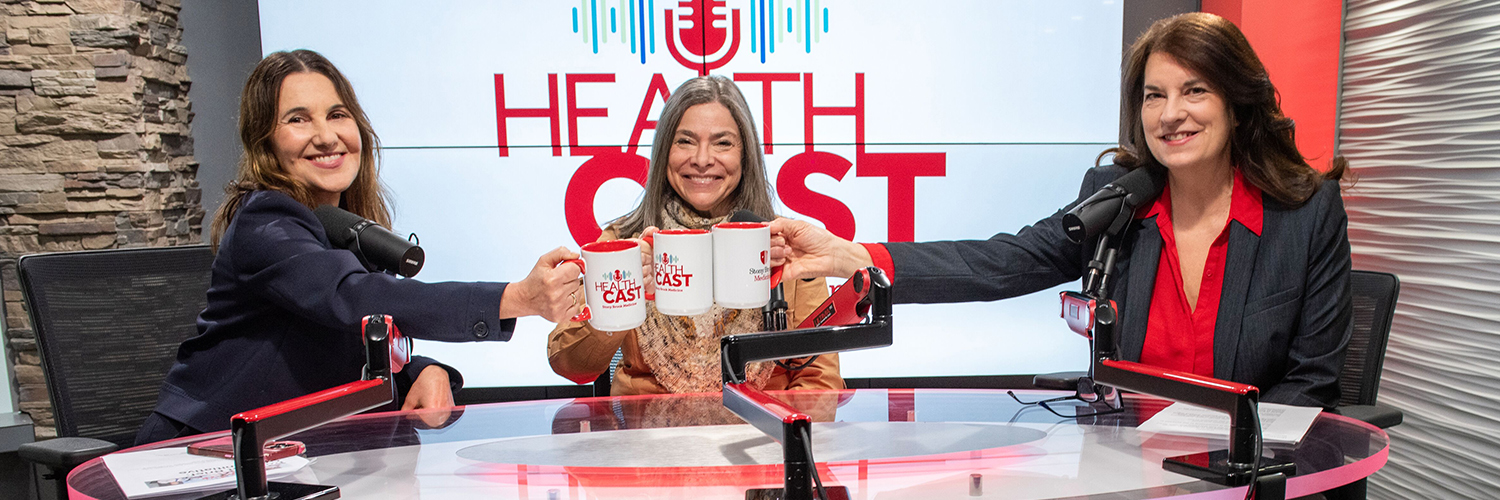
Welcome to Healthcast, where leaders and experts from Stony Brook Medicine come together to discuss a range of topics, from leadership and strategic planning to patient care and the inner workings of a successful healthcare system.
Kristie L. Golden-Campo, PhD, LMHC, CRC
Welcome to Healthcast. I’m Kristie Golden, Assistant Vice President of Operations for the neurosciences service line at Stony Brook. The neurosciences includes a variety of departments that focus on brain, spine and emotional health, leading us to launch the CARE Initiative, which includes all three plus more.
Over the past several years, communities across Long Island and beyond have seen a significant rise in the need for mental health services, especially for children and adolescents.
Schools, families and clinicians are all feeling the impact as demand continues to grow, while access to care and workforce capacity remain limited. Today’s conversation focuses on how Stony Brook Children’s Hospital is responding to this urgent need through the CARE Initiative, a program designed to support the mental health and wellness of school age children by partnering directly with K through 12 school communities.
I’m joined by Dr. Cathryn Galanter, a Professor of Psychiatry and Behavioral Health and Director of Child and Adolescent Psychiatry, and Susan Wilner, licensed clinical social worker and Director of Behavioral Health Strategic Initiatives, both instrumental in developing and rolling out the CARE Initiative.
Together, we’ll explore why CARE was launched, how it’s addressing critical gaps in services and what meaningful progress looks like for schools, families and communities moving forward.
Would you introduce yourselves?
Susan Wilner, LCSW
Hi. I’m Susan Wilner, and as you said, I’m the Director of Behavioral Health Strategic Initiatives here at Stony Brook Medicine, and one of my roles is really to work by ensuring that my passion for helping children and adolescents across Long Island comes to fruition. And so this is a really exciting initiative. I’m really happy to be here to talk about it.
Cathryn A. Galanter, MD
Hi. I’m Dr. Cathryn Galanter. I’m a child and adolescent psychiatrist and the Director of Child and Adolescent Psychiatry here at Stony Brook. It’s really nice to be here.
2:20 Increasing Demand for Mental Health and Addiction Services
Kristie L. Golden-Campo, PhD, LMHC, CRC
Thank you both for being here. So I know that the demand for mental health services and addiction services has increased over the last five years. Our communities have faced a lot of challenges after the pandemic, the change in the way school services were delivered, you know, students receiving educational services virtually.
So what do you think has really contributed to some of those increases in demand?
Cathryn A. Galanter, MD
Yeah. Kristie, thanks for asking about that. As you may be aware and as many may be aware, there has for a very long time been this increasing need for mental health care access for children and adolescents. And this big gap between what we have in terms of providers and clinicians and the need only increased with the pandemic, and the pandemic also helped to shine a light on this need.
So four years ago, the American Academy of Child and Adolescent Psychiatry, the American Academy of Pediatrics and the Children’s Hospital Association named this crisis in children’s mental health. And unfortunately, the crisis has continued. And in fact, just recently, those three groups came together and once again, said that we still have this crisis.
I think one of the things that we’ve noticed is that with the pandemic, lots of kids were stuck at home, and so a lot of the things that they got from going to school, the social interactions, the the peer to peer interactions, those developmental supports, they didn’t have access to them. So I think that also really exacerbated challenges that were already there.
Susan Wilner, LCSW
Yeah, so I mean Stony Brook Medicine, I think, has recognized this for some time, and in 2024 we did a community needs assessment across Long Island, and what was identified was the real need for behavioral health services across Long Island.
We followed that up more recently with a school survey last summer to see what the schools were seeing and what they felt their needs were, really for the kids and adolescents that they were seeing. And while the list was long, the first two things that they really needed were behavioral health, mental health and substance use services for the children in schools. There were, among other things, which we’re also addressing, a need for access to neurology or neuropsychology, orthopedics, pediatrics, developmental pediatrics. And so in response to that, the school’s desire and need to help their students, Stony Brook Medicine decided to launch the CARE Initiative, and as a result, the Children’s Hospital and all these departments are working together to help meet the needs of the kids in schools.
Kristie L. Golden-Campo, PhD, LMHC, CRC
So much work is being done. That’s wonderful to hear. I’m also hearing you talk about the workforce, and there’s been a shortage, from what I understand, in the workforce around mental health services and other kinds of behavioral health services.
5:34 Mental and Behavioral Health Workforce Shortage and What Stony Brook is Doing to Address This
And I recall our provost about a year and a half ago, maybe two years ago, Dr. Carl Ledgeway, had asked that we embark on a strategic committee that looked at, how do we help increase the workforce that graduates from Stony Brook to meet the demands of the behavioral health areas, and we have a lot of different behavioral health programs here at Stony Brook, like the School of Medicine, we have the psychiatry program, and we have a psychology program, social work, occupational therapy, etc. And a group of leadership came together to try to look at how we could better engage with students, encourage them to enter these fields so that there would be a broader workforce.
So can you speak to what you see is happening in the community around this shortage of providers?
Susan Wilner, LCSW
Yeah, I mean, we work closely with all of our schools, and as a part of that Workforce Committee, we’ve identified ways to better engage students. So the School of Social Welfare, as an example, is engaging with the districts further out east, so that we’re considering moving some of our programming out east, so there’s opportunity for students to have access and enter bachelor’s programs, get an associate’s degree.
We work with Suffolk Community College as well to help build this behavioral health workforce out east. And I think, Cathryn, I don’t know if you want to speak a little bit to the residency program that we’ve added out east to also address some of the dearth of providers the further out east we go on Long Island.
Cathryn A. Galanter, MD
Sure, sure. So Stony Brook, several years ago, started a new psychiatry residency program, which sees patients further out east in Suffolk County. And in addition, through the CARE Initiative, we’ll be having the opportunity to train more and more psychiatry residents, Child and Adolescent Psychiatry fellows, pediatric residents, who are now have a requirement to do more psychiatry, we’ll have the opportunity to partner with those training programs and really, one of our goals is to have more and more people with mental health expertise serving all of Suffolk County.
And you know, so the more that we can train, the more that we can hopefully retain people in our community. You know, Stony Brook’s really known as a bastion of mental health education, and we’re really hoping to continue that and have more and more people serving those people in our community.
Kristie L. Golden-Campo, PhD, LMHC, CRC
Very helpful. I also understand that the School of Nursing has been doing a lot to try to promote nurses to go into this area of specialty, particularly in expanding the nurse practitioner residency opportunities, and also our Physician Assistant Program to train individuals in how to best serve those in need. So there’s a lot happening, which is wonderful.
Cathryn A. Galanter, MD
Yeah, and you know that brings up an interesting point. Not a lot of places have specialized training for nurse practitioners to get further training once they’re done with their degree. And so Stony Brook has one of the first nurse practitioner fellowships in psychiatry. And so we’re really proud of that. And actually, one of the graduates from that program is working at CARE right now. And so it’s an example of our mission to train people and then retain them to serve people in our community.
Kristie L. Golden-Campo, PhD, LMHC, CRC
Yeah, that’s great. I heard he’s wonderful as well.
Susan Wilner, LCSW
He’s fantastic. And actually, one of the things that was most exciting for him, he said, after he finished the program, was joining the CARE Initiative because he felt the energy and excitement and the passion and the commitment from Stony Brook Medicine about this program, and decided that this would be an opportunity of a lifetime to join something so new and exciting at Stony Brook Medicine.
10:00 CARE Initiative: Partnership with School Districts
Cathryn A. Galanter, MD
Yeah, and we’ll talk about education a little bit more, I hope later. But I think another aspect of the education is that we collaborate with all of the school staff, and so schools have social workers on staff. They have other people who work around children’s mental health, and of course, we’re learning from them, but we’re also providing a fair amount of education. And so, you know, we’re helping to educate, or further educate, you know, thousands of people who work within the school. And we can talk a little bit about that more later, if you’d like.
Susan Wilner, LCSW
Yeah, I’ll follow if you want now, I can speak a little bit to some of that. I mean, we know that treatment is important, and that’s what our partners are really interested in. But what we also know is that prevention is really important, prevention and education. And so we recognize the value and importance of educating not only the school staff, but also families.
So we have a few things that we’ve done with the CARE Initiative, other than just the treatment arm, with all of our providers, but we provide monthly education for the staff and all of the districts that we partner with. And they can invite anyone who is relevant to the conversation or they want there, but it’s been primarily the school psychologists, social workers, some teachers, administrators, and we have topics that we’re educating them on so that we can help them better understand what’s happening in the classroom and in homes and how they can best support students.
We also have a newsletter that goes out. It gets pushed out to everybody in every district, with more information in it. Not just behavioral health, but medical, you know, there are articles about the flu, or what season we’re in, orthopedic, you know, sports injuries, etc.
And then the other thing is a monthly parent workshop, and that’s one night a month where parents from every district can come and hear more. And it’s the same topic. We like it to be thematic. However, it’s more geared towards parents rather than professionals. And so we feel that that sort of multi-arm approach to helping children is really most helpful and really adds to what we’re doing in the therapeutic environment or the medical world. This just helps people better understand what’s going on with their children.
I think that one of the things the schools and parents alike have really asked for is to help them understand better what’s happening and that’s our goal as a large academic medical center is also on the education and prevention piece.
12:50 CARE Initiative: Clinical Intervention and Access
Kristie L. Golden-Campo, PhD, LMHC, CRC
Thank you. So I know that this initiative was very strongly supported by our senior leadership, Dr. Todd Griffin and Carol Gomes, our CEO. Can you just tell me a little bit more about the CARE Initiative itself and what types of things that you are doing now, in addition to the educational components and how it’s working.
Cathryn A. Galanter, MD
Sure, I mean to Susan’s point and to your point also, right, any good partnership with schools should include a prevention piece and an education piece. And so we’ve already heard from Susan about that. So thank you, and then I can tell you a little bit about some of the clinical aspects.
So what we provide? Well, we provide both mental health access, but then also access to other aspects of care at Stony Brook. So access to concussion help, access to orthopedic help, access to neurology, neuropsychiatry. But I can tell you a little bit more about the Child and Adolescent Psychiatry mental health piece because that’s the piece I have the most to do with.
So we provide assessment, short term treatment, and then linkage to service if further services are needed. And so we’ve already, I guess we’re anticipating being able to serve hundreds of students over the course of the year. And what I will say is because we’re partnering with seven school districts, that’s providing access to mental health care for over 12,000 kids.
And what families have told us, and what schools have told us is that oftentimes one of the biggest challenges when you identify a mental health need is getting a child linked to care. So, you know, there are long wait lists, or parents can’t find anybody through their insurance. And so what I think, one thing that we find so meaningful about our program is that we can provide care for students immediately. We provide same day, next day treatment when needed, although sometimes families, for whatever reason, want to wait several days to find a time that’s more convenient to them.
The other aspect of that we have is, you know, we really are focusing on access. So one aspect of access is trying to get the care closer to where the families are. So that means we have multiple sites all over Suffolk County where families can come in, bring their kids in for care, and that’s to try to get the care as close to where the families live as possible.
Susan Wilner, LCSW
Yeah, and I’ll add a couple of things. So we also are able to provide services via telemedicine. So if a family has transportation issues or scheduling issues, we’re being as innovative as we can in where the care is, so that we can get the care to students and their families when they need it, where they need it and how they need it.
And the other important point is that it’s regardless of payer. And I think that’s really important is that nobody, whether they have insurance, whether uninsured, underinsured, we will see them and they will not be turned away. And we will then help link families to get those resources that they need.
But it’s interesting because I think the most exciting part is sort of the interplay of all of our departments and the real commitment from the Children’s Hospital in every department. And just as an example, we had a student come in, who was referred for depressive symptoms, and our psychiatric nurse practitioner saw the student and we started treatment. But he also identified that in the last two months, that student had had three concussions, sports injuries at school, and they had never even known where they could go or be linked for services for that, and we were able to get them in with our in the concussion clinic in the Department of Neurology within a week to meet with our doctors there, in addition.
And it’s really exciting how everybody is working together to get students what they need. So it’s been really exciting to watch it, you know, sort of come to life.
Kristie L. Golden-Campo, PhD, LMHC, CRC
I really love the way you talk about the partnerships with the schools too, because it’s your first year that this is launched, and you’re already partnering with seven school districts, and they have, from what I understand, been fantastic. They’re receptive, they’re responsive, they are letting us know what they need. We’re course correcting when they ask us for something that’s of value to them. And it sounds to me like they recognize the value of this as it affects a student’s learning and their ability to do well in school.
Susan Wilner, LCSW
Yeah, you know, Kristie, we meet with every district on a regular cadence. It’s usually monthly or bi weekly, and then as needed in between. But we just met the other day with a school district, and they expressed not only their gratitude, but how excited they were that all of a sudden they’re really able to have a place to send these kids, and that the families are excited.
And they’re struggling right now with school avoidance and some kids who may struggle to graduate this year, and they really feel that the partnership with us is helpful in them motivating some of these kids to do better, and as a matter of fact, have asked that we join some of their meetings in the school to help staff brainstorm ways to engage kids better. And so the feedback from the schools has been really very positive.
Cathryn A. Galanter, MD
You know, a couple of things I was thinking of, as you were talking, two main points. One is that in developing this program, it really has been a back and forth of the schools. So we opened our doors in September, but all of last year we were meeting with the schools, because we think that any program that’s a collaborative program should really be done in collaboration.
And so as we, you know, as we proceed with the program, there’s a lot of feedback back and forth. What’s working, what’s not working, how can we make changes, etc. So I think that that’s one piece of that real effort on collaboration.
The other thing I wanted to mention was connecting families to care. We’ve definitely met with a lot of families who’ve said to us, you know, Oh, we’re so grateful that we can come in to see you, that you were able to see us so quickly. I’ve been trying to navigate the system, you know, and get my kid in to see somebody, and I haven’t been able to do that. And so, you know that that’s very rewarding. You know, as a child and adolescent psychiatrist, I know how long the wait lists are, and what we’ve really been able to do is allow families who have children in our school districts to get into care so quickly, and that has been really rewarding and hopefully has prevented more negative outcomes.
Susan Wilner, LCSW
Yeah. And can I add one other thing? We also recognize that all of these school districts, while their student population, the demographics, may be different, they’re all really experiencing a lot of the same things in the schools. And so we recognize the value of them also working together.
So we’re hosting a symposium for all of the districts who partner with us, and our hope is to do that a couple of times a year, where we’re bringing them all together with us, and we have a topic that we’ll talk about, and we’ve discussed school avoidance as something that a lot of schools are struggling with. And then they are going to get together and share things between themselves, to see if there’s some ideas that they have that another district didn’t know about, or just to really be able to say, Oh, well, we’re not alone, and we’re all struggling with this, and maybe together as a system, we can find some solutions.
So we’re really excited about that, that’s coming up in the next month or so.
Cathryn A. Galanter, MD
And I think one of the ideas behind that is just that we all learn better together, right? It’s very, very much a commitment to, you know, learning from each other. So when we’ve gone out to schools, sometimes, because we’ve done a lot of the educational program will go in person to schools and, you know, I’m often so impressed, and pleasantly surprised by the commitment amongst the school staff, the knowledge that they bring to working with kids. And we want them to be able to all share that amongst each other and with us.
22:02 East End Initiatives
Kristie L. Golden-Campo, PhD, LMHC, CRC
When you talk about the schools and Stony Brook collaborating, there’s been a very long history of being involved in initiatives on the east end, the South Fork Behavioral Health Initiative, North Fork Behavioral Health Initiative, and the schools were a significant reason why those initiatives were launched, because for decades, probably they’ve been looking for solutions when children and families face these situations, and they’ve partnered with a number of community organizations along the way to try to help improve access. The county, the townships, everyone was really working together in these initiatives to make things go forward.
And I think that Stony Brook has been listening for a while, trying to better understand what the needs are and our commitment to the community, and being the academic medical center in Suffolk County, we’ve been able to now work with them to respond to those needs. Say, Okay, we’re hearing you. We’re going to increase the number of locations. You mentioned that before, the ability to train residents and individuals further east so that there’s the demand can be met, as well as locally and in western Suffolk, that the services are now available in a variety of sites.
23:25 Community Impact
So in terms of the communities themselves, how do you feel that it’s impacted the communities?
Susan Wilner, LCSW
So I mean, I think you brought up a couple of really good points. One is that there are other community providers, and I think it’s really important we are part of a community, and we recognize the need to collaborate with our community partners also. And so when we’re referring children and adolescents after they see us to something more long term, we’ve formed and continue to form relationships with other providers and individuals in the communities.
And I think that’s really important that we recognize that we are all a part of one large community here on Long Island, and that we need to all work together. And I think that’s really important for the community. Our feedback that we’ve gotten from the communities has been great. I mean, they’re really excited to hear about it. I think what excites them the most are the locations that we’ve chosen, and we were very careful about the locations we chose. We chose areas where the need was real, where there weren’t as many other services available, and where they could access some transportation and things like that.
So the response that we’ve heard has been, I mean, it’s been amazing. It’s been so rewarding.
Cathryn A. Galanter, MD
Yeah, I mean, I think for a very long time, Stony Brook has had collaborations with schools, but in terms of access to care, the consultations that we were able to provide were based at Stony Brook. And so I think the fact that we’re now expanding further out east, expanding to different sites, I think is incredibly valuable, because a lot of the families we work with, you know they have multiple demands, right? Multiple kids, multiple jobs, and coming all the way to the medical center can sometimes be a challenge.
So being able to open up centers closer to where the families live, closer to where the schools are, I think, has been a really valuable part of the initiative. And I think we’ve been able to do that due to the leadership support.
Kristie L. Golden-Campo, PhD, LMHC, CRC
Yeah, and it seems like the Lake Grove Advanced Specialty Care and the Commack Advanced Specialty Care really have also spread that access to an even greater degree.
Susan Wilner, LCSW
Yes, we have a location there, which is great, and all the way out east, as far as Wainscott, so that’s really exciting.
26:04 CARE Initiative Newsletter and Access to Information
Kristie L. Golden-Campo, PhD, LMHC, CRC
Yeah. You know, you mentioned before about education and being able to ensure that both school personnel and parents and families have access to information. There’s a newsletter. Can you tell me a little bit about the newsletter?
Susan Wilner, LCSW
Yeah. The newsletter is thematic also with what our talks are, and in that newsletter we have topics that are relevant to what our speakers are doing each month. But then there’s other things, and I think I had mentioned earlier that we put in the newsletter things that are relevant to the time, flu season, right? So now we have pediatric experts speaking about flu or sports injuries or, you know, I mean, we have a whole host of things planned, and it gets pushed out from the schools. We write this newsletter, and every month the schools push it out through some electronic magic that they have to every family in their district, and the parents love it.
We’ve gotten feedback, and as a matter of fact, the school’s personnel keep asking, can we push it out to our school personnel also because it’s so helpful. So it’s been really well received and you know, and then it also has the links to the parent workshops and things like that, so the parents can do that, and all of our talks and workshops are recorded and will be housed also. So if people can’t make it, there are links to where they will be able to access those as well.
So if a parent wants to go back to something or wasn’t able to make it, or a school social worker wants to go back to remember what we talked about when we spoke about, you know, some topic that was of interest to them. They can go back to that.
And we’ve even had topics and newsletter topics that are in Spanish and English. We did a whole presentation that was in Spanish and English for parents. And so we’re really trying to make this as accessible as possible to everybody. And I think Cathryn said it earlier, but I mean, I think the general theme to the care initiative is about access and making access easy where people need it and for what they need. And I think that’s really the general theme about it.
28:22 Impact of Early Access on the Long-Term Health of Youth
Kristie L. Golden-Campo, PhD, LMHC, CRC
Cathryn, what can you say about the impact of early access on the long term health of youth?
Cathryn A. Galanter, MD
There’s well, I’ll use an example which ties together a lot of the things that we’re offering. One of the challenges that we faced after, you know, coming out of the pandemic is kids not wanting to go to school. And we know that for school refusal, the earlier you intervene, the better.
And so some of our earlier education programming was about school refusal, about how if a child is really having a hard time going to school, it’s so important for them to at least attend, you know, for the schools and the families to work together to get those children in, and we’ve had a lot of success, actually, already with some of our students who’ve really had a hard time getting into school to slowly but surely get them back in.
But if you have a younger child who’s beginning to show some hesitancy to go to school, doesn’t want to go to school, so in the morning, they’re crying, they’re complaining, they have a stomach ache, they don’t want to go into school. And at that young age, if we can kind of help get them back into school so that they’re not a, you know, 15 year old who has been, you know, like sitting at home for day in, day out, not going to school. The earlier you intervene, the better.
And I think the schools know this, but they just, they’re not sure about, like, how to do that, how to implement it. So that’s a really nice way that we’ve been able to partner, you know, and kind of do some early intervention. But there’s so many other examples about how the earlier you intervene, the more you can prevent newer problems to pile on, because each problem puts you at risk for another problem. And we’re really working hard to try to get in and intervene as early as possible.
Kristie L. Golden-Campo, PhD, LMHC, CRC
You mentioned the topic of school refusal. So I know that, Susan, you said earlier, there’s a variety of topics. How did you decide on what those topics were?
30:39 School Refusal, Screen Time, Etc.
Susan Wilner, LCSW
Yeah, so in talking to the schools, so we did a school survey also, and then in our work the year prior to even opening, as well as these ongoing conversations, we’re asking schools really, we’re not deciding the topics for them.
One of the things that we realize is most helpful is what they need, not what we think they need. So we’re asking them and school for something that comes up time and time again, but we’ve asked for what they need. Burnout, for example, was something they talked about. Burnout in staff as well as students, and so we made that a priority topic for our last month. Screen time is another thing. You know, the parents really struggle with taking their phones away from their kids, and the struggle they have with their children, and some parents even talk about being afraid to take it away from them because their children act out or get angry.
So we’ve had a lot of presentations, and we have experts who spoke to that and spoke to families about that. We’ve had experts come talk to the schools and parents about brain development and screen time, what it does to the developing brain prior to a certain age. And so we’ve asked the schools where their struggles are and we’ve responded to that.
32:03 Benefits of an Academic Medical Center
Kristie L. Golden-Campo, PhD, LMHC, CRC
You know, what I love about Stony Brook too is as an academic center, we have expertise in everything you could possibly think of, so it really gives a wide variety of options. If a school district would like a talk on anything in particular, it’s very likely that we have the academic capability of delivering that education. So that’s good news.
32:26 Looking Ahead: Next Steps for the CARE Initiative
So what do you think are the next steps? What do you hope to do in the next year?
Susan Wilner, LCSW
Grow. Yeah, provide access to more kids in more districts. I mean, we’re really open to growing to more districts. Seven was great to start, and we’re really excited at the success of it, but we would love to grow. All departments at Stony Brook Medicine and Children’s Hospital are very involved, and so we’re working with all of them to improve the reach we have to all different specialties. But we’d be excited to have other districts join us so that we can provide access to more kids.
Cathryn A. Galanter, MD
Yeah. I think that’s our main direction. And I think working with the schools, we get so many exciting, new ideas. There’s some things I would love to do. We’d love to work with the schools on some screening. And I think now that the schools know that they can, one of the challenges with screening is that sometimes, and when I say screening, I mean like screening for mental health concerns, one of the challenges with screening is that you worry that if you screen and you find a child in crisis, you don’t know where to refer them. But we already have that relationship. And I think once you have a relationship you can start to build trust and it allows you to be a little more innovative.
You know, the other thing we’re trying to do, we’re very carefully measuring how we’re doing, like in terms of how many kids we see, what’s the time it takes to connect a child to care within our system, if they need further referral outside – how long does that take? And so the other thing that we want to continue to do is measure efficacy, measure our outcomes as we continue to grow.
Susan Wilner, LCSW
And I think the schools realize now that they have our support. So whereas in the past, they might not have wanted to do something like a screening for fear of what it would show, they now know that we’re really just a phone call away. And Dr. Galanter especially has been really responsive. If schools have questions or we have difficult cases, we work through them and help them. So I think them knowing we’re here and that we have their back has really helped them want to do more in the prevention area too.
Kristie L. Golden-Campo, PhD, LMHC, CRC
I think our Department of Pediatrics too, our Children’s Hospital has been so wonderful about this too. They are doing screenings. They are engaged with psychiatry. They really want to focus on the wellness of the children in our communities, to make children in Suffolk County as healthy as they can be, and that being the Children’s Hospital in the county is just a testament to the dedication that our staff and faculty have towards meeting the needs of the community.
So I’m, you know, I’m excited about the idea of expanding, and I know that our Children’s Hospital is excited about that as well.
35:42 How do School Districts, Students and Families Coordinate Referrals to Stony Brook Medicine?
So in terms of next steps for the future, how do school districts get in touch with you? How do they know how to reach out?
Susan Wilner, LCSW
Yeah, so for districts that are contracted with us already, we have a really solid process to set up. They have a form that they fill out online. It’s very short and simple, gves us some basic information that gets sent over to us, and we address that. We triage those forms, usually within 30 minutes for them to run over. And then we contact families, we set up appointments, and we stay in touch with schools along the way.
We consent that we can speak to all the providers, and very often we find it’s Stony Brook pediatricians who are already treating these kids, etc. But the other interesting thing is that families in districts that are contracted with us, they can call us also, and we do have a phone number that they can call so a family can self-refer, and we have had that happen once or twice.
What we haven’t had happen but we can, students could also call and refer, and so all those numbers and contact information are on our web page and in our newsletter and get pushed out to families all the time. So anybody in those districts can refer anybody. These are the contracted school districts.
37:10 How do School Districts Get Involved with the CARE Initiative?
Kristie L. Golden-Campo, PhD, LMHC, CRC
What happens if a school district is not yet contracted for this? How do they get access?
Susan Wilner, LCSW
So we have an email address where they can email us, and we’re happy to talk to them. We monitor that all the time, and have had many conversations with other districts since we’ve opened. Or they can call. We have a phone number, a dedicated phone number also, and then they would get in touch with Dr. Galanter or I, and we could follow up and talk to them about the contracting process.
37:42 Closing Remarks
Kristie L. Golden-Campo, PhD, LMHC, CRC
Thank you. Dr. Galanter, do you have any last thoughts or ideas that you want to share?
Cathryn A. Galanter, MD
Oh, just that. It’s been such a pleasure while working with you, working with the Children’s Hospital, we’re really trying to build up this program. Being able to provide more access to children and adolescents and families in need and to support the schools has been a really wonderful initiative, and it’s been great working with you guys on it.
Kristie L. Golden-Campo, PhD, LMHC, CRC
Thank you both for being here today. It’s really exciting to hear about this, and I think that it’s just another example of the efforts that Stony Brook Medicine, Stony Brook Children’s Hospital and all of the affiliate organizations are making now to really meet the needs of the community. So thank you again for your time.
And thank you to you, our listeners and viewers, for tuning in. If you’d like to learn more about how to get your school involved in the care initiative, visit the URL on your screen, and if you found this conversation interesting, like subscribe for more content, just like this.
Announcer
Stony Brook Medicine is Long Island’s premier academic medical center. We transform lives through scientific discovery, education and care and we bring together innovative research, advanced education and extraordinary healthcare expertise to set the standard for how healthy communities thrive. For more information, visit stonybrookmedicine.edu or follow us on social media.