
The mission of Stony Brook Medicine’s Center for Global Health Equity is to advance global health equity by building capacity for care, education and research. In this episode, experts dive into the impact of sustainable global health programming — why it matters, how it shapes medical education, and the meaningful work being done across international communities.
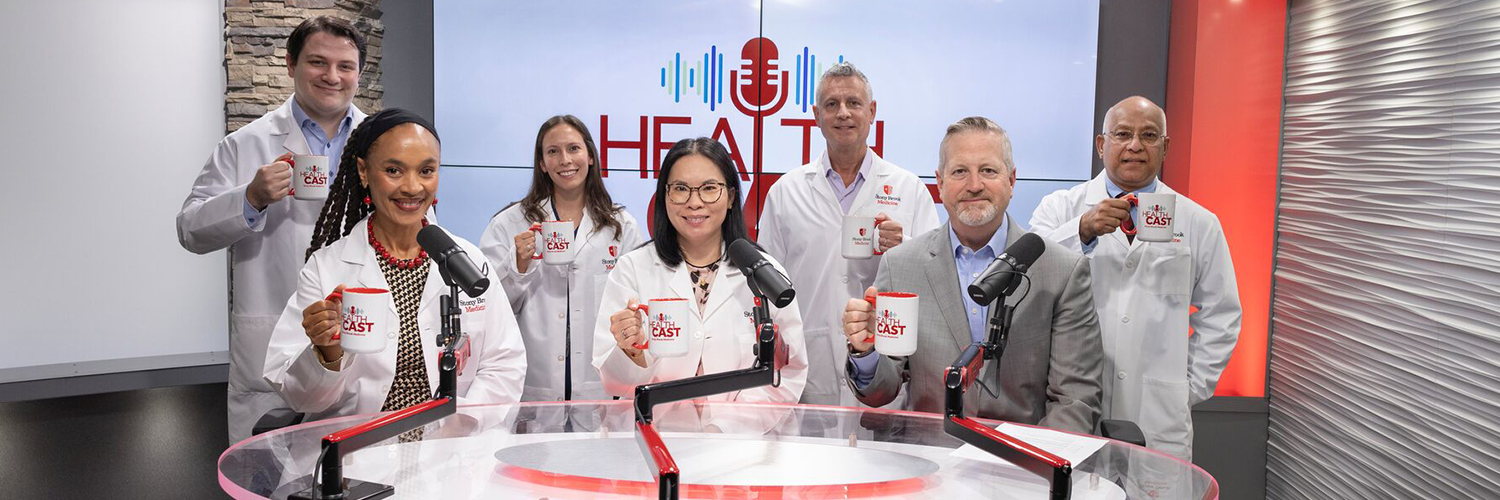
Experts in the Studio
- Vice Dean for Clinical Affairs and Vice President for Clinical Services, Stony Brook Medicine
- Director, Stony Brook’s Center for Global Health Equity, Stony Brook Medicine
- Director, Minimally Invasive and Robotic Gynecologic Surgery Division, Stony Brook Medicine
- Division Chief and Fellowship Director, International Emergency Medicine, Stony Brook Medicine
- Global Emergency Medicine Fellow, Stony Brook Medicine
- Chair, Department of Anesthesiology, Stony Brook Medicine
- Director of Global Anesthesia and Critical Care, Stony Brook Medicine
What You’ll Hear in This Episode
- 00:00 Opening and Introductions
- 1:32 The importance of engagement in global health
- 3:55 Why is it important for academic medical centers to engage in sustainable global health programming?
- 5:23 Reflections on work in Mozambique
- 7:17 Introduction of next panel of experts
- 7:37 The importance of engagement in global emergency medicine
- 9:47 Revisiting the importance of academic medical centers engaging in sustainable global health programming
- 11:40 Reflections on work in Mozambique
- 13:30 Introduction of next panel of experts
- 13:53 Revisiting the importance of academic medical centers engaging in sustainable global health programming.
- 15:27 How does engaging in sustainable global health programming benefit our community and the world at large?
- 17:13 Reflections on work in Mozambique
- 18:52 Closing Remarks
Full Podcast Transcript
Description of Video Studio: News desk with Stony Brook Medicine logo on the front. Big screen is behind experts with the Healthcast logo.
00:00 Opening and Introductions
Announcer
Welcome to Healthcast, where leaders and experts from Stony Brook Medicine come together to discuss a range of topics, from leadership and strategic planning to patient care and the inner workings of a successful healthcare system.
Todd Griffin, MD, MBA
Welcome to Healthcast. My name is Todd Griffin, and I’m the vice dean for clinical affairs and vice president of clinical services at Stony Brook Medicine, and one of the founders of Stony Brook Center for Global Health Equity.
Today, we are diving into the impact of a sustainable global health program, why it matters, how it shapes medical education and the meaningful work being done across international communities. We have several experts from Stony Brook Medicine’s Center for Global Health Equity joining us today to discuss on-the-ground experiences in Mozambique and how global engagement not only transforms patient care abroad, but also strengthens our own community here at home.
I’m first joined by Dr. Sierra Washington and Dr. Julie Lian. Dr. Washington, can you start by introducing yourself to our viewers and listeners?
Sierra Washington, MD, MSc
Sure. My name is Dr. Sierra Washington. I’m an obstetrician-gynecologist and a family planning subspecialist, and I’m also the director for the Center for Global Health Equity.
Todd Griffin, MD, MBA
Thanks, and Dr. Lian.
Xun (Julie) Lian, MD, FACOG
Thank you for having me. I’m the division director of the minimally invasive gynecologic surgery, as well as the program director of the fellowship.
1:32 The Importance of Engagement in Global Health
Todd Griffin, MD, MBA
Thank you both for being here. The mission of Stony Brook Medicine Center for Global Health Equity is to advance global health equity by building capacity for care, education and research. And with that, let’s get started. So, Dr. Washington, why is engagement in global health important to you personally?
Sierra Washington, MD, MSc
I’m so glad you asked me that question. It caused me to reflect. I came to medicine in order to do global health, and I think that’s because when I was young, I had the privilege to travel internationally and I was confronted by seeing absolute poverty firsthand. That really left an indelible mark on me and has shaped my world view. As I’ve grown older, it’s caused me to ask, you know, why do we even exist on this planet? What are we here for? What responsibility do we have towards each other? And how can I contribute?
So to me, it’s about reaching out to those on the bottom rung and trying to improve the human condition. So when I retire or end my career, I want to know that I have somehow helped improve inequities on this planet.
Todd Griffin, MD, MBA
That’s fantastic, and I know you know my introduction to you and you educating me about global health was really critical for me to understand how important this was. And again, I want to applaud you for that and your passion for it. It’s really important. How about you, Dr. Leanne? What brought you to being interested in global health?
Xun (Julie) Lian, MD, FACOG
So I want to start by saying that I first came into medicine after residency, knowing that I wanted to stay in academic medicine. Academic medicine is about, to me, teaching the next generation of gynecologic surgeons, but also taking care of a diverse patient population.
So to me, global health is an extension of that. Specifically, you know, global health is a two-way bidirectionality exchange of information, and so not only when we go to Mozambique, we are working with their doctors and healthcare professionals there, but also their residents and their doctors also come to Stony Brook as well.
So that sort of exchange of information and teaching goes both ways. And as a fellowship director, I’ve had the privilege of going to Mozambique recently with one of my fellows, Dr. Ali, and sort of having the exposure to new healthcare systems, patient populations has really improved her professionally and personally as well. So that was great to be part of.
3:55 Why is it Important for Academic Medical Centers to Engage in Sustainable Global Health Programming?
Todd Griffin, MD, MBA
Yeah, it’s fantastic. I think the way it’s grown, like you said, over the last few years has really been tremendous. Dr. Washington, in your opinion, why is it important for an academic medical center like Stony Brook to engage in sustainable global health programming?
Sierra Washington, MD, MSc
So I believe that as a physician in a premier academic medical center in the wealthiest nation in the world, we actually have a moral and ethical obligation to reach out to the poorest of the poor, whether that means locally or regionally or globally.
Global health is more than going out and doing medical service abroad. It’s about leveraging our position, our resources to create lasting partnerships and programs that are sustainable and can have a lasting impact abroad. I also think that there are real benefits to us, to our trainees, our fellowships, and our physicians to be trained as world-ready leaders. I think there are benefits to the trainees and physicians there. So in the end, all the patients benefit, whether here or abroad, and we work together to improve the human condition.
Todd Griffin, MD, MBA
Yeah, that’s so important. It really, I mean, I think when we first started talking about global health, I was thinking of it as what you would call medical tourism — us going someplace and spending a couple weeks, us feeling good about ourselves. But the part that you really convinced me about was how do we create a sustainable effort, and how do we really change a community? And I think the work that you’re doing there is really critical to that. So again, I applaud you. It’s really wonderful the work that you’re doing.
5:23 Reflections on Work in Mozambique
Todd Griffin, MD, MBA
Dr. Lian, tell me one of your most meaningful projects that you engaged in in Mozambique and how it will make a lasting impact.
Xun (Julie) Lian, MD, FACOG
So I’ve been to Mozambique three times over the past few years and really worked with Dr. Washington and the doctors and healthcare professionals in Maputo, Mozambique, to grow their laparoscopic program. Laparoscopy is a minimally invasive surgical technique where surgery is done through little incisions. There’s a lot of benefits to that over traditional open surgery, including faster recovery, less bleeding, infection, but also for patients, faster return to work and their normal activities.
And so, over the three trips that I’ve done, we’ve grown the laparoscopy capabilities of the surgeons there. There are currently six surgeons who are able to perform laparoscopy. Again, it’s a surgery that we do pretty commonplace here in the U.S. and across other developed countries, and so for them to be able to do laparoscopic surgery for common GYN emergencies like ectopic pregnancies, ovarian cysts, means that for those patients, they are able to go back to work in a few days. Which, again, in a low-income country, the benefits of laparoscopy is even more impactful.
Todd Griffin, MD, MBA
Yeah, I think that’s wonderful. To me, you know, that the idea about getting the patients back to their, you know, full capacities quicker, especially iwhere their resources are less, is really important. So again, I applaud you for the work that you’re doing there. Thank you to Dr. Washington and Dr. Lian. We’ll be back shortly with two more of our global experts who specialize in global emergency medicine.
7:17 Introduction of next panel of experts
Todd Griffin, MD, MBA
Welcome back. I’m joined by Dr. Fombonne and Dr. Rosenzweig, and I’m going to first have you guys introduce yourselves. Dr. Fombonne.
Benjamin Fombonne, MD, DTMH
Sure. My name is Benjamin Fombonne. I’m an emergency medicine physician here at Stony Brook, and the division chief for global emergency medicine.
Sara Rosenzweig, MD
I’m Sarah Rosenzweig. I’m one of the global emergency medicine fellows.
7:37 The Importance of Engagement in Global Emergency Medicine
Todd Griffin, MD, MBA
So first, we’ll start with you, Dr. Fombonne. Why is engagement in global health important to you personally?
Benjamin Fombonne, MD, DTMH
Sure, that’s a great question. I think it starts like many of us in medicine with a sort of personal journey of how I ended up even getting into emergency medicine. I moved around a lot as a child. I grew up in several different countries and sort of access to care and sort of the universality of healthcare was something that was quite obvious to me. And so as I was seeking out different specialties in medical school, emergency medicine really was the one that spoke to me. And as I progressed through that, sort of developing high-quality emergency care globally was something that I became quite passionate about.
I think when we work in the emergency department, we realize some of the difficulties we have: strained resources, health inequities, crowding, delays in access to care is something that’s shared globally across all health systems.
And so, as I began my journey in academic medicine. I was finding ways that I could sort of participate in different projects globally, and some of the most meaningful experiences in my relatively young career so far have been working and really learning alongside my colleagues in Mozambique, in Guatemala, in El Salvador and across the Caribbean.
And ultimately engaging in global health work keeps me grounded. It makes me realize how fortunate I am to be working in an institution like Stony Brook, and also to be able to make a difference to the patients I serve here, but also to patients around the world through the partnerships that we have through the educational initiatives is truly a great experience for me.
Todd Griffin, MD, MBA
That’s truly incredible. Dr. Rosenzweig, why did you decide to do a fellowship in global emergency medicine?
Sara Rosenzweig, MD
Emergency medicine has always been really important to me. My father was an emergency medicine physician and did some training in Mexico and kind of brought this global emergency medicine idea to my head. Additionally, my mother is from El Salvador, we grew up in a Spanish-speaking household, so taking care of the Spanish speakers in our community and abroad encouraged me to pursue this fellowship.
9:47 Revisiting the Importance of Academic Medical Centers Engaging in Sustainable Global Health Programming
Todd Griffin, MD, MBA
That’s fantastic. Dr. Fombonne. In your opinion, why is it important for an academic medical center like Stony Brook to engage in sustainable health global health programming?
Benjamin Fombonne, MD, DTMH
Yeah, as an academic institution, obviously we are driven by excellent clinical care. But our mission doesn’t stop there. It’s to train future physicians and physician leaders, advance knowledge through research and also impact the health of our communities both locally — but also nationally and internationally, and sustainable global health work really hits all three points.
Our trainees and our faculty who get to work in different settings globally return with a really renewed sense of clinical work, resource adaptability, cultural competency that they would not necessarily get just by working in a single system. Advancing research, especially in a collaborative way with our partners globally, really helps advance the knowledge base that helps translate to better clinical care both again here within our own hospital, but also with our partners abroad.
And then ultimately, you know, the focus on sustainable and bidirectional relationships with our collaborative partners is truly important. It strengthens both institutions, both from the trainees with our global partners who get to experience a different health system, develop their own research protocols and work with a variety of expertise, but also, as I mentioned before, our trainees getting to see what clinical work is globally.
Ultimately, for Stony Brook, the mission of sustainable global engagement fits with the institutional mission, which is again excellent clinical care and advancing the knowledge base. And continuing this work is truly important for the institution as a whole.
11:40 Reflections on Work in Mozambique
Todd Griffin, MD, MBA
Dr. Rosenzweig, why don’t you tell us about one of the most meaningful moments you’ve had in your time in Mozambique, and potentially how that’s going to shape who you are as a physician moving forward?
Sara Rosenzweig, MD
Sure. So, wow, our time in Mozambique was so meaningful, and there were many, many patients that we cared for that stick in my mind. One in particular was a young girl who was burned, who had traveled from a very far away province for care at the Maputo Hospital.
So, it encouraged me to just keep my goals in teaching emergency medicine abroad, specifically because this young girl had traveled from very far, where there was no emergency care. There’s no such thing as ambulances there. There’s no paramedics. There’s just not a way for somebody to receive emergency care in some of these very rural places. So I think it will just reinforce my love of emergency medicine, and the reason why I do this. I believe this is the best job in the world. We are able to treat any patients with any complaint, any age, any language. We can make it work.
Todd Griffin, MD, MBA
So, yeah, I think that’s really important what you talked about: rural versus being in the city. One of the great things about our global effort in Maputo and Mozambique is that pretty much it’s a hub and spoke model. So all the training is done in Moputu, and then those practitioners go back to their local environment. So that the work that you’re having and doing in Moputu actually translates to the whole country, and I think that’s a really critical thing. And that’s why, especially for emergency medicine, being involved with this is truly wonderful.
So I want to thank Dr. Fombonne and Dr. Rosenzweig for you know telling us about some of their important things they’ve done in Mozambique, and I look forward to our next panel.
13:30 Introduction of Next Panel of Experts
Todd Griffin, MD, MBA
Welcome back. I’m now joined by Dr. Shah and Dr. Oster. Dr. Shah, why don’t you introduce yourself?
Syed Shah, MD
Thank you. My name is Sayed Shah, and I’m the chair of anesthesiology at Stony Brook Medicine.
Todd Griffin, MD, MBA
And Dr. Oster.
Jonathan B. Oster, MD, FASA
I’m Jonathan Oster. I do anesthesia and critical care here at Stony Brook Medicine, and I spend a quarter of my time at Hospital Central de Maputo.
Todd Griffin, MD, MBA
So, Dr. Shah, why don’t you talk to us about why you think it’s important for an academic medical center like Stony Brook to participate in global health.
13:53 Revisiting the Importance of Academic Medical Centers Engaging in Sustainable Global Health Programming
Syed Shah, MD
Thank you for asking me. This is very important to me because I don’t know if you know it or not, I grew up in a developing country, and I have witnessed firsthand how access to healthcare, education or resources can influence the lives of individuals and communities. So, looking at that,l these experiences have changed, giving me the experience to look at it, like the challenges that come with these limited resources, how communities can have new innovations and resilience, and that helped me with that.
Todd Griffin, MD, MBA
That’s fantastic. So this is really giving back in this case. And how about you, Dr. Oster? Why is the global health mission so important to you?
Jonathan B. Oster, MD, FASA
You know, I spent the bulk of my career in private practice, and I was involved with the business end of things. And my whole life was basically trying to grow business and to make money. A little over four years ago, I decided to come to Stony Brook Medicine and to share my experience and teach residents and give back. When this opportunity came up to try to teach and help on a global level, I jumped at it, and it has become one of the most meaningful things that I’ve ever done in my entire career.
Todd Griffin, MD, MBA
And I think that’s a common theme that you hear about people who get into global health. That it has become something so meaningful for them individually, and I think that’s a really important thing.
15:27 How Does Engaging in Sustainable Global Health Programming Benefit Our Community and the World at Large?
Todd Griffin, MD, MBA
So, Dr. Shah, when we talked about why it’s important for an academic medical center like Stony Brook to engage in sustainable global health, how does it benefit us, our community or the world at large?
Syed Shah, MD
Thank you for asking such an important question. Being a premiere academic center, it goes with our mission like education, patient care, research and innovation, and community outreach. It does benefit Stony Brook in multiple ways, like with international collaboration, more opportunities for research and unique educational and clinical experiences for our students, residents and faculty members. And it also helps us recruit talented people who want to come and get that experience and want to give back to the community. Not only that, if you look at it, Long Island has a very diverse population, and we are connected to the world. And having this experience teaches us how we can take care of our diverse cultures in Long Island, how we can approach them and how we can take care of our own local community.
In addition to that, this is not a one-way thing; it’s a multi-directional thing. Like by teaching underserved communities around the world, we help them to work under their limited resources, and we learn from them also.
So what I have learned during the pandemic time is that the world is connected. So health challenges don’t follow any borders. If we know how to treat a healthcare problem in one place, ultimately it leads to take care of a healthcare problem everywhere. So this is my way of looking at this global health by being involved in global health, learning from the rest of the world, it ultimately helps us how we take care of our own diverse population.
17:13 Reflections on Work in Mozambique
Todd Griffin, MD, MBA
That’s fantastic. Dr. Oster, why don’t you maybe tell us about one of the most meaningful experiences you’ve had from your time in Mozambique, and how maybe that shaped your future?
Jonathan B. Oster, MD, FASA
This is an easy one. So early last year, I did my first trip, and I noticed that they’re missing a vital monitor that’s standard of care here in the U.S. and in Europe. It’s called a capnograph, and it measures carbon dioxide in the breathing gasses. They do anesthesia without it. They don’t have it in the ICU. They don’t have it in the emergency room. I have a background in engineering, and I thought there must be a way to make this cheaper. They have no resources there. They can’t even afford the disposables. The device can cost about $5,000. I partnered up with a team of engineers from across the street here at Stony Brook (University), John Longton, who’s a mechanical engineer, and Way Rubenstein, who’s a biomedical engineer, and with those two professors and a team of about 12 other students and graduate students, we are actually making a device that’ll be a 20th of the cost of what it costs, and we have a working prototype, and we’re going to be implementing that hopefully by next year, and that is going to have major, major impact.
Todd Griffin, MD, MBA
And as a surgeon who’s you know taking care of patients under anesthesia, I know that CO2 monitor is critical to having a good outcome. So that’s phenomenal, and it’s really interesting how you’ve taken your engineering background and even more importantly partnered with the university. And that’s the next part really about our global health is really how do we partner with the university around those other infrastructure things that need to be grown in that area. So that’s truly a wonderful example.
Jonathan B. Oster, MD, FASA
Thanks, very exciting.
18:52 Closing Remarks
Todd Griffin, MD, MBA
That’s all the time we have. Thank you to our experts and thank you to you, our viewers and listeners, for tuning in. For more information about the incredible work being done through Stony Brook Medicine’s Center for Global Health Equity, visit renaissance.stonybrookmedicine.edu/globalhealthequity.
And if you found this information interesting, don’t forget to like and subscribe for more content just like this.
Announcer
Stony Brook Medicine is Long Island’s premier academic medical center. We transform lives through scientific discovery, education, and care, and we bring together innovative research, advanced education, and extraordinary healthcare expertise to set the standard for how healthy communities thrive.
For more information, visit StonybrookMedicine.edu or follow us on social media: Stony Brook Medicine on Instagram, Threads, Facebook, YouTube, and LinkedIn, and Stony Brook Med on X.
* DISCLAIMER: The information provided in this podcast is for educational and informational purposes only and is not intended as a substitute for professional medical advice, diagnosis or treatment. If you think you may have a medical emergency, call your doctor or emergency services immediately.