

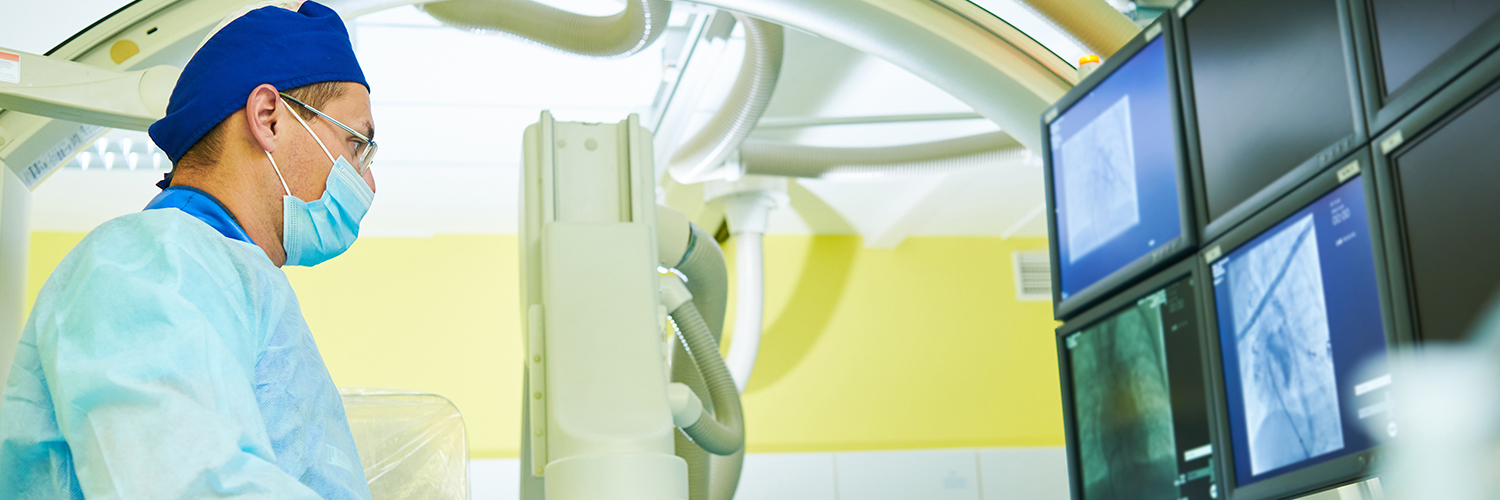
Radiologists are doctors who use medical images to help diagnose and guide treatment for many health conditions. An interventional radiologist is a radiologist who uses medical imaging to perform advanced procedures to treat problems inside the body.
Interventional radiologists are experts in providing minimally invasive surgeries that can offer relief, often with less pain and a faster recovery than traditional surgery.
This article will explain what interventional radiologists do and how they provide advanced care without major surgery.
What Is Interventional Radiology?
Interventional radiology (IR) is a medical specialty that uses imaging tools to guide treatments inside the body. Interventional radiologists are highly-trained doctors who combine two distinct skill sets. They specialize in reading medical images, like all radiologists, while also performing complex procedures, much like a surgeon. Interventional radiologists use tools like X-ray, ultrasound and CT scans to navigate precisely through the body.
This image guidance allows them to perform procedures through tiny incisions rather than large surgical openings. Because there is no large incision, medical teams refer to these treatments as “minimally invasive.”
By pairing advanced imaging with specialized surgical skills, interventional radiologists deliver highly targeted care exactly where patient needs it.
What Conditions Do Interventional Radiologists Treat?
Interventional radiologists are skilled at treating many different conditions throughout the body. Their work helps patients avoid the need for traditional open surgery.
Some of the medical problems they can address include:
- Cancer: They can deliver treatment directly to a tumor to destroy cancer cells by burning, freezing, or cutting off its blood supply.
- Women’s health: They offer minimally-invasive alternatives to surgery to treat uterine fibroids, adenomyosis and many causes of chronic pelvic pain.
- Men’s health: They offer minimally-invasive alternatives to surgery for enlarged prostate and some causes of male infertility.
- Pain management: They offer minimally invasive procedures to treat painful spine fractures, pain from cancer and other causes of chronic pain.
Common Procedures They Perform
Interventional radiologists have a large toolbox of procedures they use to help patients. Because these treatments are guided by imaging, they are incredibly precise.
Some common procedures include:
- Ablation: CT scan or ultrasound is used to place a probe directly into a tumor and destroy it with heat, cold, or electrical energy.
- Biopsy: X-ray, CT, or ultrasound is used to guide a needle to the location of a tumor to obtain a sample for diagnosis of benign, cancerous or infectious tissues.
- Embolization: X-ray is used to guide the intentional blockage of a blood vessel to stop bleeding or cut off a tumor’s blood supply.
- Kyphoplasty: X-ray is used to guide placement of needles into a fractured or cancerous vertebral body in the spine and inject cement, stabilizing the spine and reducing pain.
How Is Interventional Radiology Different from Traditional Surgery?
The biggest difference between interventional radiology and traditional surgery is the approach.
Interventional Radiology:
- Uses tiny incisions, often no bigger than a pencil tip.
- Guided by real-time imaging for extreme precision.
- Patients usually have a shorter hospital stay and faster recovery.
- Lower risk of pain and complications.
Traditional Surgery:
- Involves making a larger incision to access the area of concern.
- Often requires a longer recovery period.
- As with any surgery, there is a potential risk of infection and visible scarring.
That said, traditional surgery becomes necessary when your care requires a more extensive approach. Medical teams rely on this proven method for complex situations, such as:
- Removing large or intricate tumors.
- Repairing severe or complex bone fractures.
- Addressing conditions that image-guided techniques cannot effectively treat.
Why Choose Interventional Radiology?
Treatment decisions are always made with your doctor, who will recommend the best path for your specific condition. If interventional radiology is an option, it’s often recommended for its many benefits.
Benefits
- Less pain: Smaller incisions mean less damage to tissue and less pain after the procedure.
- Faster recovery: Many patients go home the same day and get back to their normal lives much quicker.
- Lower risk: With no large incision, the risk of infection and other complications is significantly lower.
- High precision: Advanced imaging allows doctors to target the problem area without harming surrounding healthy tissue.
Potential Risks:
Like any medical procedure, interventional radiology carries some risks. While these treatments are generally safe and less invasive than traditional surgery, it’s important to be aware of possible complications. Some potential risks include:
- Bleeding: Because small incisions are made, there can sometimes be minor bleeding or bruising.
- Infection: Any time the skin is broken, there’s a small chance an infection could develop. Doctors use sterile techniques to lower this risk.
- Allergic reactions: Some procedures use contrast dye, which can cause allergic reactions in rare cases.
- Damage to nearby tissues: Although imaging helps with precision, there’s still a slight risk that nearby organs or blood vessels could be affected.
Your interventional radiologist will discuss these risks with you and explain how they work to keep you safe during any procedure.
The Vital Role of Interventional Radiologists
Interventional radiologists are transforming modern medicine. By combining advanced imaging with minimally invasive techniques, they offer patients safer, faster and more effective treatments for a wide range of conditions.
Thanks to their skills and dedication, more patients can experience better outcomes, shorter recovery times and a smoother path back to health.
At Stony Brook Imaging and Radiology, patients benefit from the expertise of Suffolk County’s only academic medical center and access to advanced, low-dose imaging technology, including Long Island’s only PET/MRI scanner. Whether you are in the hospital or at one of our outpatient centers, our specialty-trained radiologists and interventional radiologists deliver precise, comprehensive care. Learn more or schedule an appointment at one of our convenient locations.