
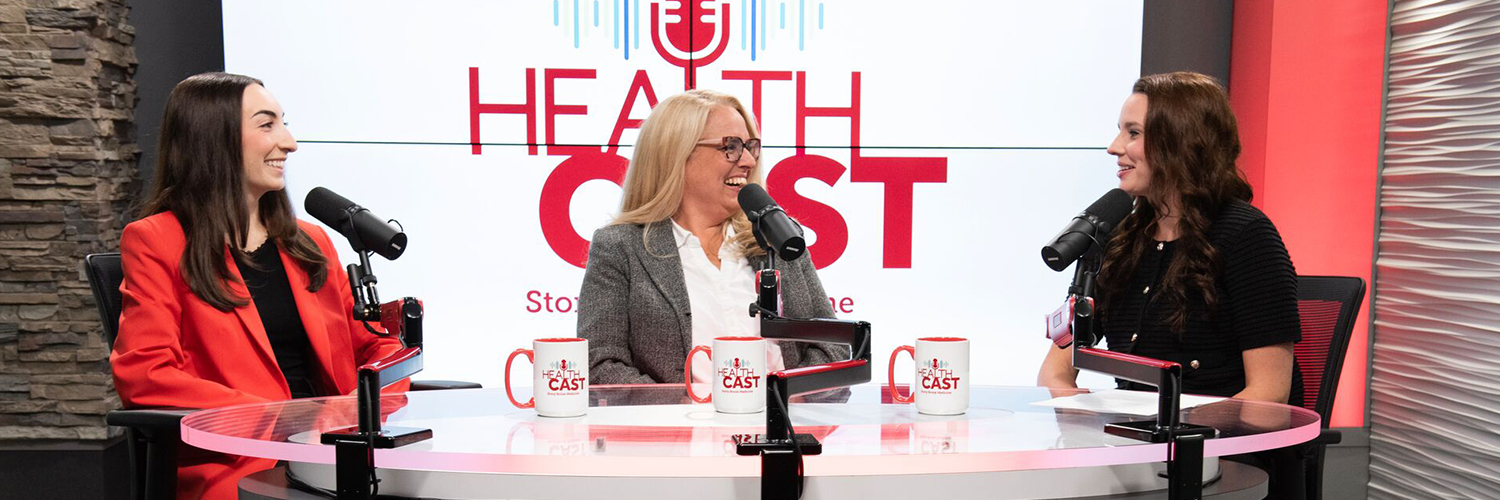
In this episode of Healthcast, experts spotlight Stony Brook’s very first cohort of their nursing evidence-based practice (EBP) fellowship, which was designed to support nurses in bringing evidence to the bedside, through identifying clinical questions, reviewing literature, and planning and implementing meaningful change.
The Experts
- Meghan Doelger, DNP, RN, CCRN
- Andrea DeRosa, BS, BSN, RN, CCRN
- Tami Robitsek, DNP, ANP-BC
What You’ll Hear in This Episode
- 00:00 Opening and Introductions
- 2:50 The journey to evidence-based practice (EBP)
- 6:12 Projects explored in this inaugural cohort of Stony Brook’s EBP Fellowship
- 6:48 Nurse confidence and rapid response
- 11:26 Nurse wellness and reducing stress and burnout
- 15:28 Experience being part of first cohort (as mentors and mentees)
- 20:53 The importance of EBP in today’s healthcare environment
- 22:22 The future of EBP
- 24:00 Advice for prospective fellows and mentors
- 25:54 Closing Remarks
Full Transcript
00:00 Opening and Introductions
Announcer
Welcome to Healthcast, where leaders and experts from Stony Brook Medicine come together to discuss a range of topics from leadership and strategic planning to patient care and the inner workings of a successful healthcare system.
Meghan Doelger, DNP, RN, CCRN
Welcome to this episode of Healthcast, where we explore how nurses are transforming care through curiosity, collaboration and evidence based practice.
I’m Dr. Meghan Doelger, Stony Brook University Hospital’s nurse scientist, and in today’s episode, we will be spotlighting the very first cohort of our nursing evidence-based practice fellowship.
This program was designed to support nurses in bringing evidence to the bedside through identifying clinical questions, reviewing the literature, and planning and implementing meaningful change. It’s also about building mentorship, community and a culture of inquiry across our organization.
Joining me today are two guests from this inaugural cohort. First, we have Andrea DeRosa, a staff nurse in the Medical Intensive Care Unit, who is participating as one of our first evidence based practice or EBP fellows.
And we’re also joined by Dr. Tami Robitsek, Stony Brook University Hospital’s Director of Rapid Response, who’s serving as a mentor in the program.
Today, we’ll talk about their backgrounds, what drew them to evidence based practice, the work they’ve done so far, including their literature reviews and where they’re heading next.
Andrea, let’s start with you. Can you tell us a little bit about your nursing background?
2:50 The Journey to Evidence-Based Practice (EBP)
Andrea DeRosa, BS, BSN, RN, CCRN
Sure. So I started my nursing career here at Stony Brook Hospital in August of 2023. I started off in their ICU flow pool. So I was cross trained in each ICU, and went to them each night, depending on their staffing needs. I did that for a little bit less than a year, and then I transitioned to solely working in the medical ICU in May of 2024 and I’ve been there ever since.
Meghan Doelger, DNP, RN, CCRN
And Andrea, we actually have that in common, because I started as a staff nurse here at the hospital in the float ICU. So it was kind of an interesting job to get to know a little bit about all the different critical care nuances. So yeah, that was great.
And then Dr. Robitsek, same question for you. Can you tell us a little bit about your background and your current role in nursing?
Tami Robitsek, DNP, ANP-BC
Sure. So I have been in nursing for over 20 years, most of which has been as a nurse practitioner. I have worked in inpatient, outpatient, sort of spanned multiple specialties, primarily neurosurgery.
About seven years ago, I joined the Rapid Response Team, and I am currently the Director of Rapid Response.
Meghan Doelger, DNP, RN, CCRN
And we have actually worked together in different capacities. Also, I was a staff nurse in the neuro ICU, and you were the nurse practitioner. So yeah, we’ve worked together for a while as well.
So Andrea, can you tell us, how did you first become interested in the evidence-based practice, and what made you want to be part of this first EBP cohort?
Andrea DeRosa, BS, BSN, RN, CCRN
Sure. So I was originally introduced to EBP during my time as a nursing student here, in their accelerated nursing program at Stony Brook. All of our clinical groups had to do an EBP project, and I immediately fell in love with the idea of going through the research and seeing the evidence in order to instill change, and that passion grew even stronger during my time at the Nurse Residency Program here when I started working as a staff RN two years ago.
So as soon as I saw this fellowship, I was immediately drawn to it and very excited to apply, because I knew that I could again research and use evidence to create change in the field that I started working in.
Meghan Doelger, DNP, RN, CCRN
Yeah, like you, actually, I started as a nurse resident, and I still remember my evidence-based practice project. I was at a different organization, but I worked with the Brain Aneurysm Foundation to bring in educational materials for patients who are in the neuro ICU, because they had a lot of changes due to their clinical status. So they would go home and still have headaches and, you know, have some neurological deficits, and so to kind of prepare them for that and provide them with support going forward.
And I still remember being so excited about, you know, not just being able to come and care for the patients, but improve the care that we’re providing every day.
Dr. Robitsek, similarly, what led to your interest in EBP and becoming a mentor in the EBP fellowship program?
Tami Robitsek, DNP, ANP-BC
So I have always been interested in research. As a matter of fact, when I graduated college, I was a research assistant, and I had an experience where I was there taking care of people, sort of gathering data on Wernicke-Korsakoff Syndrome.
In that environment, I felt compelled to really be more involved in direct patient care, as opposed to just extracting, you know, sort of data from people. So at that point, I went back to school and I became a nurse, and I realized that this was an opportunity for me to combine my love of research with providing direct patient care.
So throughout my career, I have been involved in various sorts of projects, and when I heard about the EBP fellowship, I was really excited to hear that we’re doing this here at Stony Brook and I was excited to be a part of it as a mentor.
Meghan Doelger, DNP, RN, CCRN
And that’s so nice because research is generating new knowledge, but EBP is sort of taking the research and applying it into practice, and making changes that you actually see happen in front of you. So it’s very rewarding, I think. And that’s one of the things that drew me to EBP also. So I also enjoyed research. I had the opportunity, as a new nurse, to be involved in interdisciplinary research. So we looked at, at another hospital, we looked at family satisfaction with ICU care, and if different rounding styles made an impact on that.
So we were changing things. We were, you know, leadership was meeting with the families every once in a while so they could kind of put a name to a face and see if that made an impact on making the families feel a little bit more comfortable, and know like they knew who the point person was. And so I love kind of seeing how research can impact and make changes to practice for the better.
6:12 Projects Explored in this Inaugural Cohort of Stony Brook’s EBP Fellowship
So in our first cohort of the EBP fellowship, we have ten fellows, and then we have ten mentors, so it’s a one to one ratio, and they’re divided up into four groups, and each group is working on a different project, and they kind of run the gamut from clinically based projects, like there’s a group that’s looking at reducing pressure injuries in OR patients. There’s another group that is looking at improving sleep and reducing delirium among ICU patients.
And you guys also have two different projects that you’re working on. So I want to talk a little bit more about each of your projects. Dr. Robitsek, can you tell us what project you’re working on with your fellows, and what led your group to select this topic?
6:48 Nurse Confidence and Rapid Response
Tami Robitsek, DNP, ANP-BC
Sure. So my fellows all work on different med surg units, and they all had a shared interest in patient deterioration and rapid response. You know, they’re on units where they do see rapid responses quite a bit. And so the interest was in really improving the process so that nurses felt more confident when patients are deteriorating, and really recognizing that, relaying that information, and then responding was part of the interest. So that is what led us to looking into nurse confidence in rapid response.
Meghan Doelger, DNP, RN, CCRN
I remember, you know, my first sort of rapid response situation as a new nurse and feeling like I didn’t know what to do. And like, the heart starts beating a little bit and, you know, but you’re expected to just respond and know who your resources are. So I think it’s kind of a universal, nursing interest.
And can you synthesize what some of the findings were from the literature on this topic?
Tami Robitsek, DNP, ANP-BC
Sure. So the fellows looked at a total of 14 articles, and in general, the literature was basically confirming what their thoughts were about the fact that at Stony Brook, nurses are saying that they don’t feel very confident all the time in rapid responses. And then the literature reflected that. So that was sort of a theme.
They were also looking at how to best educate in rapid response and simulation was really a theme as a superior method of education, where we have basically had didactic education for many, many years. The literature is really speaking to the fact that simulation, as an adjunct to that, is highly effective.
Meghan Doelger, DNP, RN, CCRN
Yeah. I mean, patients are getting sicker in the hospital these days, and emergencies happen within the hospital for a variety of different reasons. So when the nurse has to respond, they kind of have to work through the steps of what is actually going on. What do I need to do here? So it’s a complex process, really. It’s not something that’s just easy. So it’s important to train the nurses so they feel comfortable in dealing with these situations.
And simulation is such a great tool too, because it allows for practice in an environment where their mistakes won’t hurt a patient. So I think that really is going to be important.
And how will you support your fellows? And now thinking about how to apply that research into practice and implementing it.
Tami Robitsek, DNP, ANP-BC
Yes, so rapid response sort of spans the spectrum of the hospital. We see rapid responses everywhere. So that can be complicated as far as who to query in regard to stakeholders, you know, sort of who to reach out to for what. Part of what I do with them is really make sure that they have the best resources for the different aspects of the project that they’re working on, also to really be an expert to them in the subject matter itself.
There are lots of questions, you know, there were more questions at the start. I mean, they really have become very knowledgeable. But, you know, they have lots of questions about how we have come to do different things, and, you know, sort of different clinical scenarios that require different interventions. And so I really can be a resource to them in that.
Meghan Doelger, DNP, RN, CCRN
And I think it’s also important, speaking from my own experience as a mentor, you know, you have a problem that you want to tackle, and you’re very passionate about it, but you kind of have to focus in on one particular area and make one small, meaningful change, and then continue to build upon that. So sometimes that’s part of the mentorship process.
Tami Robitsek, DNP, ANP-BC
Yes, absolutely. I mean, this is really a vast topic of conversation, so it’s very easy to go off onto different tangents. There’s so much work that needs to be done, and so I always applaud all of the different ideas, but it really is part of my role to help streamline that so that we can focus on something that’s actionable in the intervention.
Meghan Doelger, DNP, RN, CCRN
Thanks, Tami. And Andrea, can you tell me about your project, and what question are you investigating?
11:26 Nurse Wellness and Reducing Stress and Burnout
Andrea DeRosa, BS, BSN, RN, CCRN
Sure. So I am working with an emergency department nurse and we’re focusing on nurse wellness, focusing on reducing stress and burnout. When we were first trying to figure out what to do for this project, we started talking about our experiences, me and the medical ICU and her in the emergency department.
And you know, they’re both very high intensity, high acuity units with a lot of patient turnover and a lot of patient deterioration and codes. We just started discussing the stress levels that we were feeling, and the same with the nurses that are on our units as well, feeling really the effects of such a high intense area. So we really want to focus on stress and burnout.
So we found, through the literature, using multiple nursing databases, the use of stress first-aid, which is a peer support stress management tool, was able to help in that area. We found around 14 articles that we appraised and synthesized, and we found two major outcomes, stress first-aid led to decreased stress and burnout in the nurses and critical care areas, and it also led to increased feelings of self efficacy, increased resilience and increased support from peers and management as well.
Meghan Doelger, DNP, RN, CCRN
Wow, that’s great. Andrea. You know, Tami and I went through COVID. So, you know, having gone through covid, it’s kind of like at the forefront of everybody’s mind is well being among healthcare members. And you know, how do we support the staff to optimize well being? And what we kind of know also from COVID is that just sort of repeated exposure to stressful things can build up over time.
So I think this stress first-aid model kind of focuses on recognizing and treating stress in the moment, rather than letting it build up. So I think that’s great because in the past, other programs have focused on maybe recognizing burnout, but at that point, multiple stressors have led to burnout, so kind of getting a little bit better at getting ahead of it.
Tami Robitsek, DNP, ANP-BC
I think also, you know, in my world, in rapid response, the work that you’re doing really dovetails with the work that that our group is doing where, you know, we kind of get through the emergency and then need the stress management element of that every time. So it really is kind of nice to see how the projects do complement each other.
Meghan Doelger, DNP, RN, CCRN
And Andrea, so now your group is into starting to think about implementation. So can you tell me a little bit about what that might look like for your group?
Andrea DeRosa, BS, BSN, RN, CCRN
Sure. So we’re getting very close to implementing the project, which is very exciting because we worked on it for quite some time. And stress first-aid is a great tool because it has been shown to be effective. So essentially, it’s a way of just checking in on yourself and others, what your stress level is, and knowing how and when to intervene. So essentially preventing the stress from getting to a point where it’s very harmful to yourself. So we really want to instill that.
So before we implement it on the units, we are first going to collect data on our nurses to see their burnout levels and their resilience levels. Then from there, we are going to determine the stress first-aid champions or leaders for the units on the medical ICU and the ED. And from there, we want to educate the stress first-aid champions, as well as all the staff on the units so they’re aware of the project being implemented.
And we hope to implement it between October and go all the way through December of this year, and hopefully after that, around January or so, collect data again on the nurses to see if their burnout levels go down and their resilience goes up.
Meghan Doelger, DNP, RN, CCRN
That’s really, that’s a great project. Yeah, very excited about that. So thank you for, you know, working on this very important work. I think that’s going to make such a big difference to those nurses. And I just know personally, that sort of no one else understands it like your peers, like the people who are also going through it. They understand healthcare, they understand the unique challenges, so I think that peer support is going to be so helpful.
15:28 Experience Being Part of First Cohort (as Mentors and Mentees)
So as the fellowship coordinator, I’m really excited to see the differences these are going to make in our organization. And I want to shift a little bit to talking about the experience of being part of this first cohort, because we’re doing this for the first time. So this question is for both of you, from your different perspectives, as someone who is teaching and mentoring in EBP and also someone who is learning it, what has the experience been like so far being part of this new program?
Andrea DeRosa, BS, BSN, RN, CCRN
The experience for me has been great so far. You know, I did two EBP projects in nursing school and during the Nurse Residency Program here, but we didn’t get to fully implement it. So now in this fellowship, I can actually see the change that we really worked so hard on doing. So we get to see how we make change in the hospital, which is great, and everyone has been so supportive. You Meghan, and all of our mentors that we have are so very supportive and encouraging. And I’ve also made a lot of connections with nurses in a wide variety of areas in the hospital, which is also great.
Meghan Doelger, DNP, RN, CCRN
What about you, Tami?
Tami Robitsek, DNP, ANP-BC
I mean, it’s been fantastic. You know, I have enjoyed being a mentor, but I also really have learned a lot from the fellows. You know, they’re so brilliant. And while I like to say I’m sort of the expert in this, they bring a lot of information to me that I, you know, might need to think about, because they are at the bedside and they are thinking about really applying this evidence-based outcome into practice, which is really important for the work that I do. So I have loved it.
Meghan Doelger, DNP, RN, CCRN
And Dr. Robitsek, anything that’s been rewarding or surprising, maybe as being a mentor?
Tami Robitsek, DNP, ANP-BC
Yeah, sort of echoing what I was just saying. I was very surprised when we first met, to see the amount of work that these fellows had put into the preliminary work for the fellowship. They were very knowledgeable. I felt like I could have a conversation with them about this topic that usually takes quite a bit of time to get into the complexities of rapid response and patient deterioration. And they were, they were really, really knowledgeable before they even started. So I was very surprised by that, also very pleased, because it made my job a lot easier.
Meghan Doelger, DNP, RN, CCRN
Yeah, I have to say, this group of fellows are, like, very engaged, you know, very interested, and it’s been fantastic.
Tami Robitsek, DNP, ANP-BC
And it’s nice to have them as leaders on their unit to really bring back what we’ve all been working toward.
Meghan Doelger, DNP, RN, CCRN
And what supports have been helpful to you as a mentor, Tami?
Tami Robitsek, DNP, ANP-BC
So we have a teams tile that I’m sure you can speak more specifically to, that has been really helpful for me. It’s a resource that provides me with tools to kind of go through the methodology that I may forget little bits and pieces of over time. I think that, as well as the collaboration with the other mentors, has really been helpful to me as a mentor.
Meghan Doelger, DNP, RN, CCRN
Yeah, we use an online platform as our classroom, and all of our materials are there. We have used the Iowa model of EBP as our model. So it’s a very structured way of going about making a change. And they provide different tools and templates for users that just make it really structured, very easy. So that’s very helpful. We’ve been utilizing them a lot during the course and just sitting in on some of the discussions with you and the other mentors, it’s been nice, because it’s been a true collaboration among the mentors who can talk about, you know, some challenges, about how to implement something, or, you know, how you might handle, say, a mentee who’s struggling, or something like that. And everybody has so much wisdom to share, so it’s been really helpful.
And then Andrea, can I ask you also, how has the mentorship helped you along the way?
Andrea DeRosa, BS, BSN, RN, CCRN
Yeah, our mentors for our project are Emily Emma and Katherine Lewin, and they are both so great. They are so encouraging and very supportive of our project, and have helped us along the way to gather ideas. Before we started, you know, having the idea of doing stress first-aid, giving us a lot of resources for that as well. And during the process, they have given us resources that we can use that are online and in person here in the hospital, that I didn’t even know existed until we started this fellowship. So it’s been a really great plus for this fellowship.
Meghan Doelger, DNP, RN, CCRN
Yeah, I remember as a new nurse, I had a mentor who was under a specialist on my unit, and she pulled me into some of these different projects and said, I think you would be a good fit for this, and let me help you through the process of learning how to do this, or you seem like you would be really interested in this research project. So she really inspired me and opened up some opportunities for me. So I think that mentorship is just such a great piece of this.
20:53 The Importance of EBP in Today’s Healthcare Environment
So as we’re wrapping up, I want to get some final thoughts from both of you. Why do you think EBP is important in today’s healthcare environment? And this is for both of you.
Andrea DeRosa, BS, BSN, RN, CCRN
I think it’s great because for me, in my opinion, it’s the key to advancing healthcare, finding new interventions that can be done in the hospital in order to improve either nursing workflow or the outcomes of the patients. So I feel like it’s really essential for healthcare, whether it’s doctors, nurses, PAs, anyone can really use it in order to instill change in their area of interest.
Tami Robitsek, DNP, ANP-BC
I agree. I couldn’t have said it better myself, you know, I think it’s really foundational in nursing.
Meghan Doelger, DNP, RN, CCRN
Yeah. I mean, we want to be always grounded in not just we’ve always done it that way, but you know, what does the research actually show? And you know how, what are some of the patient preferences that we should take into account? How do we kind of meld those together? So I think it’s so helpful.
Tami Robitsek, DNP, ANP-BC
And I feel like it also kind of helps to break down silos that sort of traditionally exist in the hospital in general, when you’re talking about something and you’re presenting evidence. You know it might be that you’re sort of speaking the language of someone else on the healthcare team that’s not necessarily with you all the time, but they can really understand, you know that you’re reading the same things, you’re looking at the same evidence, and you’re both able to synthesize it in a similar way to better the patient.
22:22 The Future of EBP
Meghan Doelger, DNP, RN, CCRN
And what do you foresee as the future of EBP for both of you?
Tami Robitsek, DNP, ANP-BC
I mean, I feel like this, like I said, this is foundational work that I think will become more and more a part of our nursing education. Fellowship programs are sort of the start to really enhancing evidence-based practice in nursing. I think that will continue to develop in the future.
Andrea DeRosa, BS, BSN, RN, CCRN
I agree. I feel like this is something that needs in the future to definitely be utilized a lot more. And we have 10 nurses and four projects, and they’re already about to implement change in many different areas of the hospital.
So if we think just how many areas we can change and improve with more nurses getting introduced to EBP, whether it’s through nursing school or residency programs across the state the country, I feel like it could really have a positive impact on healthcare and the patients.
Tami Robitsek, DNP, ANP-BC
And I think that it also, for me as a leader in the institution, it actually helps me to really put forward some of the changes that I’ve been working on, because it’s, you know, it’s that constant feedback that we’re now getting from the nurses that are at the bedside when working on evidence-based projects that’s really helping to move forward, the change that we all want to see.
Meghan Doelger, DNP, RN, CCRN
Yeah, I mean, as the nurse scientists, I kind of foresee this fellowship is going to continue. We’re going to have a cohort running every year, you know, we’re going to increase the capacity of nurses to be proficient and experts in EBP and continue to make changes going forward.
24:00 Advice for Prospective Fellows and Mentors
So, to that end, for future cohorts, what advice would you have for people who are planning on applying to the program as a fellow, or who are considering acting as a mentor for the program?
Andrea DeRosa, BS, BSN, RN, CCRN
I would say if you’re on the fence of applying, you’re not really sure about what EBP is, I feel like it’s a good opportunity to join or apply to the fellowship because you will learn all about it. You’ll become confident in EBP in order to do it on the unit that you work in. And once you’re in the fellowship, don’t be afraid to challenge the norms that you see in the area that you’re in.
Tami Robitsek, DNP, ANP-BC
And I would say for anyone that’s contemplating being a mentor, just do it. I think it’s really a unique opportunity that we have here to impact sort of the future of nursing here at Stony Brook, to have an impact on patient outcomes, and sort of, you know, the outcomes within the institution in general.
I would encourage anyone to do it, regardless of how busy you may be on the unit. I think it’s a really, really good opportunity to impact care.
Meghan Doelger, DNP, RN, CCRN
And I think evidence-based practice is a complex process, right? Which is why you can’t just teach it. I think you need that mentorship aspect of it built in, and the mentors have committed to meeting with the fellows on a monthly basis and have that dedicated time to work together on their projects. And they’re really just as much invested in the projects as the fellows. They’re really a team working on the projects, which I think has been successful so far. So that’s what I hope to continue in the future as well.
Tami Robitsek, DNP, ANP-BC
I agree with that, and like I said before, I think for those of us that are busy working, whether it’s on our units or in our departments, you know, we have things that we would like to try and move forward, and this is such a great opportunity to do that in a collaborative way.
Meghan Doelger, DNP, RN, CCRN
Thank you both so much for sharing your insights, your projects and your passions. It’s clear that this first cohort is paving the way for something truly meaningful, not just in terms of project outcomes, but in building a community of inquiry and growth across nursing.
Announcer
Stony Brook Medicine is Long Island’s premier academic medical center. We transform lives through scientific discovery, education and care, and we bring together innovative research, advanced education and extraordinary healthcare expertise to set the standard for how healthy communities thrive. For more information, visit stonybrookmedicine.edu or follow us on social media.
*DISCLAIMER: The information provided in this podcast is for educational and informational purposes only and is not intended as a substitute for professional medical advice, diagnosis or treatment. If you think you may have a medical emergency, call your doctor or emergency services immediately.