

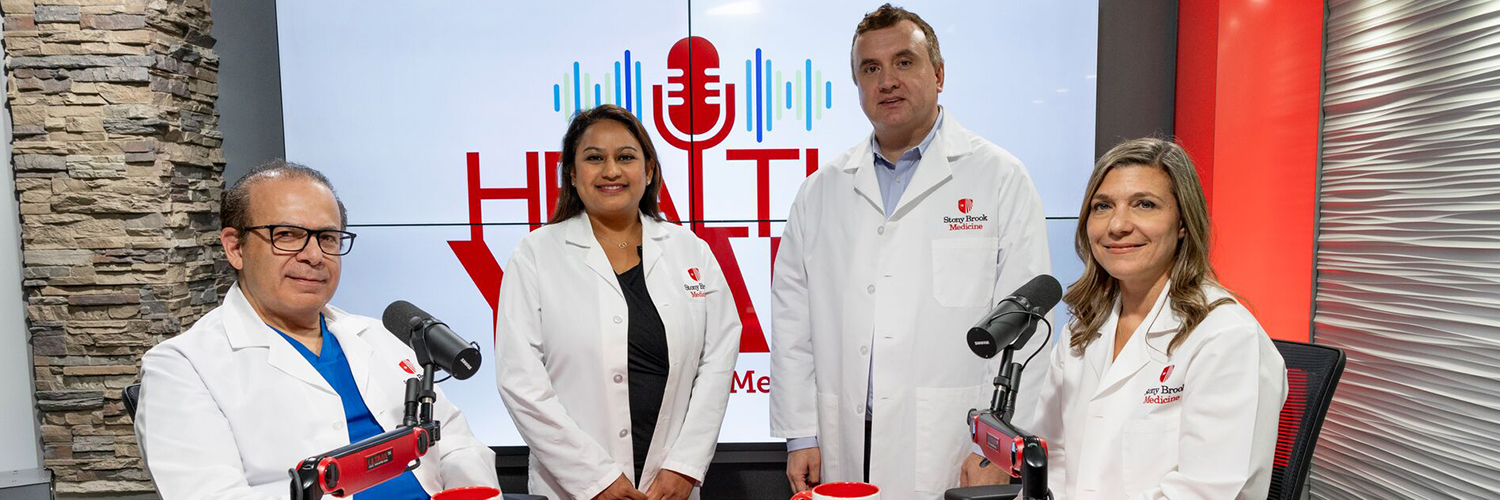
In this episode, gastroenterology experts break down some of the most common digestive health concerns, from inflammatory bowel disease (IBD) and irritable bowel syndrome (IBS) to acid reflux, GERD, bloating and celiac disease. Learn the key differences between Crohn’s disease and ulcerative colitis, the symptoms and causes of IBD, available treatment options, and how patients can achieve long-term remission and maintain a healthy quality of life.
The conversation also explores reflux triggers, digestive symptoms that should never be ignored, colon cancer screening recommendations, probiotics, and common myths about gut health. Whether you’re managing a gastrointestinal condition or simply looking to better understand your digestive health, this episode offers practical, expert-backed guidance.
Experts in the Studio
- Chief, Division of Gastroenterology and Hepatology
- Stony Brook University Hospital
- Director, Inflammatory Bowel Disease Center
- Stony Brook Medicine
- Associate Director, Clinical Research
- Division of Gastroenterology and Hepatology
- Gastroenterology
- South Shore Digestive Medicine
What You’ll Hear in This Episode
- 00:00 Disclaimer
- 00:16 Opening and Introductions
- 2:00 Inflammatory Bowel Disease (IBD) v. Irritable Bowel Syndrome (IBS)
- 2:52 Crohn’s Disease v. Ulcerative Colitis
- 3:44 Symptoms and early signs of IBD
- 4:36 IBD diagnosis
- 6:20 Causes of Crohn’s Disease and Ulcerative Colitis
- 8:30 Treatment options for Crohn’s Disease and Ulcerative Colitis
- 11:11 Can IBD go into remission?
- 12:02 Are there foods that can trigger or improve IBD?
- 13:28 Can Crohn’s Disease and Ulcerative Colitis put somebody at increased risk for colon cancer?
- 14:22 Can a patient with IBD live a normal and healthy life?
- 15:45 What should an IBD patient look for in their care team and support services?
- 18:05 GERD and GI health
- 18:42 GERD v. acid reflux and heart burn
- 19:28 What is happening in the body when somebody experiences acid reflux?
- 20:00 Symptoms of acid reflux
- 20:36 Are there specific triggers, habits or foods that can exacerbate reflux symptoms?
- 21:32 How to tell if heart burn or chest pain may be an indication of something more serious?
- 22:28 Proton pump inhibitors (PPIs)
- 24:05 What are some reasons why bloating happens?
- 25:48 How to distinguish between food intolerance and celiac disease
- 27:10 What digestive symptoms should a patient never ignore?
- 28:11 When do you start screening for colon cancer?
- 29:08 Debunking common myths about gut health
- 30:19 Probiotics
- 31:19 When should somebody see a gastroenterologist?
- 32:08 Closing Remarks
Full Podcast Transcript
00:00 Disclaimer
Disclaimer: The information provided in this podcast is for educational and informational purposes only, and is not intended as a substitute for professional medical advice, diagnosis or treatment. If you think you may be having a medical emergency, call your doctor or emergency services immediately.
00:16 Opening and Introductions
Announcer
Welcome to HEALTH Yeah!, where experts from Stony Brook Medicine come together to discuss topics ranging from the complex inner workings of an infectious disease to tips and tricks for staying safe and healthy all year long.
Olga Aroniadis, MD, MS
Hello and welcome to HEALTH Yeah!. My name is Dr. Olga Aroniadis, Chief of the Division of Gastroenterology and Hepatology at Stony Brook University Hospital.
Today we’re diving into some of the most common and important digestive health topics affecting millions of people. We’ll discuss inflammatory bowel disease or IBD, including Crohn’s disease and ulcerative colitis. We’ll break down what IBD is, how it’s diagnosed and treated, and what patients should know about managing flares and remission, and how to live well with these chronic conditions.
We’ll also talk about GERD, acid reflux and other common gastrointestinal concerns. We’ll cover everything from heartburn and bloating to food intolerances, colon cancer screening and the digestive health symptoms you should never ignore.
I’m joined by Dr. Farah Monzur and Dr. Lasha Gogokhia. Can you both take a moment to introduce yourselves to our listeners and viewers?
Farah Monzur, MD
Yes. Hi. How are you? I’m Farah Monzur. I’m the director of IBD, which is an inflammatory bowel diseases. So nice to be here.
Lasha Gogokhia, MD, MS
I’m Lasha Gogokhia. I’m a physician scientist and IBD gastroenterologist, working along with Dr. Monzur with our IBD patients.
Olga Aroniadis, MD, MS
Thank you both for being here today. Whether you’re looking to better understand a recent diagnosis, learn more about digestive health or pick practical tips for staying well, this episode is packed with expert insights. Let’s get started.
2:00 Inflammatory Bowel Disease (IBD) v. Irritable Bowel Syndrome (IBS)
So, tell us what is the difference between inflammatory bowel disease or IBD, and irritable bowel syndrome or IBS?
Farah Monzur, MD
I think that’s a great question. A lot of our patients ask us the same question. So IBD stands for inflammatory bowel diseases, and that comprises Crohn’s disease and ulcerative colitis, which I’m sure we’re going to get to in a bit about the differences.
And inflammatory bowel disease is different from IBS, which is irritable bowel syndrome. IBD comprises of actual pathologic issues in the GI tract, so ulcers, that’s basically what we see when we do our procedures, whether it’s an endoscopy or colonoscopy.
IBS, we don’t see any of that, and it’s a diagnosis of exclusion. So it just depends on what symptoms. But sometimes the symptoms can mimic each other.
2:52 Crohn’s Disease v. Ulcerative Colitis
Olga Aroniadis, MD, MS
Great, thank you so much for that answer. So, Dr. Gogokiya, can you tell us the difference between Crohn’s disease and ulcerative colitis?
Lasha Gogokhia, MD, MS
IBD comes in different forms, and two major forms of inflammatory bowel disease is Crohn’s disease and ulcerative colitis. There is a small portion of the so-called indeterminate colitis that doesn’t look like Crohn’s or ulcerative colitis, which is a different group of the inflammatory bowel disease. But main forms of the IBD are Crohn’s and ulcerative colitis.
They are different in many different ways. One of them is that Crohn’s can develop anywhere in the gastrointestinal tract, from mouth down to the anus. Ulcerative colitis can develop in the large intestine only. As the word tells, colitis is confined to the colon, so ulcerative colitis in colon, Crohn’s disease anywhere in the gastrointestinal tract.
3:44 Symptoms and Early Signs of IBD
Olga Aroniadis, MD, MS
Great, thank you so much. And can you tell us, tell the audience, what are some symptoms of inflammatory bowel disease, and what are some early signs that they should be aware of?
Farah Monzur, MD
Yes. So commonly, for ulcerative colitis and Crohn’s disease, you can develop abdominal pain, and that could be anywhere. For Crohn’s disease, it primarily is in the right lower quadrant, but honestly, you can have abdominal pain anywhere, and then changes in bowel habits. So I would make sure that we note that as well. And that could be diarrhea, that could be constipation. It depends on which variety of Crohn’s or ulcerative colitis, and then bleeding. Those are the three big things to look for.
A lot of the times, you can also have low blood count or anemia or weight loss. So sometimes those are alarm symptoms and things we also look out for, but any changes in your bowel habits, honestly, that’s what we would look for.
4:36 IBD Diagnosis
Olga Aroniadis, MD, MS
That’s very helpful information for our audience. And so how do we diagnose IBD?
Lasha Gogokhia, MD, MS
IBD diagnosis is a complex process. It entails different type of the diagnostic modalities, and all of them should be pursued to make a final diagnosis of an inflammatory bowel disease.
It includes endoscopic evaluation or direct visualization, which is the mainstay and the very important aspect of the IPD diagnostics. Colonoscopy and upper endoscopy, if we are talking about the Crohn’s disease.
This way, we look at the mucosa directly, get the biopsies, and send the testing for the biopsies, which will confirm the inflammation or rule out the inflammation in many cases.
Other than endoscopy, we do stool testing and the blood work that are essential part of the IBD diagnosis in general, and imaging. Endoscopy and colonoscopy can reach a good portion of the gastrointestinal tract. However, a large portion of the small intestine is not reachable by routine endoscopy and colonoscopy. Therefore, we have to do extra steps and extra diagnostic modalities to look at the rest of the mucosa in the gastrointestinal tract, such as capsule endoscopy, is sometimes pursued, or in terms of imaging, an MRI or a CT scan, which is essential for confirmation of the diagnosis.
As I mentioned, stool studies are extremely important because in a lot of times, mimics of the gastrointestinal disease are infectious, and the first thing that we do in a patient who is suspected to have inflammatory bowel disease, we need to rule out that this is not an infection. Once the infection is ruled out, then we go down to the next step in the workout for the inflammatory bowel disease that we just discussed.
6:20 Causes of Crohn’s Disease and Ulcerative Colitis
Olga Aroniadis, MD, MS
Great, thank you. I’m sure many patients ask you this, but why do Crohn’s and ulcerative colitis happen, and are these conditions inherited or do they run in families?
Farah Monzur, MD
Yes, we do definitely get that question a lot. A lot of the times, you know, patients blame themselves for it, and you can’t, you can’t do that at all. It’s an autoimmune disease, but there’s a lot of different factors that play into why someone can get Crohn’s disease or ulcerative colitis. So we say it’s multifactorial.
Genetics definitely plays a role, but just because you have a family member with Crohn’s or ulcerative colitis does not mean that you’re going to get it as well. But definitely genetics plays a role. So hereditary issues are a big thing, but it can happen because of anything that you were exposed to as a child. Environmental factors can play a role as well, and honestly, it’s a tough question, don’t you think?
Lasha Gogokhia, MD, MS
I think so. I think so. There are strong genetic components, as Dr. Monzur mentioned an environmental component. We have some studies that indicate that exposure, early exposure to antibiotics, increases the risk. Does not cause obviously, but increases the risk of the development of the inflammatory disorders in the gastrointestinal tract.
Several factors such as infections that can predispose the flare-ups of the IBD. There are circumstances when the patient has a predisposition to the inflammatory bowel disease, but it never reflects the final step that we don’t know what it is, and the patients don’t develop the disease.
However, this can be triggered by infections. This can be triggered by multiple environmental factors, and we’re trying to figure out what are these factors that are potentially preventable, or the factors that can improve the prognosis of gastrointestinal eye inflammation.
Farah Monzur, MD
I mean, the one modifiable risk factor that we say, and I think both Dr. Gogokhia and I talk about this with our patients, is smoking. So for Crohn’s disease, that’s the one thing. If you’re smoking, you know, to stop smoking is the most important thing because regardless of what treatment we can offer, if you’re still smoking, it makes it very difficult for us to help.
8:30 Treatment Options for Crohn’s Disease and Ulcerative Colitis
Olga Aroniadis, MD, MS
Yeah, that’s definitely a helpful insight and a helpful tip for our patients. And so, how do we treat ulcerative colitis and Crohn’s disease? Are there differences in the way we treat it? And what about this class of medicines called biologics? How do they work?
Lasha Gogokhia, MD, MS
So, treatment of the inflammatory bowel diseases are stepwise. 10 years ago, about 10 to 15 years ago, approach to the IBD treatment was sort of a stepwise, going from the bottom to the up, meaning that we would use the anti-inflammatory medications and then would have sort sort of a reactive approach to the treatment.
But many different studies, clinical studies, have proved that the reactive approach for IBD does not work as good as the proactive approach, meaning that using the strongest and the best medication that we have available for inflammatory bowel disease early is essential for avoiding the long-term complications for gastrointestinal inflammation and IBD.
So the biologics are the group of medications that are proteins, meaning that there are antibodies that are made outside of the human body, and they attach and bind to a certain pathway, an immune system pathway that is dysregulated in patients with inflammatory bowel disease.
So this blocks downstream pathways and sort of puts out the fire in the intestine by blocking the inflammatory pathways. And this gives the chance in the intestine to heal and recover.
Biologic therapies have been used for the past at least 25 years, and as the time goes, there has been a tremendous progress and development of a new type of the inflammatory bowel disease medications and specifically biologics. About 20 years ago, we had only one or two medications, biologics, that we were using successfully to treat the IBD patients. These days, we have at least 12 different medications that we can use for IBD patients.
The availability of these medications increases the chance of success from the first try. There is no guarantee that the medication, unfortunately, we do not have the specific target or the biomarkers that’s going to predict whether this medication will work versus another. But we have very good ideas which will work in specific phenotypes of the disease. So, using the disease modifying agents such as biologics, anti-inflammatory, immunomodulators is going to alter the course of the inflammatory bowel disease and prevent the further complication of the IBD. And therefore, it’s very essential that we start the treatment soon, early, so as to avoid the downstream effects of the end complications.
11:11 Can IBD Go into Remission?
Olga Aroniadis, MD, MS
Yeah, thank you for that comprehensive answer. It’s great. Let me ask you: Can IBD go into remission? And if so, what does that look like? How? What might patients expect on how they’ll feel?
Farah Monzur, MD
It can go into remission, and actually, when we get one of our patients into what we call deep remission, I think it’s it’s the best feeling in the world for both of us. But deep remission basically means clinically they feel well. Endoscopically with a colonoscopy, if their disease is in the colon or in the small bowel that we could reach, then that’s in remission, which means we don’t see any ulcers there. And then the biopsies as well have no inflammation, and when we can get a patient into remission with all the different medications we have, the biologics or the oral small molecules, or even mesalamine, then then we feel very very happy. But it is definitely possible to do that.
12:02 Are There Foods that Can Trigger or Improve IBD?
Olga Aroniadis, MD, MS
So there’s a lot of hope then for our patients seeking care. So I, you know, we often think about foods in the digestive tract. So are there specific food triggers for IBD, and can certain foods actually put the disease into remission or make it better?
Lasha Gogokhia, MD, MS
None of the studies that we have available have confirmed that the food alone and the dietary change alone can put a patient in remission.
Dietary interventions and nutrition is a very important integral part of the overall management. However, diet alone is very unlikely to lead to remission.
In terms of nutrition and the active disease versus when a patient is in remission and maintaining this remission, we have some data that in early stages, when the patient is active or has an active inflammation, having a high fiber diet can trigger the symptoms. It will not change the inflammation because we don’t have the evidence that it changes the path of the inflammation.
But a high fiber diet can trigger the symptoms such as bloating etc., which is very pronounced in IVD patients and can cause the objective or subjective feelings worse. However, when the patient is in remission, maintenance of the remission can be achieved with a healthy diet such as Mediterranean diet, and we routinely recommend this to our patients in our clinics.
13:28 Can Crohn’s Disease and Ulcerative Colitis Put Somebody at Increased Risk for Colon Cancer?
Olga Aroniadis, MD, MS
That’s very helpful and empowering, certainly. Tell us a little bit about the risk of colon cancer, and you know, does Crohn’s disease and ulcerative colitis put our patients at increased risk for colon cancer?
Farah Monzur, MD
Yes, absolutely. So it can now, if you have small bowel Crohn’s disease and it doesn’t affect the colon, that’s a different entity entirely. So that generally doesn’t. But if you have Crohn’s disease of the colon, or you have ulcerative colitis, which affects the entire colon, like Dr. Gogokhia just said, then it can, especially if it’s untreated inflammation.
But even if it’s treated after eight years of having the diagnosis, it can increase your risk of colon cancer, which is why we recommend colonoscopies every one to two years after having the disease for eight years, or if you have untreated inflammation, to keep checking to make sure that it’s treated completely.
Olga Aroniadis, MD, MS
So our patients with IBD should be getting screened more often than the general population?
Farah Monzur, MD
Yes.
14:22 Can a Patient with IBD Live a Normal and Healthy Life?
Olga Aroniadis, MD, MS
Okay. Great. Can a patient with IBD live a normal and healthy life?
Lasha Gogokhia, MD, MS
Absolutely, the change from a flare and subjective unwell-being to a remission and medication working very well and complete recovery and remission is so dramatic that the patient satisfaction that we get is tremendously high. And this is the reason why I chose to be an IBD gastroenterologist is because we can see the results soon, and we have the medications to make these results real.
The best medication that we have available on the market is effective in about 60 percent of the cases. That leaves 40 percent of the patients not well controlled. However, this is when it gets very important that we have 12 different other medications available. We can combine the two different medications, which increases this number of the available choices even substantially higher.
So there is a very good chance that these patients can lead an absolutely normal life without any difference than their peers or their family members that have a normal lifestyle and health.
Farah Monzur, MD
And I think that’s our goal as well, especially as IBD physicians, to make sure they’re able to do different things: weightlifting, exercising, whatever they want.
15:45 What Should an IBD Patient Look for in Their Care Team and Support Services?
Olga Aroniadis, MD, MS
Yeah, absolutely. And so, tell me, what should an IBD patient look for in their care team and the support services that they may need to manage their condition well?
Farah Monzur, MD
Honestly, I think an open communication with the physician is the most important. So there’s so many different medication options, as we just spoke about. I think if there’s one option that’s not appealing, I think that open discussion is very important. We call it shared decision making, so that’s very important.
Sometimes, you know, there are other members of the team that would be helpful, whether that’s a therapist or psychologist or nutritionist. But I think the most important is the patient physician relationship, especially with all these different medication options that are out there now.
Lasha Gogokhia, MD, MS
And one additional comment that I have is that we should not think about surgery as a failure of the medication. I think surgical management of the inflammatory bowel disease just as good as any of the medications, and in a lot of scenarios that Farah and I see a lot of times is that sometimes surgery is the better approach for the treatment for improvement of the quality of their lives than any of the medications. So we deliberately make the decision and the recommendation that you know what is a better idea to take care of this surgically and then carry on with the rest of the medications that we have available to achieve the best results.
So I encourage all of my patients not to think about surgery as a failure of the medication or a particularly complex disease, because even in uncomplicated Crohn’s disease, surgical approach and removal of the inflamed section of the bowel is a much better approach than any of the medications that we can give them.
Olga Aroniadis, MD, MS
Thank you both so much for joining us today. I think that was wonderful to hear your experiences and your perspective, and I think the conversation was very informative and uplifting for our patients. So thank you for your time.
Thank you to Dr. Monzur and Dr. Gogokhia for their time and their expertise. Don’t go anywhere. We’ll be right back with another one of our experts as we dive into GERD and answer some frequently asked questions related to GI health.
18:05 GERD and GI Health
Welcome back. Joining us now to discuss GERD and to answer some commonly asked questions about GI in general is Dr. Darius Sorbi from South Shore Digestive Medicine, part of Stony Brook Medicine Community Medical Group. Dr. Sorbi, can you take a moment to introduce yourself to our listeners and viewers?
Darius Sorbi, MD
Thank you very much for the invitation. I’m Dr. Sorbi. I’ve been practicing on the South Shore of Long Island for over 20 years. My practice is mostly general GI. My interest is GI endoscopy, and I also treat patients with liver disease and hepatological conditions.
18:42 GERD v. Acid Reflux and Heart Burn
Olga Aroniadis, MD, MS
So, can you tell us what GERD is and how it’s different from occasional acid reflux and heartburn?
Darius Sorbi, MD
I’d be happy to. GERD is a chronic condition, whereas acid reflux or heartburn is the typical symptom that most of us experience occasionally, especially after eating something spicy or consuming maybe a large meal or eating late at night. It’s that sensation of acid or taste or sour taste or burning in the chest that comes on from regurgitation of the stomach acid.
When that condition occurs frequently, multiple times in a week, then one may develop GERD, which is that chronic condition that’s actually abbreviated as gastroesophageal reflux disease.
19:28 What is Happening in the Body When Somebody Experiences Acid Reflux?
Olga Aroniadis, MD, MS
Great, thank you so much. And what is actually happening in the body when someone has acid reflux?
Darius Sorbi, MD
The acid is always present in the stomach. It’s one of the juices that’s present in the stomach, along with some of the other juices like the bile or the digestive enzyme. Sometimes, so when that regurgitation takes place, the stomach contents regurgitate up into the esophagus, the food pipe, and sometimes those juices can even come up all the way to the to the throat. During that process, one may feel a burning sensation or an acid taste or a bitter taste.
20:00 Symptoms of Acid Reflux
Olga Aroniadis, MD, MS
And are there some less common symptoms that patients should know about that they should be aware of when thinking about reflux.
Darius Sorbi, MD
Some patients may just feel nauseous. So nausea could be a presentation of acid reflux. Some patients have more like clearing of the throat. Some patients may experience hoarseness. Some patients may lose appetite. Some patients eventually may develop problems swallowing.
And some patients may have asthma-like symptoms, even problems sleeping at night.
20:36 Are There Specific Triggers, Habits or Foods That Can Exacerbate Reflux Symptoms?
Olga Aroniadis, MD, MS
Yeah, I think that’s very helpful for our viewers to know those common symptoms and less obvious ones as well. Tell me, are there certain kinds of triggers or habits, certain foods or habits that patients should be aware of that may exacerbate or worsen reflux symptoms?
Darius Sorbi, MD
Reflux is very much triggered and affected by lifestyle habits. Food products that contain caffeine, anything with carbonation, seltzer, soda, coffee, chocolate, wine, red sauces can all trigger and aggravate the acid reflux.
Also, eating late at night is very important. I usually advise patients not to eat or snack for about three or four hours before going to bed. Gravity also helps when someone especially eats late at night. So, keeping the head of the bed elevated can also be beneficial. Maintaining ideal body weight is also beneficial, and overall a healthy eating habit and lifestyle. Smoking and alcohol in general also can aggravate it.
21:32 How to Tell if Heart Burn or Chest Pain May Be an Indication of Something More Serious?
Olga Aroniadis, MD, MS
Thank you. Those are very helpful tips. And how might a patient know if heartburn or chest pain may be actually an indication of something more serious?
Darius Sorbi, MD
Generally, as as a rule of thumb, any symptom that doesn’t resolve over a short period of time should be concerning, and should alert the patient to seek medical attention, especially if there’s chest pain associated with exertion or chest pain associated with shortness of breath, may be indicative of a cardiac etiology. So the patient should always see a physician, cardiologist or maybe even go to the nearest emergency room.
Other alarming symptoms would be difficulty swallowing if they bring up blood-tinted phlegm, for instance, or even if they have vomiting, persistent vomiting, loss of appetite associated with especially weight loss. Some of those conditions could indicate that maybe there is something more severe going on, or there is another underlying condition.
22:28 Proton Pump Inhibitors (PPIs)
Olga Aroniadis, MD, MS
Great, thank you. I get this question all the time in my practice from patients, specifically surrounding proton pump inhibitors, and what are the potential risks, and is it safe to be on a proton pump inhibitor, which suppress acid? What do you tell your patients, and how do you think about that space?
Darius Sorbi, MD
Again, what I tell my patients as a rule of thumb is don’t take any medication unless absolutely indicated. So I’m personally not much in favor of empiric therapy for even acid reflux or ulcers, despite what some guidelines actually recommend, because many of these drugs, long term, can cause other problems.
The proton pump inhibitor use has been very prevalent. We’ve been using those drugs for decades now, and for many years we had no idea that they actually could cause problems absorbing many nutrients, including calcium and magnesium. We were not aware that they could lead to kidney problems potentially with long-term use. We were not aware that they may cause osteoporosis or osteopenia.
Generally, if there’s a good reason for an individual to take a proton pump inhibitor, say if you have stomach ulcer or esophagus ulcer, usually treat them for about two months, and then hopefully try to help them out also with lifestyle changes, lifestyle modification, and then eventually stopping the proton pump inhibitor unless it’s a very strong indication, or switching the patients to a medication that’s safer long term, such as the H2 blockers.
24:05 What are Some Reasons Why Bloating Happens?
Olga Aroniadis, MD, MS
Yeah, I couldn’t agree more. Weighing those risks and benefits is so important. To switch gears a little bit, we often hear patients ask, “Why am I bloated?
So bloating is a very common complaint in GI practice. What are some common reasons why bloating happens?
Darius Sorbi, MD
Yeah, bloating is, as you mentioned, very common. Common as bowel irregularities and acid reflux in the GI practice. There are many reasons why some patients feel bloated. Those reasons could be lifestyle related. They could be hormonal. They could be digestive in etiology, and sometimes being bloated may also not have any digestive causes. It could be related to an underlying, you know, gynecological problem.
Female patients who’ve been experiencing progressive bloating and even weight gain always make sure that they’re current with the gynecological examinations, that’s because sometimes ovarian cyst, ovarian malignancies can present with bloating, so it’s important that we take that into account. Hormonal changes can also make one feel bloated, as some female patients may feel more bloated during pregnancy or hormonal changes.
Diet and lifestyle can also affect bloating. Some patients have a habit of swallowing air. They talk and eat at the same time, or they eat fast, or they chew gum, or use a straw, which introduces gas and air into the digestive system, causing them to feel bloated.
And then there are other causes for being bloated, such as irritable bowel syndrome, or food intolerances, or gluten sensitivity or celiac. The reason for those patients to feel bloated is because some of those substances either cause an inflammatory response or those sugars are not processed properly. Those fermentable sugars, and the patients develop gas and bloating subsequent to consuming those food products.
25:48 How to Distinguish Between Food Intolerance and Celiac Disease
Olga Aroniadis, MD, MS
So yeah, so you just brought up food intolerances and celiac disease. So how do patients distinguish between the two, and what is a classic food intolerance compared to true celiac disease?
Darius Sorbi, MD
So it’s not uncommon at least in my practice that even sometimes patients who have irritable bowel syndrome or more functional bowel conditions feel better going gluten free, which I generally do not recommend. To check for gluten sensitivity or to check for celiac sprue, usually we proceed with a blood test. We can check antibodies to see if the patient may have antibodies to gluten.
And to confirm, we generally do endoscopy with biopsies with sampling of the small intestine, which is analyzed in the lab under the microscope, and then we can see if there are typical changes of celiac sprue.
Those changes under the microscope, in conjunction with the abnormal blood test, confirm the diagnosis of celiac spruce. Patient with celiac spruce secondary to celiac spruce may also have intolerance to other food products and fermentable sugars, and they may be intolerant to lactose, which is very common. So that’s the dairy sugar, milk sugar, or even some other sugars such as fructose or sucrose. So, they can develop bloating or gas subsequent to consuming those sugars.
27:10 What Digestive Symptoms Should a Patient Never Ignore?
Olga Aroniadis, MD, MS
Great. Thank you for that great response. Now, if you were trying to direct patients to tell them for our audience what symptoms they should never ignore and digestive symptoms that they should never ignore, what would you say?
Darius Sorbi, MD
So there are a few symptoms that are definitely concerning. Definitely, if there is refractory or progressive or very severe pain, any place, seek medical attention. If there are any signs of bleeding, vomiting blood, red blood, or coffee ground type blood, passing red blood per rectum – definitely seek medical attention.
If someone’s losing weight, progressive weight loss, progressive dysphasia, difficulty swallowing, refractory acid reflux that’s not controlled with medication, losing blood to the point of becoming anemic, the blood count dropping. Those are definitely some of the signs or symptoms that warrant immediate attention.
28:11 When Do You Start Screening for Colon Cancer?
Olga Aroniadis, MD, MS
Great, thank you. Along those same lines, so you know, colonoscopy and getting a colonoscopy for colon cancer screening is very important, of course. So, when do you start screening for colon cancer? And can you tell us a little bit more about that?
Darius Sorbi, MD
For screening purposes, average risk individual we start around age 45, and it’s very important that no one delays that. Many times, patients they’re concerned about the prep, they’re concerned about potential risk.
Overall, colonoscopy is a very safe procedure. The preparation may be somewhat involved for some patients, or they may not find it very pleasant. If one does not go undergo a colonoscopy, that individual is definitely at risk for developing colon cancer. So it’s absolutely important that they proceed with colon cancer screening as soon as they turn 45.
Otherwise, if there are any other symptoms, if someone has bleeding, changes in bowel habits, if there’s a family history, colonoscopy may be performed even at an earlier age based on genetics and based on presentation.
29:08 Debunking Common Myths About Gut Health
Olga Aroniadis, MD, MS
Is there some type of a myth that you can think of about gut health that your patients have, or that you wish that they understood?
Darius Sorbi, MD
Many patients that I see in my practice feel that probiotics treat everything. So when you talk about them, discuss reflux with them, they think by taking probiotics, the reflux gets better. When you talk to them about pain, they feel probiotics help them with pain, bowel issues. So basically, they feel probiotics take care of every digestive condition, which is not true.
Obviously, you know nothing replaces good, healthy eating and good gut health and good eating habits. There are many types of different probiotics. There are different strains, and they are not all used for all GI conditions, so I think it’s best that they discuss it with their gastroenterologist or physician.
The other myth that commonly I come across is about diverticulosis and nuts and seeds. A lot of patients are worried about having popcorn or having bagels with seeds on them or sesame seeds. They are concerned that they will have a diverticulitis attack. I always educate them. I inform them that basically there are no proven studies that indicate that if you add a couple of popcorns, you have an attack.
30:19 Probiotics
Olga Aroniadis, MD, MS
To just add to that, are there specific conditions where you do recommend probiotics, or where you at least allow patients to think about maybe taking them?
Darius Sorbi, MD
Sure. I think patients with lower digestive issues, I think probiotics could be beneficial. Personally, myself, I’m more a fan of natural products. I think if one is not lactose intolerant, especially or if one likes yogurt, a good dose of yogurt could be beneficial and less expensive and provide the same vitamins and calcium and nutrients. Yeah, mostly patients who have lower digestive issues, irritable bowel syndrome. Sometimes patients who take antibiotics, I do tell them to maybe take some probiotics to just kind of reduce the risk of developing an infection, which could be a complication of antibiotic use.
But I think if one eats healthy and eats the right food and in moderation and the right amount. Many of us don’t really need extra supplements. I think we could, you know, do as well just by watching our diet.
31:19 When Should Somebody See a Gastroenterologist?
Olga Aroniadis, MD, MS
Great, thank you. So you mentioned some conditions where patients should seek out the attention of a gastroenterologist. Those alarm symptoms that you mentioned. Are there others that you say warrant the attention of a gastroenterologist, and when should someone come to see you in the practice?
Darius Sorbi, MD
Any time and any digestive issue or you know complaint is not resolved within a week or two, even if they’re mild. I think one should seek out a gastroenterologist. It’s not unusual that some patients have some bowel irregularity; they develop diarrhea a bit here and there. They make assumptions that it’s all going to go away, but then that becomes chronic over two weeks.
I think any condition that you know lasts more than about two weeks definitely should be evaluated and investigated, even if the symptoms you know are very mild and there are no alarming symptoms.
32:08 Closing Remarks
Olga Aroniadis, MD, MS
Thank you, Dr. Sorbi, for joining us today. I’m sure our audience found this very informative and helpful. That’s all the time we have for today. Thank you to our experts for joining us, and thanks to all of you for watching and listening.
For more information on IBD, GERD, and other GI conditions, visit our GI website. Be sure to like and subscribe for more health-related conversations and insights.
Announcer
Stony Brook Medicine is Long Island’s premier academic medical center. We transform lives through scientific discovery, education, and care, and we bring together innovative research, advanced education, and extraordinary healthcare expertise to set the standard for how healthy communities thrive. For more information, visit stonybrookmedicine.edu or follow us on social media: Stony Brook Medicine on Instagram, Threads, Facebook, YouTube, and LinkedIn and Stony Brook Med on X.