
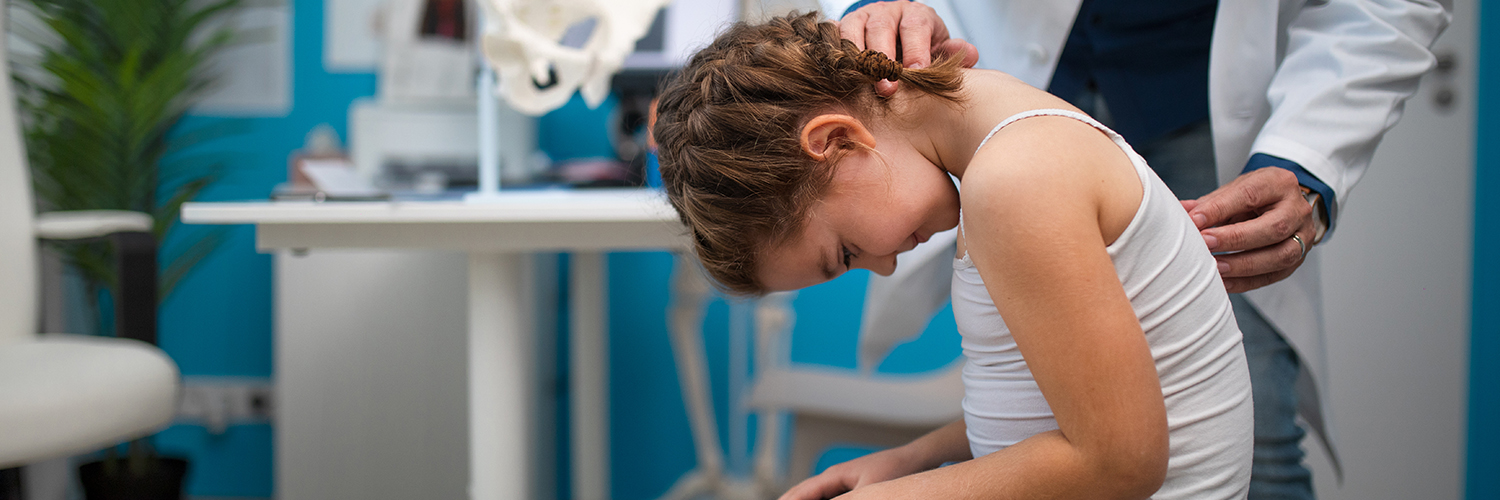
Scoliosis affects millions of people in the United States, and yet there are several misconceptions surrounding this condition, where the spine develops an abnormal sideways curvature. In this episode of HEALTH Yeah!, experts from Stony Brook Children’s Hospital will discuss pediatric scoliosis, including its causes, treatment, screenings and more.
The Experts
What You’ll Hear in This Episode
- 00:00 Opening and Introductions
- 1:57 What is scoliosis?
- 3:03 When is scoliosis typically diagnosed?
- 3:53 What causes scoliosis?
- 4:37 Addressing common misconceptions surrounding scoliosis
- 5:30 Treatment for scoliosis
- 6:25 Bracing and physical therapy
- 10:15 Surgical options, Vertebral Body Tethering (VBT) and implants
- 14:45 School screenings for scoliosis
- 15:30 How do patients benefit from Stony Brook Medicine being an academic medical center?
- 18:35 The future of scoliosis treatment
- 20:00 Closing Remarks
Full Transcript
00:00 Opening and Introductions
Announcer
Welcome to HEALTH Yeah!, where experts from Stony Brook Medicine come together to discuss topics ranging from the complex inner workings of an infectious disease to tips and tricks for staying safe and healthy all year long.
Timothy Brown
Hello and welcome to HEALTH Yeah!. Today, we’ll be speaking with experts about a condition that affects millions of people in the United States alone, and that is scoliosis.
I’m joined by Dr. James Barci and Dr. Brian Lynch, and we’re going to start off with having each of you introduce yourselves to our audience and tell us a little bit about what you do here at Stony Brook Medicine. And Dr. Barci, you’re next to me, so we’ll start with you.
James Barsi, MD
Perfect. Thank you for having me. So a little bit about myself: I’m a proud member of the Division of Pediatric Orthopedics here at Stony Brook. We’re a small division, and we have four pediatric orthopedic surgeons and three PAs. We have offices, not only in Stony Brook and Lake Grove, but in Commack and then out east and Southampton and Riverhead, too. And despite our size, we are pretty busy.
We saw nearly 20,000 patients last year and had 500 surgeries. And we also have an active research component, too. So I think one of the beliefs that both Brian and I have is that we’re here at Stony Brook, it’s an academic medical center, and we want to really advance and push the field forward.
Timothy Brown
I love the fact that you brought that up, we are an academic medical center. We’re going to talk about that a little bit more during the program because I think that is critical for patients and their families, because of the work that’s done behind the scenes, even before it comes to treatment.
Dr. Lynch, could you talk a little bit about your role here?
Brian Lynch, MD
Yes. So my name is Brian Lynch. I actually was a resident here for my training. I loved it so much I had to come back. And it’s been amazing being a part of the team, really getting to help children, and to also teach and work with medical students and become a real big part of the community. So I’ve had an excellent time.
1:57 What is Scoliosis?
Timothy Brown
Well, let’s start off, if we can with our audience, and just talk about what is scoliosis, and if either one of you can take that, or both of you and give us a definition of what it is and and what it might look like to the parents of a child who has it.
James Barsi, MD
Sure. So I’ll start off with this one.
Scoliosis, by definition, is really any curve in the back greater than 10 degrees. And we know that it’s not just a curve in the left to right plane. We know it’s more of a three dimensional deformity. As the spine curves, it rotates as well.
And what does that mean for a parent looking at a child? So we know that things that are apparent is that a curve can cause a shoulder imbalance. So usually one shoulder is elevated relative to the other. We know that the pelvis can look unbalanced too. So it could look like that one of the legs is longer, and that’s because the curve is tilting the pelvis up when the child bends forward, because of that rotational asymmetry as well.
We know that the ribs are higher on one side than the other side. It’s more of a visual diagnosis, so the parents can see it, the pediatricians can see it, the school nurses can see it, but those are the more common factors and signs of scoliosis.
3:03 When is Scoliosis Typically Diagnosed?
Timothy Brown
Dr. Lynch, I’m kind of curious, when do parents start noticing this, or physicians start noticing this? I think a lot of people think of diagnosis when the child gets to school. Does it happen earlier at times?
Brian Lynch, MD
Sometimes. You know, it could occur at any age, more commonly around adolescents, and that’s going to be because that’s when we have our biggest growth spurts.
So when you have a large growth spurt, that’s when a small curve can become quite large. Ideally, we catch it earlier than that, but you can see it at any point.
There’s even children who have other congenital conditions that can result in a scoliosis curve that can be from birth. So it is something that can be seen at any age, but typically it’s adolescents, and that’s going to be around a time when they’re really starting to grow and have a deformity, increase in size.
3:53 What Causes Scoliosis?
Timothy Brown
I suppose that probably magnifies the underlying issue, and you notice it more.
What causes scoliosis?
James Barsi, MD
The vast majority of curves are what we will call idiopathic in nature. That basically means that there’s no known cause for it. We do know that there are some genes associated with it, but those genes increase the risk of a curve developing, but there’s not a guarantee of it happening in each generation.
Other than the 90 percent of curves that are idiopathic, sometimes you’re born with a curve. So you can have a congenital curve in which the bones themselves aren’t formed properly.
And then we know that there are some neuromuscular conditions that are associated with scoliosis too, such as spina bifida, cerebral palsy. But again, the vast majority of curves, 90 percent, are really idiopathic in nature.
4:37 Addressing Common Misconceptions Surrounding Scoliosis
Timothy Brown
Interesting. I’ll throw this one open to both of you. What are some of the common myths around scoliosis? And I know there are quite a few.
James Barsi, MD
Correct. Yeah, so I’ll start. You know, a common myth that we get is that, oh, my child’s heavy backpack caused scoliosis. We know that’s a really common misconception. Scoliosis is sort of developmental in nature, so there’s nothing external someone can do to cause it. So heavy, backpacks really have no effect on it.
Brian Lynch, MD
Another one I hear all the time is poor posture. They say, Oh, I tell them to stand up all the time. Can I have them stand up more? And that’s something that you know, in regards to maintaining good back health, in regards to pain and strengthening, things like that do play a factor, but not in scoliosis.
5:30 Treatment for Scoliosis
Timothy Brown
Well, and it’s unfortunate, because even particularly the posture one, it’s almost like you’re blaming the child for the issue when it’s not their fault at all.
Can it be treated or corrected? What happens once you have that diagnosis and you know your child is struggling with this, what happens then?
James Barsi, MD
Yeah. So as I said before, scoliosis is really any curve in the back greater than 10 degrees. So if a curve is under 25 is considered a small curve. If it’s between 25 and 50 degrees, still a little bit more of a moderate size curve. And if it’s greater than 50 it’s a severe curve.
And we use those numbers to dictate treatment. The highest risk factor of any curve changing is during a growth spurt. So if you have a small curve and you have some growing left, we might just watch it. We might prescribe some physical therapy. Once you get up to that moderate range, though, if you’re still growing, that’s when we start to think about bracing. And then once you get up to that 50 degree number, that’s when we start to think about surgery for scoliosis.
6:25 Bracing and Physical Therapy
Timothy Brown
Interesting. And you mentioned bracing. So what happens there?
Brian Lynch, MD
When you come in and you have a curve, typically over 25 degrees, that’s when we talk about starting bracing. And it’s an important thing to talk about with the family, because it’s quite an undertaking.
And the reason that it’s important that everyone understands what is associated with it is that a good brace can have an astounding effect in regards to preventing curves from progressing and even sometimes making them a little bit less. But if you have a brace, even if it’s the best fitting brace, that’s not being worn, it’s going to do nothing.
So that’s been a big point of research in the past, you know, in regards to how often they have to wear them and what they have to do. But typically, I recommend patients wear them 16 hours a day, and the reason for that is studies have not shown a significant increase in effectiveness after you go above that. So when you compare 16 hours a day to 23 hours a day, the difference in prevention of progression of the curve is not significant. So it’s something that the child and the parents have to make sure that they’re going to keep up with and use and really dedicate to that in order to help give it the best effect.
Timothy Brown
So are there different types of braces?
Brian Lynch, MD
Yeah, so there’s quite a few different types of braces. The first thing to start with is the difference between daytime bracing and nighttime bracing. Daytime bracing, we’re going to try to aim for that 16 hours a day. That’s a brace that’s hopefully comfortable enough for the child to do what they want to do, to sleep in, to really be able to accommodate their lifestyle and not hinder them while providing them the treatment.
Nighttime braces are a little bit more exaggerated. That’s something that some providers use. You really can’t wear it out and about. It’s only when you’re in bed. But there are a lot of different braces now, the most common ones that you’ll see in regards to daytime bracing is going to be the Boston brace, which is what we call a thoracolumbar type of orthosis or brace.
And then some newer braces that look a little bit more like the 3D positioning and the curvature, like the Rigo Cheneau bracing. But to be honest, the most important thing with bracing is that you have a brace that fits well, so it’s not going to cause skin breakdown. It’s not going to be a brace that the child comes home and throws in the corner and says, this is not comfortable, I’m not wearing it. But it also gives us, you know, aiming for 50 percent correction of that main curve that they have, because if we have that, that gives them the best chance of having a successful outcome and avoiding progression and potentially surgery.
Timothy Brown
So, along with the bracing, I want to get to the surgery in just a minute, because I think that’s important as well. But is physical therapy a part of this as well, or is it just, you just wear the brace and you’re good?
Brian Lynch, MD
You know, it’s something that is going to be child dependent. Anytime that I have a child with scoliosis or without scoliosis come in where we’re having some cause of what we call functional back pain or muscular back pain, where they have tight hamstrings or they need some work on core strengthening, I like to include physical therapy in that.
There is a type of physical therapy that is tailored to scoliosis, called Schroth physical therapy, that a lot of physical therapy offices around Long Island have really adopted or having people who are certified in it, and it’s something I discussed with the patients, because it focuses on posture, it focuses on breathing techniques, it focuses on core strengthening. It is something that is useful.
There have been some studies that have even shown that maybe it can help decrease the curve slightly, but in reality, it’s something that just helps them with their breathing, their strengthening. And I like to offer it if it’s something that they’re interested in.
Timothy Brown
Are the braces as noticeable as they used to be?
Brian Lynch, MD
There are some braces for curves that are a little bit higher, that have to include the neck, although that is rare. The majority of these curves are going to be more what we call thoracic, that’s going to be around your rib cage, and with those curves, the brace is going to be able to be hidden underneath clothing.
So sometimes the children may be more comfortable wearing a sweater over it, but certainly not as noticeable as they used to be.
10:15 Surgical Options, Vertebral Body Tethering (VBT) and Implants
Timothy Brown
Great. Let’s talk about surgery a little bit. And there are multiple types of surgery that can be done. Can you explain that to us?
James Barsi, MD
Yeah. So first of all, we pick surgery once your curve gets up to about 50 degrees. And we pick that number because we know that those curves typically will continue to progress even after you’re done growing, whereas curves below that typically do not. A curve in and of itself, it’s not really functional until it gets up a little bit higher. So you can imagine, as your curve increases, especially in that thoracic spine, 65-70 degrees, then you start to become functional, which means you’re compressing your heart and your lungs on the cavity of the curve. And we really don’t want that to happen.
We know that as curves increase in magnitude, it becomes stiffer, and from a technical standpoint, they become more challenging. That’s why we picked that 50 degree number as the number that we start to think about surgery.
In terms of surgery, there are two basic surgical options. One is called posterior spinal fusion, and that’s really the gold standard for scoliosis surgery. Been around for 30-40 years. The general idea is that we have a series of anchor points. And those anchor points are most commonly screws, and we can pull the spine using two rigid rods to those screws. So from a curve standpoint, we can get you really straight with the spinal fusion. It comes at the expense of motion, though.
A newer type of surgery, which we started doing here at Stony Brook, is called vertebral body tethering. The idea of that is that it’s done through a minimally invasive approach. So it’s done with a video camera through small poke holes in between the ribs. We place an anchor point in the front of the spine, in the vertebral body, and then we connect that with a flexible tether. And what that does is that we’re slowing down the growth of one side of your spine just really indicated for children who are still growing, the other side of the spine continues to grow at its normal rate, and you can, in effect, grow out of your scoliosis. And you can preserve the motion in the process too.
Timothy Brown
And I know you did one of those procedures fairly recently. How’d that go?
James Barsi, MD
She did great. The patient was in the hospital for a few days, so it doesn’t add significantly to the length of stay for the normal spinal fusion. I think the difference is really the post op recovery. So since the incisions are smaller incisions, and they’re really minimally invasive, the recovery is a lot faster.
I cleared her for full sports at six weeks. So on our follow up video, I have mom sending me a video of her playing as a lacrosse goalie six weeks after spine surgery, which is really impressive.
Timothy Brown
That’s an incredible story. So does the tether stay or is it eventually removed? How does that work?
James Barsi, MD
So for most of the patients, the tether stays in forever. So the idea is to get the curve balanced and controlled until you’re done growing. Once you’re done growing, if your curve is under 50, it’s considered a stabilized curve, and it’s unlikely to progress.
Timothy Brown
This is kind of a silly question, I know, but it’s something that I’m sure people will wonder, if you have the spinal fusion, you have the metal, does that impact you later in life, as far as MRIs, going through the airport, things like that? What happens with that?
Brian Lynch, MD
Not typically. Modern implants that we use for the screws and for the rods are actually MRI compatible. There may be a little bit of artifact, meaning that when we get the MRI, if there’s a specific thing we’re looking at near it, it may be a little bit harder to see, but it’s absolutely safe and compatible for modern devices that use titanium, things like that, so that’s safe for you to use.
As far as going through the airport, it’s not an issue. I have not had any patients tell me that they got stopped by TSA or anything like that. So that should not cause any problems.
And as far as the implications for the future. When we do this surgery, we put a lot of thought into it and put a lot of thought into our correction. We put a lot of thought into all planes of it, not just the side bending deformity that you can typically see. And the reason for that is because, if we plan it correctly, the potential risk of having future progression and need for other surgeries secondary to that scoliosis and that correction is much lower. So our goal is that we have the hardware in there. It stays in there forever. The bone that is between the different levels becomes one bone, it fuses together, and they have no further need for anything.
14:45 School Screenings for Scoliosis
Timothy Brown
Fantastic. So back in the old days, and I’m old. I remember they would do the school screenings. Does that still happen?
James Barsi, MD
They do, yeah, so that’s state by state dependent. We’re in New York State. New York State does mandate school screening. Typically, the highest risk of any curve developing is during that early adolescent period. So usually it begins around fourth or fifth grade, and it continues up through early high school.
Timothy Brown
Is that adequate in your mind? Or Should parents be looking for something?
James Barsi, MD
I think the school nurses screen patients, the pediatricians do it at their annual checks too. And I think we get an uptick in patients too during the summer months, as parents are noticing their children, swimming in pools and things like that.
15:30 How do Patients Benefit from Stony Brook Medicine Being an Academic Medical Center?
Timothy Brown
Yeah, that makes sense. So I promised we would talk about this at the very beginning of the program, because I think you made an excellent point as far as Stony Brook being an academic medical center. And I love to talk about that because it just, to me, I think it’s so important, and I think it really is a value to the patients that come here and see experts like the two of you.
So talk to us a little bit about just that collaborative effort between physicians, between different areas within the AMC, and how important that is to patients.
James Barsi, MD
I think that’s one of the really unique things about practicing at Stony Brook. So we’re at a children’s hospital here. We have multiple specialties involved. For example, the tethering, I don’t do it by myself. So we have Dr. Calabro from the pediatric general surgery area that assists with that. We have experts in all fields in ICU and neurology. So we have an entire team of specialists treating children.
Not only clinically, are we able to handle the complicated cases that others might not be, but I think one of the nice things about being in an academic hospital is the research aspect of it. Most of us are here because we have a desire to advance the field, to push it forward. So we have an active research program. We want to try to offer our patients the latest in terms of technological advances, to try to make the recovery as smooth as possible. And I think that’s one of the things that we do great here.
You know, we have what’s called an ERAS protocol here, so it’s an enhanced recovery after surgery. So when I started here over a decade ago, people were staying in the hospital for about a week or so. We’re now able to better control the pain after surgery. We’re able to get our length of stay down to two to three days. So I think the benefits of an academic hospital and having your surgery here are important, and all parents should consider that.
Timothy Brown
Dr. Lynch anything to add to that, I love the fact that you’re both wearing the children’s lab coat.
Brian Lynch, MD
I think it’s a big part of being part of the Stony Brook team here. The other thing too that we both are very involved in is research with the residents and the medical students. And because of that, we’re able to do a lot of different projects to help treat patients best. We both had grants from the pediatric orthopedic community to help us further progress and improve our treatment of pediatric patients. I think it’s something that’s a really nice factor about being at an academic center.
Timothy Brown
You know, this is kind of inside baseball, but I do think it’s important. And most patients don’t know about this, but we talk about the tripartite mission here a lot, and that’s education, research and, of course, care. And all three of those things combined.
I think it rings true to the mission and what we’re trying to do, educating the next generation of physicians and nurses as well. And of course, you know, the research that goes behind all of this great work, as you guys just talked about, so it’s really important. And you know, hats off to you. It’s really impressive, the work that you do and the help that you give these children.
And we do have the only Children’s Hospital in Suffolk County. So, you know, that’s important.
18:35 The Future of Scoliosis Treatment
One last question, what do you see for the future for scoliosis and treatment for children? Is there anything on the horizon that you can kind of point to that’s exciting?
James Barsi, MD
I think, from the surgical standpoint, tethering or growth modulation technologies are really at the forefront of treatment. You know, I think if we can control these curves early and even correct them without more invasive spinal fusions, I think that’s going to be a game changer.
Another aspect of the future, I think, is the use of what’s called enabling technologies in the operating room. So one of the things that we have, and we use routinely during our cases, is what’s called computer navigation. You can imagine, when you put a screw in the vertebral body, it goes through a very narrow channel, and sometimes threading that needle is very difficult.
So we can use in real time an imaging modality with a real time computer screen, and we can see how the screw is in relation to the bone. It really enhances the safety of these surgeries. And we really have a culture of safety here, and we want to try to do these surgeries as safely as possible.
Brian Lynch, MD
I think some of the other research that we’re doing too, that could help us is looking into different causes, different risk factors, to see if we can catch it earlier and treat it earlier as well. So I think that there’s a lot of exciting things to come.
20:00 Closing Remarks
Timothy Brown
Well, thank you, gentlemen, that was fantastic, really, really informative. That’s all the time we have today. Thank you to our experts for your time and expertise, and of course, thank you to our viewers and listeners.
If you found this conversation interesting, don’t forget to like and subscribe for more informative health-related content. And if you’re in need of expert care when it comes to spinal disorders like scoliosis, reach out to the spine and scoliosis center, Stony Brook Orthopedic Associates, you’ll be in good hands. Thanks for watching.
Announcer
Stony Brook Medicine is Long Island’s premier academic medical center. We transform lives through scientific discovery, education and care, and we bring together innovative research, advanced education and extraordinary healthcare expertise to set the standard for how healthy communities thrive. For more information, visit stonybrookmedicine.edu or follow us on social media.
*DISCLAIMER: The information provided in this podcast is for educational and informational purposes only and is not intended as a substitute for professional medical advice, diagnosis or treatment. If you think you may have a medical emergency, call your doctor or emergency services immediately.