

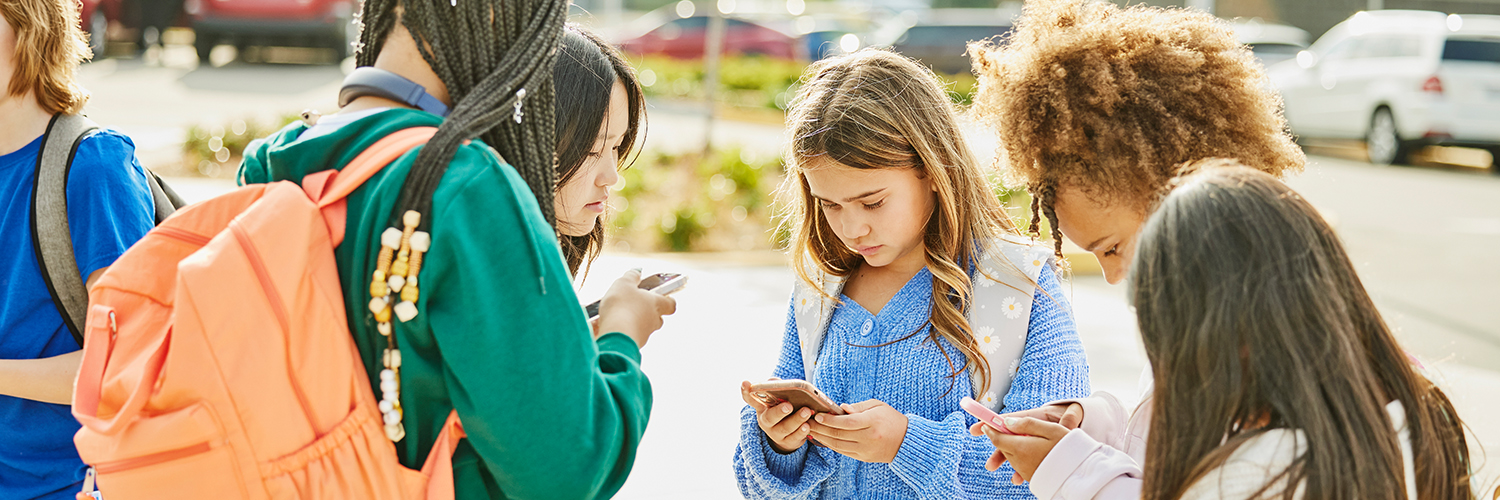
New York Governor Hochul’s Bell-to-Bell Policy prohibits cell phone use during the entire school day. While the policy sets this overarching rule, it also grants schools the flexibility to develop their own strategies for enforcement, ensuring they maintain open lines of communication with parents. In this episode, experts delve into the policy’s design and its goal of fostering stronger connections between students and their work, teachers and peers.
The Experts
- Anthony Anzalone, PsyD
- Saurabh Gupta, MBBS
- Brian Zahn, PhD
What You’ll Hear in This Episode
- 00:00 Opening and introductions
- 1:54 What is the Bell-to-Bell Policy?
- 2:53 Student and parent reactions to the cell phone ban
- 5:03 How does cell phone use impact children?
- 9:33 Changes in student behavior, performance and learning patterns
- 11:56 Consistency at home
- 16:37 Strategies for implementation (early intervention, digital citizenship)
- 24:45 Healthy balance
- 26:18 School preparations for the cell phone ban
- 30:22 Teachers modeling behaviors
- 31:27 Positive change on the horizon
- 32:55 Closing remarks
Full Transcript
00:00 Opening and introductions
Announcer
Welcome to HEALTH Yeah!, where experts from Stony Brook Medicine come together to discuss topics ranging from the complex inner workings of an infectious disease to tips and tricks for staying safe and healthy all year long.
Anthony Anzalone, PsyD
Hello and welcome to another episode of HEALTH Yeah!. My name is Dr Anthony Anzalone and I am the Director of Child and Adolescent Outpatient Behavioral Health at Stony Brook Medicine. I am joined here today by my colleague, Dr. Saurabh Gupta, and good friend to Stony Brook, Dr. Brian Zahn.
I’m going to kick things off by asking each of you to introduce yourselves to our viewers and listeners. Dr Gupta, let’s start with you.
Saurabh Gupta, MBBS
Thank you so much, Anthony, for having me here today. This is great. My name is Dr Saurabh Gupta. I’m a child and adolescent psychiatrist by training, and I am Assistant Professor of Clinical Psychiatry here at Stony Brook Medicine. I deeply care about the issues that we’re going to be talking about today in our conversation, so I look forward to that.
Brian Zahn, PhD
Hi. I’m Dr. Brian Zahn. I am Assistant Superintendent for Curriculum Instruction from the Southampton Unit Free School District. Prior to this appointment that I’ve just recently stepped into, I served for 13 years as high school principal in Southampton High School, so certainly right on the front lines of the issue that we will be discussing today, and looking forward to our conversation.
1:54 What is the Bell-to-Bell Policy?
Anthony Anzalone, PsyD
Great. Thank you so much for joining us as we sadly reach the waning weeks of the summer months. We have students, educators and parents preparing for the new upcoming academic year, but this year is going to be a little bit different because we have the passing of Governor Hochul’s bell-to-bell policy. So for those that aren’t aware, this bell-to-bell policy bans cell phone use throughout the entire school day, not just within the classrooms, but throughout the whole entire school day.
The policy also allows schools their own agency to create a plan to effectively police this policy. Students are allowed to have stripped down cell phones that do involve just calling and texting. But as well, it also allows parents the ability to contact their children, to be in communication with them. It is across from elementary school, middle school, high school, across public schools, charter schools and BOCES schools. And really the spirit of the plan is to help children be more connected with their work, connected with their teachers and connected with their peers.
2:53 Student and Parent Reactions to the Cell Phone Ban
So with that being said, my first question to you, Dr. Zahn, exactly how excited are your students for this bill? I guess a follow up to that, what are parents saying as well?
Brian Zahn, PhD
Well, having the opportunity to speak to some of our students over the summer, I can tell you, they are not too happy about the cell phone ban.
Anthony Anzalone, PsyD
Shocker.
Brian Zahn, PhD
Right, right. So certainly something, and from our former grads that just graduated the class of 2025, I think there’s a sense of relief from them in terms of not having to experience the ban.
In speaking with parents, I’ve really heard both sides of the issue. I have parents that are very excited because of the ban, because they understand and they see the issues impacting their children. But on the other side of the issue, parents are very anxious about the inability to be able to communicate and connect with their children, especially in the event of an emergency or when something is happening. So it’s been interesting.
Anthony Anzalone, PsyD
Yeah, and I know I’ve had the pleasure of meeting with your faculty and I know that some of the students have even had this mixture of, I know I’m on my phone too much, but how dare you take it away from me? So there’s that little give and go. Would you say that that’s something that you’ve heard from students?
Brian Zahn, PhD
Absolutely, we have heard that. Actually, last year, one of our classroom teachers participated in her own little mini pilot where she had two classes. In one of her classes, she implemented her own cell phone ban in the classroom, whereas the other class just maintained our current code of conduct policies. One thing that she heard from the group that was minus phones is that the students felt that they were able to engage in the lessons much more, they were much more focused, the teacher reported higher performance rates in the classroom, and the students themselves self-reported that they felt much more higher engagement levels. They felt better about their learning, and they also felt more connection to their fellow classmates there.
So for this little sample, I think this is pretty positive and students were pretty self aware of the issue.
5:03 How Does Cell Phone Use Impact Children?
Anthony Anzalone, PsyD
Wow, getting students to begrudgingly say you were right. Kudos to your faculty. So Dr. Gupta, I’ll send it over to you. We have what I like to think is like alien futuristic technology in the palm of our hands that delivers low quality information at alarmingly fast speeds to developing brains. What could go wrong with that?
So give me an idea of your work with your patients, with your families. What are you seeing with cell phone use and how it’s impacting children?
Saurabh Gupta, MBBS
Well, thank you, Anthony, for that question. Yes, I can tell you from my clinical work that I do with my families every day in my clinic, and also a little bit of research experience that I have acquired researching this issue over the past some time. Yes, this is an issue that comes up all the time in the clinic. I would not be wrong in saying that at least seven or eight out of 10 families that come to my clinic, they have a question, or they they have at least felt that this is something they really want to get a better handle on, that this regularly interferes with some of the daily tasks or the goals they have them for themselves, and especially for the for the kids.
If you think beyond that, one thing that I tell my colleagues and my families is that, hey, this is an issue we really want to, you know, get a better handle on as we progress. This is certainly a question of public attention and in some sense of public health of our generation. We know that the cell phone that we have in our hands is more powerful than the machine that we sent to the moon. So this is a really powerful tool and, of course, if we do not have a good sense or develop a good understanding of the guidelines, how are we going to develop a healthy relationship with this strong tool that we have? We are going to have challenges.
We know from evolutionary biology how the human mind works right now, we know one of the ways of thinking about our brain function is this two system theory that we know that there’s one part of the brain which is more instinctual, habitually driven, and the other one is more conscious, more purposefully driven. We know that some of the technologies behind these powerful machines, they, by design, target the habitual part of the brain. And there’s a lot of research to support that. That’s where people struggle.
Lots of the problem behaviors, or the problematic screen use, as we call it, is falling in that domain. I can go on and on to talk about it, but all of that to say that neurobiologically speaking, psychologically speaking, socially speaking, it is a very complex behavior. We’ve got to understand it that way, and we are the ones who are the vanguards of driving that force and leading the charge of making it useful for our young kids.
Anthony Anzalone, PsyD
Yeah, it’s very difficult because, I always like to say that technology moves at a pace faster than we can actually understand it, so it usually takes us about five years to figure it out. So when we’re done with this talk, we’ll be coming back in six months, talking about chatGPT and assistive AI. So the game is constantly changing.
And I always like to say too, that kids are a lot better at understanding technology than us, but then there’s this emotional immaturity against the backdrop of risk taking behaviors. So that’s just a very combustible combination.
So as you know, I had the pleasure of meeting Dr. Zahn’s faculty. They’re amazing. Can they keep up with the TikTok influencers? Is algebra ever going to be as exciting as a TikTok reel? All due respect, I think that’s a hard game to drive home.
So to be able to be on top of it, I love what you’re saying about that evolutionary piece, that you know, there’s so many threats to our attention, that I like to note that it’s a great phrase that in 2025 we never have to be bored, and because of that, our thresholds of boredom is razor thin.
9:33 Changes in Student Behavior, Performance and Learning Patterns
So I’m going to switch it over to you, Dr. Zahn, going with that, what have your colleagues seen, especially the old vanguard of the school, what have they seen over, say, the past 15 years? Have they noticed anything anecdotally?
Brian Zahn, PhD
Sure and I could speak for myself. And just saying, as a high school principal for 13 years in Southampton, there were major shifts and major changes that we’ve seen in just student behavior.
I think one of the biggest pieces that we’ve seen is really much shorter attention spans for our kids. I think that struggle resonates with our teachers in the classroom. I often speak to teachers about the frustrations with really trying to keep our students engaged and motivated, especially when they’re competing against the phones in classrooms.
Teachers also found that they’ve had to really shift their instructional deliveries and strategies because of the shorter attention spans and because of this TikTok culture that we live in.
Some of the other pieces that we’ve experienced over the years, we’ve seen an increase in cyber bullying taking place. We’ve seen less person to person interaction, especially in our cafeterias, and much more of our social areas. And then the other piece, which is very alarming, is that we saw a decrease in our student participation in many of our traditional and classic events, such as, we talk about our homecoming events, we talk about our dances, we talk about all of these great social experiences that were part of the high school experience.
Unfortunately, we’ve seen a decrease in that participation and many students reporting because of some of the issues with the phone use, particularly when you’re seeing boys that are playing on their video games and girls that are using social media in other ways. But it has been quite a challenge, and we’ve seen major shifts in student performance, student behaviors over these years.
Anthony Anzalone, PsyD
Wow. I mean, you know, it’s hard to have this conversation without the back in the day approach. I think within colleges, and I know I’ve spoken with people at Stony Brook where you know, long gone are the days where you threw a Frisbee in the quad and had a hacky sack. So maybe we’ll do that after this conversation, but to see that lack of engagement, that it’s such a juxtaposition, that we have this technology that can bring us together but it’s on such a surface level, it doesn’t really have that, that meaningful engagement within peers and within teachers and students.
11:56 Consistency at Home
So Dr Gupta, one of the hallmarks of good therapy is the generalization of skills outside of the therapy session. So we have Dr. Zahn who’s working within Southampton to make sure that within school cell phone use is contained, that it’s healthy usage. But what good is that if students are going home and they’re going right back on Roblox, are going right back on Instagram, and they’re spending excessive time there.
What would you propose to help make sure that these gains within the school are also carried over within the home.
Saurabh Gupta, MBBS
No, absolutely. That’s a great question, Anthony. And when I think about this problem in my clinic, and we work together on some of these clinical problems together, I think at this point, we’ve got to think about it as a two prong approach.
One, we want to think about what we can do in the short term, here and now. Since now we are almost in the middle of some of this problematic usage that we talk about. So we got to do something more cross-sectionally, something like what schools are trying to do. How do we make sure that we have a consistency, the same ideas, same approach in the homes that the family are on board, and they reinforce the similar ideas at home. So that it gets more generalized.
Some of the tools that we could use, interestingly, we use technology to that end. So it’s not all bad, right? We got to think about things more holistically, in the middle path. There are several family media plan templates that are available out there. I use them frequently in my clinic, when I work with my families and suggest that, hey, this is something you could put down together. Work it as a collaborative rather than a one sided, unilateral approach that’s “I know what’s the problem, I have the solution as a parent, just go and implement it,” right?
Sit down, work with your kids. Have an understanding, what are the needs that they are getting met with the use of this technology or their smartphones, and develop a customized solution that works for your family.
The second thing that I would say is that as we move forward to deal with this problem more comprehensively, I not only see this as a, to an extent, a clinical problem, but I also see it as an educational problem. Thinking about this like, if we decide that we’re going to rely only on the ban as the only way to solve this problem. I think we should also start thinking that, can we use this opportunity to develop a curriculum that addresses this challenge, like, think about a health curriculum that we have in this school. We don’t go and say, don’t talk about some of these health problems. Like in the adolescent age, we don’t say don’t talk about HIV infection or sexually transmitted diseases.
We said, no, it’s our responsibility to teach our kids the skills and the tools that they need to understand the problem and be a problem solver, or think about it wisely. I was actually at a research conference in Washington, DC, a couple of weeks ago, there is research actually to show that the kids who rethink so called educational videos that they’re watching in their pre-verbal times, that their language acquisition is actually poorer in comparison to when somebody, a human person, sitting down with the child and reading a story to them, versus they are hearing the same story in a so called engaging and entertaining way from a screen.
So we’ve got to start at that level, understand the skills needed, that parents need to understand? What are the skills they need to develop in order for it to be a successful enterprise? And of course, it falls from there.
Anthony Anzalone, PsyD
I love what you said, especially about the family media plan. And for those that don’t know, this was espoused by the past US Surgeon General. It has a really comprehensive guide of every aspect you could think about, when to use it, where to use it, keeping phones out of the bedroom, how much is problematic, and I love what you’re saying, making it more of a collaborative approach. Because one thing that we know, it’s not “because I said so,” and the other flip side of this, being able to engage people to start early education.
16:37 Strategies for Implementation (Early Intervention, Digital Citizenship)
So I’m going to put you on the spot. Dr Zahn, what would you think from kindergarten
up until college and college through – what do you think are some of the more practical things that we can do to implement this interest goal so the messages get rehearsed?
Brian Zahn, PhD
I have to say, Dr Gupta, just listening to what you said in the piece of research on how kids are learning is very interesting, because in the educational field and in the industry, we’re seeing more and more educational materials pushed out in digital format, and many schools, of course, are falling into that. Number one because it’s much more cost efficient, that’s one piece, and the access piece is another one.
But when you look at the research that says it’s not nearly as effective, I find that fascinating. So I’m certainly going to bring that back to our school.
Anthony Anzalone, PsyD
And I think we actually had a moment where I spoke to your faculty and I said, oh, reading on a screen is not as effective as reading in a book, which prompted the response of but we just took the SATs and they all took it on a screen, where I almost ran out because of the tension in the room. So I think, yeah, it’s under educating students on that, right? But again, I turn it to you.
Brian Zahn, PhD
Yeah, so very interesting. We have a couple of plans for that, because we truly believe that a ban is not going to solve the problem as well. Just look at what we did when we had zero tolerance policies in terms of suspensions, drug use and everything else. It was very problematic. It didn’t yield the results that we were hoping for.
So we firmly believe that education is key here. So we’re putting a lot of emphasis on digital citizenship, which is how to effectively use these devices with our students, particularly that’s for our students. So we’re finding opportunities in ways in our schools, whether it’s through advisory models and your non-traditional core classroom setups, where kids can go in and have these conversations, learn these “soft skills” outside of an algebra math class or an English class. So that’s something where schools are looking at structures. We at Southampton are doing that. So the education piece is key. That is a major piece of our plan.
The second piece is really talking to parents about healthy ways at an early age to educate. Education is all about the earlier that you intervene, the more effective those interventions are going to be. So really, speaking with parents about resisting the urge to use the phones as babysitters is a big one, and I know it’s very, look me as a parent myself, I know I could say I was probably guilty of that myself, but in hindsight, I think it caused bigger problems in the long run that parents never really anticipated.
So it’s that early intervention education with parents, and we’re doing that through parent universities, parent institutes, and also these educational platforms, just as we’re doing right now, is one piece. And then for the student piece, it’s really talking about that digital citizenship through different means, and non-traditional means of delivery.
Anthony Anzalone, PsyD
Yeah, it was the saying “hard choices now for easy choices later.” That we’re able to be more proactive and make sure that our students have something to deal with that boredom, or to be able to contend with boredom, which is going to be such a valuable research resource and treat for them as they grow older. That’s important.
I know in my household, we had the parody book “If You Give a Mouse an iPad,” and my kids still will quote that, about a little mouse that’s missing everything in life. So even starting young with that and not making it one of these week long, no cell phone bans. We know those aren’t effective. But also having the government and having other people pitch in, I know in other countries, they’ll have more public campaigns to advocate this, identifying students that may be at risk or engaging in risk, which isn’t to say all of them, but to get those students that may be using it in a harmful way. So I love this idea of “it takes a village” approach to make sure that the parents are on board and they’re getting the education.
I like to say sunlight is the best disinfectant. So the more we can provide education on different levels. It starts with “If You Give a Mouse an iPad,” and maybe it ends with understanding algorithms and how it’s targeting you, because we’re all guilty.
You know, Facebook knows I’m a middle aged guy. It knows what I like seeing. So, then it’s also trying to figure out how to work with kids, to outsource that willpower. Again, it’s hard for a lot of us to say no, but if you’ve got this developing brain that’s being fed this algorithm. Sometimes we have to outsource our willpower to be able to provide ways to do that so kids can be kids, and that’s the whole point of this bell-to-bell policy.
Saurabh Gupta, MBBS
If I may just say one thing about the SAT example, that this is exactly the point that, yes, you can administer a test like SAT on a digital format and it takes out that subjective variability and all those environmental factors that may affect your performance, that’s great. So that’s a good use of it. That does not equate that I’m going to learn in a similar fashion to prepare for that test. So it has to be a combination of things and knowing where the technology is useful. And it’s not only potent to solve all the problems that we have, but use it judicially.
One of the things that, when I think about digital citizenship, and we talked about it when I was at the International Congress a couple of weeks ago, that, hey, this is the opportunity for the kids to help them appreciate, educate them on what they’re up against. For that matter, all of us think about that all by the way, all of the research big companies who have the social media and whatnot, their research departments combined are bigger than any research departments that we could ever have. They do tons of research. They know so much more about human cognition and how we work, the persuasive communication, the algorithms that design the engagement, and all the factors that we know how we engage the human mind, all of that.
And yes, from the business point of view, they are going to design, and rightfully so, to maximize the output. That makes sense. But our job here is to make sure, as the educators, as the public health folks in the community, to make sure that it stays within the healthy bounds.
I think it’s not that we are at cross with each other. I think there is a space for both the ideas and the groups to coexist and develop in a healthy way. I don’t think necessarily when I think about this problem, when we have had the conversation that, hey, there is a maleficious intent here by purpose. No, I think when I’m designing a tool for myself to serve a certain need, the tool is going to serve that purpose. But there has to be somebody on the other side of the equation saying, no, no, I want to make sure that tool continues to do what it’s best to do without having harmful effects.
We know from the human mind functioning that it is the boredom, it is the inertia that has those fundamental habitual mental states where people are most likely to use their smartphones or these electronic devices in the most unhelpful way. These problems have existed forever. People have tried using different ideas to address those mental states. This too is so much easier, the least cognitive effort that it addresses that problem. That’s how you want to think about it.
24:45 Healthy Balance
Brian Zahn, PhD
I think you make a fantastic point because we as educators know the power of some of the platforms that we use on the screen and how useful they can be. And I think we’re trying to find as educators that healthy balance as well. And I think all of us kind of fell into, I think we leaned a little bit too heavy, and especially when you look back at the pandemic, I think that was a major piece, we really turned education upside down, and, in fact, really made everything digitalized at that point.
So now I think we’re really focused on trying to find that healthy balance, because we know the impact that digital platforms can have, but also we’re seeing the effects on our students in terms of our cyber bullying, major mental health spikes and everything else that’s associated with it.
Anthony Anzalone, PsyD
Yes, such an issue of good servant, bad master when we rely on technology. When we harness it the right way, and I like to say with student’s input, because they know it better than we do, right? So they’re not the head of the table, but they need to have a seat at the table. That could be something very transformative for education, for a lot of learners that are more visually based, to be able to harness technology to help them out, to be able to have AI listening, to be able to have students that maybe have executive functioning problems and notes being taken for them so they can help out, help with their test scores. That can be a beautiful thing. So it’s just how much we’re having these ongoing conversations.
26:18 School Preparations for the Cell Phone Ban
I also have to know, Dr. Zahn, how much are you preparing for it? Are there already tunnels being dug where there’s cell phones being put? What does it look like?
Brian Zahn, PhD
No, we are actively preparing for this because we anticipate that there are going to be some challenges with this, especially when you look at your upperclassmen in every school, it’s not so much our, let’s say, our freshmen, our ninth graders that are new to the high school, they’re going to come in and they’re going to naturally abide by the new school rules. But when you take your rising juniors, seniors, even tenth graders, and you apply that even to the middle school, those are the students that I think have already been conditioned in a way, and that we have to now go back and reset some norms for them.
So we do anticipate that there are going to be challenges. We anticipate that there’s going to be an increase of students in the hallways during class time because of that short attention span. So we anticipate that we’re going to see many more bathroom passes being issued to get out of the classroom. We do know that teachers are going to have a little bit of a challenge with engagement levels in the classroom, we do know that.
And we do see from our students, our students self reporting, like as a running joke but seriously, you’re going to see some students withdrawing these first couple of months. And in a way, there is truth to that. So we are encouraging our teachers really just to give our students some grace during this period, because it really will be a major change of our practices within the building.
I think, on the parent end, how we’re preparing is that we want to make sure that we are over communicating with parents because of the anxieties that parents have of not being able to connect with their children. We’re giving alternate, and making sure that parents know, alternate ways to do that, whether it’s contacting the main offices and we can connect. We’ve also allowed students to have email access that they haven’t had traditionally in the past with parents. So that’s a means, but it’s not as quick as your texting, and this is done on our own approved devices.
Again, I think that’s something that gives a little bit of relief for parents as well. And again, it just comes down to that education. We are anticipating, in terms of student behaviors, you know, we’ve seen some creative things that students have done when we visited another school that actually piloted this, this type of model last year. Some of the things that they were reporting were they had many students coming in with burner phones, and when students were placing their devices into their yonder packet pouches, which is what this one school used, there was an uptick of students coming in with two phones, one being a burner phone.
So we are anticipating things that we never thought that we would be dealing with in schools, but we’re really trying to listen and it’s funny because the students are the ones that are really, if you listen to the students, you’re going to know what we’re going to be facing.
Anthony Anzalone, PsyD
That’s great. So it’s going to be like a big scavenger hunt, but it’ll be interesting, because, you know, with my work, the typical scenario is I’ll be working with a student that will be doing an essay that’s either low value or maybe very difficult. It’s so easy to go on the phone and to relieve that tension, but then every time you go to that phone, as Dr. Gupta was talking about, re-engaging with that work becomes more and more difficult.
So I’m really just curious to see how students contend with that either low value, perceived low value, or that difficult work, because it’s so easy to alleviate that sense of tension, and that’s not always a good thing. So sometimes it’s okay to sit with that tension, because once you get through it, you can get into that flow state. So I’d be very curious to see how the students respond to this overall.
30:22 Teachers Modeling Behaviors
And in terms of what you’re hoping to see, well, let me start off with this one: What happens to the student that sees the teacher on their phone?
Brian Zahn, PhD
Yeah, I think we as educators have to model those expectations for our students. Now, the New York State law is a student cell phone ban, but we have to be very much aware as educators, we are modeling for our students. So at no time do we want to see our educators in classrooms picking up their phones and showing their phones. Now clearly our educators will need them on off periods and other times. But I think if we are modeling these behaviors for our students, and students are not just seeing that this is imposed on them, but we’re all part of this, and we all understand, we all are experiencing these issues, and we’re going to be solving them together. Students will, then even more, fall in line with some of the practices that we are striving for.
31:27 Positive Change on the Horizon
Anthony Anzalone, PsyD
All right, so we’re going to finish up your last, final question for both of you gentlemen. I want you to finish a sentence: By the end of the school year, students in New York State will be…fill in the blank.
Brian Zahn, PhD
Students in New York State will be performing at higher levels. Students in New York State will be less likely to be engaged in social media bullying. Students in New York State will have a much healthier mental health, and students in New York State will be able to much more effectively communicate, orally communicate and collaborate with one another, which is a skill that’s needed for the 21st Century workforce and learning.
Saurabh Gupta, MBBS
For me, I’m hoping that this initiative will do for us, of course apart from improved educational achievements, as Dr. Zahn talked about. I’m also hoping that there will be a trickle down benefit for me in my clinic when I see my families and the kids, that they have a better appreciation of this factor that plays into their mental health, and I can talk to them.
Because sometimes what happens when I talk to them, they really look at me and say, how is that related to what I’m experiencing in my mental health? So I’m hoping that there will be some spin-off improvements in their mental health.
32:55 Closing Remarks
Anthony Anzalone, PsyD
Great. Let’s see, let’s hope. We’ll have to check back in a year and see if that happens.
So that’s all the time that we have today. Thank you to our experts for being a part of this conversation, and thank you to our viewers and listeners for tuning in.
Announcer
Stony Brook Medicine is Long Island’s premier academic medical center. We transform lives through scientific discovery, education and care, and we bring together innovative research, advanced education and extraordinary healthcare expertise to set the standard for how healthy communities thrive. For more information, visit stonybrookmedicine.edu or follow us on social media.
*DISCLAIMER: The information provided in this podcast is for educational and informational purposes only and is not intended as a substitute for professional medical advice, diagnosis or treatment. If you think you may have a medical emergency, call your doctor or emergency services immediately.