

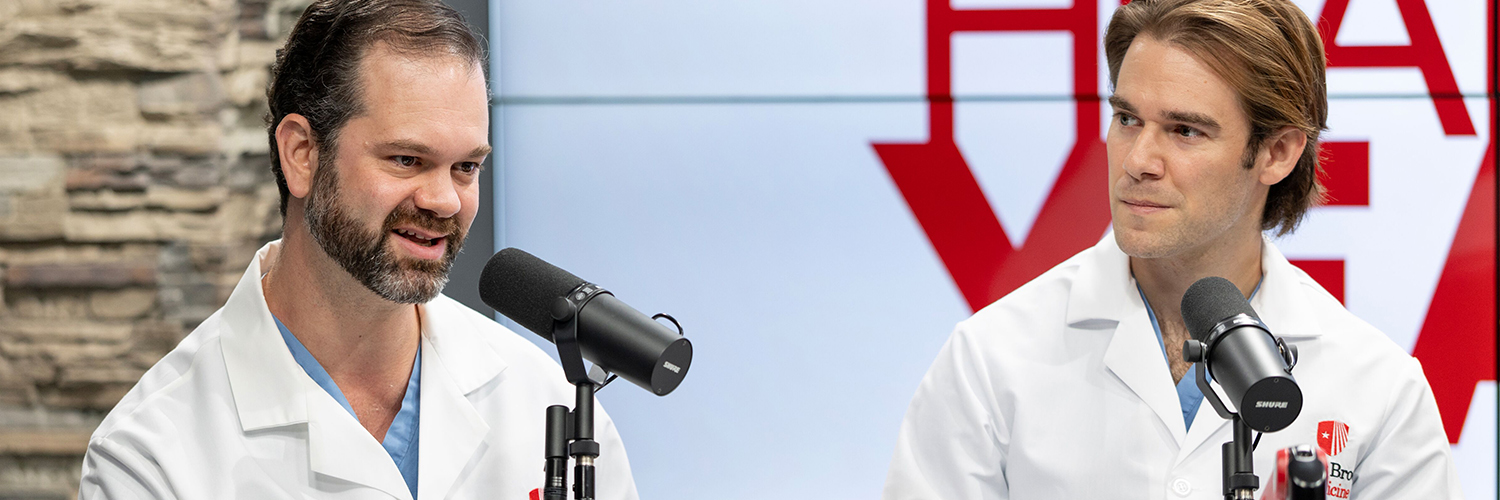
Back and neck pain are common, but when could they signal something more serious? In this episode, we discuss degenerative spine disease, including common symptoms, risk factors, diagnosis and treatment options. Learn how to recognize signs of nerve compression, when imaging is helpful, what you can do to protect your spine and when surgery may be the right choice.
Experts in the Studio
Timothy Brown
- Chief Communications and Marketing Officer
- Stony Brook Medicine
- Associate Director, Stony Brook Spine Institute
- Stony Brook Medicine
- Director, Stony Brook Spine Institute
- Stony Brook Medicine
What You’ll Hear in This Episode
- 00:00 Disclaimer
- 00:16 Opening and Introductions
- 1:33 The benefits of an academic health system
- 2:30 What is degenerative spine?
- 3:45 Symptoms, pain and prevention
- 6:45 When should I see a doctor?
- 9:05 Diagnosis and imaging
- 10:55 Signs and symptoms that can become emergent
- 12:10 Do genetics play a role in back pain and degenerative spine?
- 13:40 Surgical intervention
- 16:22 What does degenerative spine mean long-term?
- 18:05 The future of treatment options for degenerative spine
- 20:38 Circling back to the benefits of an academic health system
- 22:45 Closing Remarks
Full Podcast Transcript
*Description of Video Studio: News desk with Stony Brook Medicine logo on the front. Big screen is behind experts with HEALTH Yeah! Logo.
00:00 Disclaimer
Disclaimer: The information provided in this podcast is for educational and informational purposes only, and is not intended as a substitute for professional medical advice, diagnosis, or treatment. If you think you may be having a medical emergency, call your doctor or emergency services immediately.
00:16 Opening and Introductions
Announcer
Welcome to HEALTH Yeah!, where experts from Stony Brook Medicine come together to discuss topics ranging from the complex inner workings of an infectious disease to tips and tricks for staying safe and healthy all year long.
Timothy Brown
Hello and welcome to HEALTH Yeah! I’m Tim Brown, Chief Communications and Marketing Officer for Stony Brook Medicine. Just like the tires on your car wear down over time, so can your spine. In fact, degenerative changes in the spine are extremely common as we age, and many people may not even realize they have them. Now, most people over the age of 60 have some degree of degenerative spine.
Joining me today to talk about what degenerative spine actually means, the symptoms to watch for and when to seek care, we have two experts from the Stony Brook Spine Institute.
And Ivan, we’re going to start with you. If you don’t mind, just introducing yourself to our audience and tell us a little bit about what you do here.
Ivan Zapolsky, MD
Yeah, hi, I’m Ivan Zapolsky. Thanks for having us, Tim. I’m an orthopedic surgeon, and I’m the Associate Director of our Stony Brook combined Spine Institute.
Timothy Brown
All right, Dr. Mushlin, let’s go with you next.
Harry Mushlin, MD
I’m Harry Mushlin. I’m a spine surgeon in the neurosurgery department. I’m the Director of the newly developed Spine Institute, which is combining our two departments.
1:33 The Benefits of an Academic Health System
Timothy Brown
Before we jump into the questions, I always like to kind of highlight this as an academic health system, an academic medical center, it’s kind of fascinating to me to see how we work together with the various entities. And you just mentioned the combination here, and how important you know that’s important to patients.
Harry Mushlin, MD
Yeah, no, absolutely. I think in the past maybe it was kind of separate silos, but you’re doing a similar thing. I think all the teams need to be coordinated, and it’s better for patient care.
Ivan Zapolsky, MD
He’s doing one surgery, and I’m doing something completely different for the same reason. It confuses patients. It sends a mixed message, and it can be really helpful when we’re all in agreement, taking care of people the same way, having the same goal to make people better for the same problems.
Timothy Brown
Yeah, you get multiple minds involved. I think that’s always a positive and multiple skill sets. That’s great.
2:30 What is Degenerative Spine?
So let’s jump right in because you know when we did the intro a few minutes ago when I was talking about the majority of folks over the age of 60 might have some type of degenerative spine. That ‘s kind of a scary thought I think to many people. I’m over the age of 60. It’s a little bit of a scary thought to me.
What exactly does that mean? What is degenerative spine?
Harry Mushlin, MD
You know, it’s funny because if you throw in the next word, which is they’re told they have a disease, I think disease is probably the wrong word. But degenerative isn’t, and so degenerative overall is telling you that the components that sort of make up your spine have different areas where it can get wear and tear. And so the classic place might be you’re told you have disc degeneration. So those are the cushions between the bones in your vertebrae and your spine. And over time, like any shock absorber, they can lose water and kind of decrease in their ability to cushion you as much as it used to previously.
The other place where you can get a lot of degeneration, so to speak, is the joints in the back, and so those are the connections between the bones. Just like in your hands, I show patients, I’m like, you know how your hands help those joints and they get bigger over time. Same concept in the back.
So the back is extraordinarily complex because there’s lots of places where it connects, and everywhere where you can get motion and connection, you can get “degeneration,” so I think that it’s very common. So everyone has it as they age, that’s what I would say.
3:45 Symptoms, Pain and Prevention
Timothy Brown
Yeah. So you know, as you get older, I’m sure that, you know, the symptoms probably get more pronounced. But are there things that you can look for even at an earlier age?
Harry Mushlin, MD
Some people are going to be disposed of relative to what they do for a living. So the things that you might have more wear and tear, especially people have a more laborious job that can exacerbate it.
I think having a good core strength throughout life is key. Making sure our muscle mass is really good. All of those things which we’re kind of becoming more in tune for. Making sure your protein is really well taken care of, that you are keeping yourself fit, so to speak, the best you can is usually the best thing I tell patients. There’s not the magic answer, but overall, just like in everything else in medicine, the more healthy you live, the better off you are.
Some people, there’s some things you can’t avoid, and we can get into that. But that’s really the general answer.
Ivan Zapolsky, MD
And there’s some people that, just, their parents had bad backs, and so they might have bad backs a little earlier than the average person. And there are some people that have quite severe degenerative disease, and they never knew. You get an X-ray one day because they had a little bit of back pain, and they have terrible arthritis, a terrible degenerative disease. But it never bothered them until the day before when they decided to come in, and then you’ll have some people who have mild degenerative changes on an MRI or X-ray, and they’ll have severe pain, and it’s not for any specific reason why they have pain, and we can get into why they might have pain, but it doesn’t always correlate as far as if you have degenerative spine, are you going to have pain? You may, you may not, and our goal is to figure out what the pain generator is and try to help them with that.
Timothy Brown
So, speaking of the pain, what kind of pain are you feeling? Is it just general like lower back pain, pain throughout your entire back? What do you see?
Ivan Zapolsky, MD
Well, that really depends on kind of what’s bothering the person. Again, if you have back pain due to arthritis or because of an injury, then maybe something got a little banged up or a little worn out and ground down a little, and so that’s causing you pain.
We can probably talk later about pinched nerves, which happen in the spine, which can cause quite a bit of pain. And then there’s, as we talked about, the back’s very complex, and so there’s muscles and ligaments, and all those things can cause pain in their own way. And whether that be pain with activities, pain when you’re sitting around doing not much or pain because you’re stiff because you just got up from a seated position, those are all ways it can give you pain.
Timothy Brown
And Dr. Mushlin, you mentioned kind of the core strength and how that’s important to keep that up, and I would imagine just exactly what we were speaking about. That kind of exemplifies why it’s good to have good core strength and maybe do some exercises.
Harry Mushlin, MD
Yeah, absolutely. So I think that it’s hard to do, but those are the things that we kind of preach in clinic. I think as part of our non-operative recommendations.
6:45 When Should I See a Doctor?
Timothy Brown
Yeah, a lot of people go through life with back pain. I mean, it happens. You might strain something. You might think that it’s something else, and just a strained muscle.
When do you need to see a doctor?
Ivan Zapolsky, MD
When one should seek help is when maybe that pain’s out of the ordinary. It can be very crippling. It goes on for many days. Those are reasons to seek, you know, professional help.
But also, maybe if you’re having weakness or issues even getting up to walk that aren’t associated with pain, but just you’re lacking the ability to function in a certain way, those can be signs that something’s going on that’s wrong with the spine.
Maybe for a day or two, you should try to work through the pain. You know, it’s easy to pull your back out in some way that gives you pain for a day or two. But it’s very unusual for severe, severe pain to go on for many days or be associated with crippling symptoms for more than even a very short period of time.
Timothy Brown
Is neck pain a problem as well?
Harry Mushlin, MD
Neck pain is definitely a problem. I think neck pain and back pain and headache are almost the number one and two reasons people go to the primary care doctor for complaints of pain. So headache and back pain is pretty universal in terms of reasons that exacerbate it.
But just to add to what Dr. Zapolsky is saying, it’s pain, but also there are certain things that worry us, like if it goes down a limb, we’re always more worried. Limb association is a major concern. If you were moving your boxes, moving to a house, and suddenly your right foot feels funny for two weeks, I think that’s usually when we get more concerned.
And so I think those things for neck pain, very common. I’m worried about actual limb issues commonly, and I’m worried about, you know, your ability to use your hands. I’m worried about strength in your hands, which some people don’t associate with the spine. But as we get into, it is extremely common when the spine presses on the spinal cord, and things like walking and your balance.
So all of those are the things that I think when we really start to think about pain associated with that as well.
Ivan Zapolsky, MD
If you strain your neck and your neck hurts, give it some time. But if you strain your neck and you get a radiating pain that goes all the way to your thumb or your fingers or your fingertips are numb, that’s of concern.
Now, if it’s mild and you want to wait it out for a little bit, then that’s fine. But if your hand’s not working or if your whole arm is cramping, you know that could be a sign that there’s really something going on that needs looking into.
9:05 Diagnosis and Imaging
Timothy Brown
So when they come to see you, how do you diagnose? Do you use an MRI? What do you do?
Harry Mushlin, MD
Most of the time, what we need is imaging, and so there’s always a very good physical exam, understanding in our minds where it could be coming from, and then we’re getting an MRI, and commonly whether some version of bony scan, which is a CT or X-ray. But usually the combination of an X-ray and an MRI is usually where we start our evaluation.
Ivan Zapolsky, MD
When you talk to the person about their symptoms: I have neck pain, it’s radiating down my arm, you can have a decent idea of what the cause is, whether it be pinched nerve or something in their neck that’s bothering them, and the honest answer is that the vast majority of people will get better with just some tender loving care.
You can give them some medications, you can do some exercises and stretches guided by a physical therapist, and the vast majority of people will get better with just that. And then when that doesn’t work, is oftentimes when we start looking into MRIs, unless of course there seems to be a severe problem like weakness, and that’s kind of where the decision making really comes in. People often come in, they’re like, “My neck hurts. I need my MRI,” and whether that’s true or not, it can be a very complicated answer.
There are some conditions that can be very well managed without us ever getting an advanced picture of it, and the reason why is because an MRI is just a picture, and while it helps guide treatment, it doesn’t actually treat people in any way. It’s an expensive study that takes hours to do, and oftentimes there’s a little bit of a disagreement or an agreement with insurance of when they’re performed.
Sometimes just treating you first, and then if it doesn’t get better or if it gets worse, getting the imaging. That’s kind of the order that we go. So many times we’ll initiate treatment without actually seeing an MRI or any advanced imaging first.
10:55 Signs and Symptoms that Can Become Emergent
Timothy Brown
So, Dr. Mushlin, you mentioned, like tingling hands, fingers. There are other issues too – like bladder or bowel issues. How significant is that? What causes that?
Harry Mushlin, MD
The most common thing we treat are issues that can be handled in an elective fashion. Pain and some degree of weakness. We also do deformity surgery. Things like that are usually an elective surgery. And then there’s a subset of patients whose symptoms can be emergent. It’s not as common, but things like bowel or bladder or the inability to walk are usually signs that your nerves are being pressed on in a rather dramatic fashion.
So usually it means that somewhere in your body you went from the nerves being happy and free, and then something happened in a short amount of time that they got pressed upon, and when that happens, things that we see that are emergent are going to be you’re not going to the bathroom normally, whether it’s bowel or bladder, and then sometimes another common reason I think is actually more common is that people come in with a lot of trouble walking. I think that also gets missed. Bowel and bladder, I think people know, but walking, you know, you’re supposed to walk normally. And if one day you’re suddenly like, you know, need a cane, it doesn’t always make sense. So those are the things that we really worry about that are more emergent in nature.
12:10 Do Genetics Play a Role in Back Pain and Degenerative Spine?
Timothy Brown
Just briefly, you mentioned genetics earlier because you talked about parents. Maybe if your parents have some back issues, you may have back issues. Is that pretty common that there’s a genetic component to this?
Ivan Zapolsky, MD
As far as what a parent’s X-ray looks like compared to their child’s, I don’t have that kind of data, and it’s hard to follow that exactly. But are there going to be similarities between people and families and how quickly their backs wear out? Absolutely.
And so there’s many factors. I mean, if you’ve had a major injury to your back, you’re gonna get more wear and tear over time as a post-traumatic arthritis or post-traumatic degeneration.
Some people have excellent genes for their back, and their parents never had trouble with their back, and they never have trouble with their back. And some people there’s some amount of luck here, where throughout their life or early in life you get an X-ray or an MRI of their back and they just have a lot of degenerative disease and it’s hard to explain why sometimes, there’s clearly a lot of contributing factors.
There are inflammatory conditions like rheumatoid arthritis lupus things like that which can be a treatable disease that can cause severe arthritis, and so when we see very advanced arthritis or very advanced regenerative disease in a young person or somebody that’s you said most people by the age of 60, but if somebody comes in with advanced disease in their 40s or their 30s, sometimes we have to think about that and maybe have them see a rheumatologist or do some other sorts of investigations to figure out well why are you having such a hard time?
13:40 Surgical Intervention
Timothy Brown
So, Dr. Mushlin, we get to the point where maybe surgery is needed. What? How do we get to that point, and what exactly happens?
Harry Mushlin, MD
Yeah. So, excluding the emergencies, which we talked about, which is only a small percentage, everyone else usually has some degree of non-operative care. So, generalized speaking, patients who come in with degenerative disease are going to have some degree of a combination of physical therapy plus or minus injections of some sort and/or medication. So we’ll call that the non-operative period.
So when you fail the non-operative period and your quality of life doesn’t match what you want, that’s when we offer surgery. So I tell patients, if you’re not where you want to be and you have failed what we think is non-operative techniques, then I offer you surgery.
So it’s a personal decision, and usually it’s in this setting, as I said, after we’ve tried other techniques, and then it’s a decision between us two of what is best for you.
Timothy Brown
So when you get to that point, and the patient has decided, yes, I need this; you’ve suggested it. What happens next?
Harry Mushlin, MD
Well, what happens next is we go over the surgery you’re going to get done, and we discuss that and the length of what that means for your recovery and what the hospital stay is like. And usually at that point, you’d be booked by our booking person to get into the hospital within a certain amount of time.
Ivan Zapolsky, MD
Yeah. As far as when to do surgery or when it becomes necessary, there are people who have a hard time with their back, and sometimes there are good answers for that, that are surgical. But there’s also some situations where there’s not a good easy answer, and when people start having enough pain with their back or enough functional loss that there isn’t necessarily a good surgery to fix that problem.
And that can be an advanced conversation with the patient, whether it’s due to there being a problem that’s not obviously fixable, or if that maybe the patient has a lot of medical diseases that make the surgery not worth it from a danger point of view. But many of the things we do give a lot of functional improvement and are very safe. But that is definitely part of the conversation of whether or not surgery is not only the next step but is appropriate for that individual person and what fits their goals.
Because there are some people that might be aiming toward getting back to their activities as quickly as possible, in which case we might make a very small intervention. And there are some people that want kind of a long-term absolute fix. They don’t want to follow closely after it or something like that. In which case, you might choose a different intervention. But knowing that that might be a longer recovery after it. And so there’s a lot of patient goals and a lot of talking about what their goals are after surgery to determine what the appropriate operation is.
16:22 What Does Degenerative Spine Mean Long-Term?
Timothy Brown
And I imagine just by the nature of the word degenerative, this is something that will progress potentially. You probably suggest a multitude of things. You might have this treatment, but you also want to start exercising to help protect that sort of thing. Can we talk a little bit more about that?
Harry Mushlin, MD
You get that asked all the time. So what’s going to happen to me? And the truth is, some docs might scare you and say, “Well, you’re in big trouble.” But most of the time, I tell them that I don’t totally know. And so the pace at which you degenerate is variable. It’s not linear. And so I can’t tell you every year it’s plus this. There are things like we said that you can do to protect yourself, core strengthening, things like that can help you.
There are certain things where I say, yeah, there’s no way around it. You will get worse for some things. You can protect yourself to the degree that we get there. I can’t predict the pace. It’s amazing. Sometimes we’ll see someone in two years, the spine can look significantly worse, and you see someone else that’s kind of stayed. They get to a point and then they plateau, and so do we know how to look at that perfectly in a crystal ball? I do not, and so that’s sort of the art of our job.
Ivan Zapolsky, MD
Yeah, there are certain conditions like cervical myelopathy, which basically means spinal cord compression in the neck, that we have decent evidence will get worse or put you at certain risk over a certain number of years, or certain types of severe scoliosis will progress at a certain rate. And once it gets to a certain point, we say, “Well, if you don’t do something about it, it’s going to get a lot worse quickly.”
But the majority of degenerative spine is going to get very slowly worse throughout your life. But that doesn’t necessarily mean very slowly more symptomatic. You know, just because something gets worse on an X-ray or worse on an MRI doesn’t necessarily mean you’re going to have worse symptoms throughout your life.
18:05 The Future of Treatment Options for Degenerative Spine
Timothy Brown
What do you see for the future of degenerative spine disease and treatment?
Harry Mushlin, MD
Where do I think we’re headed with the treatment? Well, I think you know it’s interesting. Our population is much older and live much healthier as they get older. So we see a lot of patients now in their 70s or early 80s, who are still good surgical candidates because physiologically they’re younger than they appear. Or we use the word frail; they’re not frail, as they were even 10 years ago. I
mean, our medicine’s gotten better, and so has our nutrition in America, and so as our health-conscious ways, right, and so a lot of that has influenced that. I think in terms of degeneration, there are some modulating drugs that help with some of the arthritis conditions that are out there. We’ve made good strides in sort of some technology we put in patients for more advanced, better like disc replacements that exist out there. So there’s we’re pushing it forward in terms of some of the interventions being more varied, but there is no magic pill out there that kind of reverses anything. It’s all about slowing it or having interventions that help maintain some mobility or smaller interventions. So it’s a complicated answer, but I think that that sums up part of it.
Timothy Brown
And Dr. Zapolsky, what do you think as far as the future for treatment?
Ivan Zapolsky, MD
Yeah, I think a lot of our solutions to spine issues is either decompression or fusion. When decompression means taking the pressure off of nerves to reduce limb pain, or fusion, which is to kind of screw things together more or less to prevent them from moving abnormally and reduce pain.
There are some things like in the neck where you can do a disc replacement surgery, which preserves motion and has been shown to have very good outcomes. That’s been a direction that medicine’s gone. They’ve grown quite a bit over time. But then there’s things like low back disc replacements, which while they’ve been available for quite some time and seem like a very attractive option, the outcomes have been very mixed, and they don’t really seem to be a superior solution at this time. And they can be very complex to put in with very mixed outcomes.
And so, what I see is that in the long term, there’s going to be more of these motion sparing options that aren’t quite so invasive. There are even people doing fusion operations with smaller incisions with faster recovery. Though there’s good reasons and bad reasons to do procedures like that. So just because there is a smaller incision way of doing something doesn’t necessarily mean that’s a good fit for everyone. But there’s certainly an advance in the minimally invasive and motion sparing approaches in spine surgery.
20:38 Circling Back to the Benefits of an Academic Health System
Timothy Brown
We live in an academic health system here, and I think there are some tremendous advantages to coming to an academic health system for treatment, just from a variety of different standpoints. The research that’s done, the fact that there are so many minds working together.
Can either one of you speak a little bit about that and why that is important to the patient?
Harry Mushlin, MD
The milieu of being in an environment where the goal is to do what we think is the best for you, also relative to where the literature stands or what, in a national basis, we think is the right answer, requires sometimes a more academic setting because we’re always trying to stay on it. Part of that is because we have residents and we have academic meetings with neurosurgery and orthopedics actually almost twice a month.
We’re always watching each other. You’re not in a silo, and being in a silo is dangerous. You don’t think differently, and you also can get sloppy or start thinking that that’s an appropriate way to do something because no one’s checking. I think all of those things make it an easy decision. I think for most patients choose an academic center.
Ivan Zapolsky, MD
Yeah, and you just brought up like where the cutting edge of surgery or spine surgery is, and the cutting edge and the most advanced technology isn’t always the best technology that’s supported by data. And so, while in certain non-academic settings they’re always trying to do the most attractive, the most blogged about option that’s talked about the most, that’s not always necessarily the thing that’s supported to actually give you the best outcome.
And so, at academic institutions, I wouldn’t say that we’re old-fashioned, but we try to really do the things that we know are going to work because we’re trying to teach the right way to do something. We stay up on what’s most up to date, but we also try to avoid that cutting edge where you might actually put somebody in danger because you’re being experimental with something.
I’d say that in most academic institutions, you’re not really trying to experiment with patients. You’re trying to learn from the experience out there and involve that in your patient care constantly to make sure that you’re doing the right thing at all times.
Timothy Brown
That’s all the time we have for the program today. Thank you, Dr. Harry Mushlin and Dr. Ivan Zapolsky, for joining us and for leading the team of experts at the Stony Brook Spine Institute who work so seamlessly and collaboratively together to provide such advanced, comprehensive and personalized care for all spinal conditions, ranging from the most common to the most rare and complex.
And thanks to all of you for watching and listening. Be sure to like and subscribe for more health-related conversations and insights.
Announcer
Stony Brook Medicine is Long Island’s Premier Academic Medical Center. We transform lives through scientific discovery, education and care, and we bring together innovative research, advanced education and extraordinary healthcare expertise to set the standard for how healthy communities thrive. For more information, visit stonybrookmedicine.edu or follow us on social media.