
Stony Brook Health Outreach and Medical Education (Stony Brook HOME) is a medical student-run, physician-supervised free clinic affiliated with the Renaissance School of Medicine at Stony Brook University. SB HOME provides high quality and comprehensive primary care to uninsured adults on Long Island at no cost.
The Experts
Jedan Phillips, MD
- Medical Director and Faculty Advisor, Stony Brook HOME
- Associate Dean of Student Affairs, Renaissance School of Medicine
- Clinical professor, Department of Family Population and Preventive Medicine
Raya Skopicki, MS4
- The Renaissance School of Medicine at Stony Brook University
- SB HOME Steering Committee
Jacklyn Cho, MS4
- The Renaissance School of Medicine at Stony Brook University
- SB HOME Steering Committee
What You’ll Hear in This Episode
- 00:00 Opening and Introductions
- 1:30 What is Stony Brook HOME?
- 2:10 The mission of Stony Brook HOME
- 3:03 What type of care can somebody expect to receive through SB HOME?
- 4:30 Why is a clinic like SB HOME important for the communities we serve at Stony Brook Medicine?
- 6:00 Patient feedback
- 7:12 How can a patient make an appointment?
- 7:48 What are some of the strategies used to ensure continuity of care?
- 8:45 What makes SB HOME stand out?
- 10:09 What sort of hands-on work can medical students expect to take on at SB HOME?
- 12:34 What roles do students play in clinic operations?
- 13:55 SB HOME: Personal anecdotes from Jacklyn and Raya
- 16:04 Closing Remarks
Full Podcast Transcript
00:00 Opening and Introductions
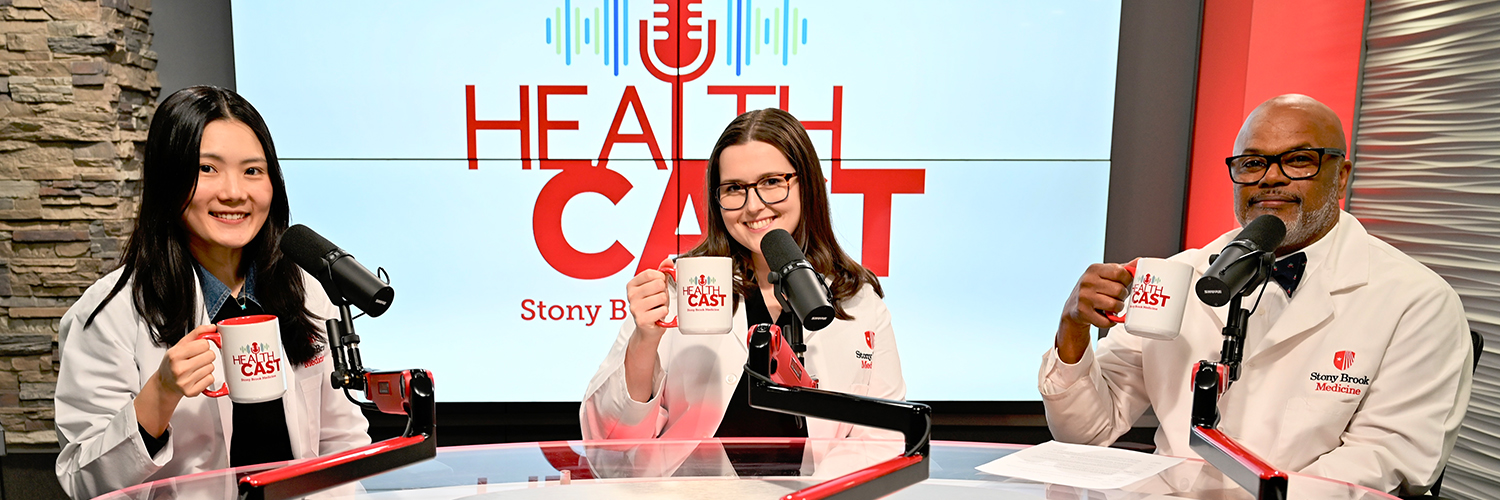
Description of Video Studio: News desk with Stony Brook Medicine logo on the front. A big screen is behind seated experts with the Healthcast logo (red uppercase lettering with a microphone at the top of the “L”). Music plays as the announcer introduces the episode.
Announcer
Welcome to Healthcast, where leaders and experts from Stony Brook Medicine come together to discuss a range of topics, from leadership and strategic planning to patient care and the inner workings of a successful healthcare system.
Jedan Phillips, MD
Good morning. Welcome to Healthcast. My name is Dr. Jedan Phillips. I am the associate dean of student affairs in the Renaissance School of Medicine. I’m also a clinical professor in the Department of Family Population and Preventive Medicine, and I’m the medical director and faculty advisor for the Stony Brook HOME Clinic. I’m joined today by Raya Skopicki and Jacklyn Cho, two students in the Renaissance School of Medicine at Stony Brook University.
Raya and Jacklyn lead (the) Stony Brook HOME Steering Committee, and together we’re going to talk about Stony Brook HOME, also known as SB HOME. But before we get started, I’d like to ask Raya and Jacklyn to share a bit more about themselves with our listeners and viewers.
Raya Skopicki, MS4
Hi everyone. My name is Raya Skopicki. I am a fourth-year medical student here from Long Island, New York. I’m currently applying into pediatrics, and it’s great to join everyone today.
Jacklyn Cho, MS4
Hi. My name is Jacklyn Cho. I’m originally from Queens, New York, and I’m also a fourth year medical student here.
1:30 What is Stony Brook HOME?
Jedan Phillips, MD
Thank you, ladies. And I’d like to say we’re going to jump right in. And I’d like to start by providing a little overview of what Stony Brook HOME is.
Stony Brook HOME stands for Stony Brook Health Outreach and Medical Education. It is a medical student-run, physician-supervised, free clinic affiliated with the Renaissance School of Medicine at Stony Brook University. We’ve been operating since 2007 but started our planning in 2006 and are providing high quality, comprehensive primary care to uninsured adults (in) the Long Island area at no cost.
2:10 The Mission of Stony Brook HOME
Jedan Phillips, MD
So first question we have is, I’d like you both to just comment a little bit about what Stony Brook HOME’s mission is.
Raya Skopicki, MS4
Yeah, so just like you were touching upon — Stony Brook HOME’s mission is to provide comprehensive primary care services to Long Island, specifically Suffolk County residents. We do see some residents from Nassau County make the journey out here, but mostly serving Suffolk County.
You know, we love providing primary care services of all kinds. We focus on preventative services, we focus on annuals as well, and most importantly, focus on culturally competent care, ensuring that it’s based (on) patients’ preferences, patients’ cultures and patients’ unique identities, is really important.
Jacklyn Cho, MS4
Another core mission of ours is education, which includes educating our patients, and also members of our medical school, undergrad and graduate school, as well.
3:03 What Type of Care Can Somebody Expect to Receive Through SB HOME?
Jedan Phillips, MD
Focusing on health outreach for a moment, what type of care can somebody expect to receive at SB HOME? Is it urgent care? Is it immediate care? Is it like a primary care office? Is it emergency care?
Raya Skopicki, MS4
Yeah, at this time, no immediate emergency or urgent services are provided, mostly primary care services. So like I was saying previously, focused on comprehensive primary care. So like, if you need to come for an annual, if you need to come for a history and physical, let’s say that’s really where our meat and potatoes, we love to say, is focused on.
We also provide preventative services, so mammograms for older ladies. We have colon screenings for older individuals, which is super important. We also provide vaccinations come flu season, and we also can provide referrals to specialists as needed.
Jedan Phillips, MD
As a primary care doctor, this preventive mission that we have, I feel is incredibly important, because unfortunately, we see a lot of communities suffering, especially the ones that are dealing with healthcare disparities.
Preventive issues such as high blood pressure or stroke or diabetes, which can be picked up in these primary care settings, can be extremely helpful improving health outcomes in the community, and then, as was just stated, access to preventive testing like mammograms and colorectal cancer screening and preventive GYN care is extremely important and effective as well.
I think another thing that I’ve heard over the years, students that have graduated have shared has been how having this experience has really helped them when they’ve worked in underserved communities, not on Long Island (but) elsewhere in the country, and just having the system that we’ve established in our learning helps us to be more methodical and more complete in how they’ve been able to serve the communities that they work in.
4:30 Why is a Clinic Like SB HOME Important for the Communities We Serve at Stony Brook Medicine?
Jedan Phillips, MD
So Jacqueline question for you, why is a clinic like SB HOME important for the communities that we serve?
Jacklyn Cho, MS4
So one of our primary missions of our clinic is to educate our patients beyond taking care of themselves, beyond their diagnoses. So we’ve collaborated with our nutrition department so that patients are aware and they know how to really take care of themselves, and are very comprehensive in terms of their lifestyle as well. So again, patients really appreciate that we’re able to help them, both in and outside of the hospital and clinic setting.
Jedan Phillips, MD
I think another thing to add on with Jacqueline’s answer is the importance of learning how to work with teams. Our clinic has been extremely successful as far as collaboration with other entities at the hospital, including our social welfare and social work department, also our Community Outreach Division. So again, as you get to practice medicine in the world, you’re going to have to be able to work with teams of providers. And I think SB HOME does a great, you know, job in doing that.
6:00 Patient Feedback
Jedan Phillips, MD
Raya, just got a question for you as well. You know, what are some things that you’ve heard from patients about their experiences coming to SB HOME?
Raya Skopicki, MS4
Yeah, I think something I’ve heard is that this is truly some of the first time patients have had someone fighting in their corner. This is some of the first time they’ve had someone following up on them and really saying, you know, here are your lab results. It’s not a one time deal when you come to SB HOME, it’s not here’s what’s going on with you, and maybe we’ll see you in a couple of months or in a year or so.
We have continuity of care at SB HOME, and we really follow up and care about all of our patients. And that’s something we really see and hear in our patients when we get feedback from them, so that they truly appreciate what we do for them.
And when you hear a name that they recognize and they say, Oh, hey, so and so, it’s so great to hear from you again. They really, truly appreciate the calls that come to them on the weekends or the time that we put in in our free time, they can really appreciate the effort that we put in.
Jedan Phillips, MD
Yeah, I would definitely concur with that. I’ve even had some patients over the years that I’ve seen that even (after) getting insurance, they say that they prefer to care that they get at SB HOME and try to come back to the clinic, even though they have insurance now.
7:12 How Can a Patient Make an Appointment?
Jedan Phillips, MD
So now for you, Jacqueline, question, how can a patient interested in making an appointment at SB HOME start the process?
Jacklyn Cho, MS4
Yeah, so patients are welcome to contact SB HOME by phone, and they’re welcome to also leave a voice message so that one of our volunteers can reach out to them at a time that’s convenient for them. They’re also welcome to email the clinic directly, and again, one of our amazing volunteers will reach out to our patients and really follow up on everything and all the different situational barriers that they may have in accessing the clinic or accessing care.
And so we try our best to really mitigate them.
7:48 What are Some of the Strategies Used to Ensure Continuity of Care?
Jedan Phillips, MD
What are some of the strategies that we use to deal with some of these difficulties? Like, you know, for example, when we had the pandemic, and we had to close down the clinic for in-person visits. What were some of the other modalities that the clinic used to stay in touch and continue serving the patients?
Jacklyn Cho, MS4
Yeah, that’s a really important topic for us. It’s definitely been using our telehealth services, which has been really a great way also, especially because a lot of our patients are unable to physically come into the clinic. So this is when we really try to troubleshoot and work with our patients individually to find different resources and different methods of working with our patients, even if they’re not seen physically.
Jedan Phillips, MD
That telemedicine, telehealth part, really makes a big difference, because many times patients have said, I can’t come to clinic, but they need refills of medication, you know, so it allows them to still take care of things like go to work and take care of their medical issues.
8:45 What Makes SB HOME Stand Out?
Jedan Phillips, MD
Raya, how is the clinic unique in comparison to other student-run health clinics?
Raya Skopicki, MS4
Yeah, I think that’s a really strong suit of SB HOME, we have various ways that we help students advance not only their interest in medicine, but their education here at Stony Brook, primarily, we offer a variety of courses.
We offer, starting this year, our Service Learning Elective, where students really get to understand how the social determinants of health are integrated into primary care, as well as our Telecycle Elective, where students understand the context of social determinants of health and psychiatric care, which is very unique to our students applying into psychiatry.
We also have networking opportunities. We have department-specific student liaisons. We have specialty clinics that we host throughout the year. So we have our third and fourth year students who actually get to work directly with the departments and get those early networking opportunities, which is really so important for fostering early connections and really building those meaningful connections as they look towards residency, which is great.
And lastly, we offer a variety of research opportunities. We’re constantly looking, how can we improve our clinic, and how can students learn how to improve a clinic. So right now, we’re studying our clinic operations and our clinic workflow. Now, how can we better ourselves every day? In the past, we’ve studied our nutrition efforts as well as barriers to transportation.
10:09 What Sort of Hands-On Work Can Medical Students Expect to Take on at SB HOME?
Jedan Phillips, MD
Shifting gears to focus on medical education. This is real hands-on experience for medical students. What sort of work are the students doing in the clinic?
Raya Skopicki, MS4
Yeah, students have a variety of roles in the clinic, so it goes all the way from administrative roles to clinical roles. So starting in the front, students assume the roles of what we like to call clinic managers. They check patients in. They really take everything from the back end, what typically an office desk staff would do in a real doctor’s office, so students get the administrative side of a clinic versus all the way into the exam room.
We have our preclinical students who are first and second year students, who help with taking vitals. They observe our clinical students who are third and fourth year students. They watch the clinical students as they take histories and physicals, and really watch their clinical skills and be able to really compartmentalize that and use it for future knowledge.
The clinical students actually work directly with the attending physician to make comprehensive treatment plans and work together to say, this is what we’re going to do for the patient, and they end up ordering labs, ordering medications and it’s really such a unique experience for clinical students. It’s really as someone who served as a clinical student, it’s really such a great experience.
Outside of those roles, we have phlebotomy students who actually draw labs right in clinic, which is super convenient for our patients. They don’t have to go to another lab center or come back to clinic another day just to draw labs. So it’s really a one stop shop.
And outside of that role, we actually have some in-person Spanish translators. That’s our most commonly encountered language besides English in our clinic.
So when students are in clinic, they can experience various roles. It’s not just coming to clinic, and it’s one role that you expect to assume. There’s so many different avenues that you can pursue.
Jedan Phillips, MD
I think, just to add on to a very thorough answer, Rhea, is one of the other student roles, or student groups that we see in the clinic is our undergraduate clinical experience program students who are undergraduate students who are pre med and want to, they have to apply for an opportunity to shadow and get other clinical education that would support them in their application in medical school. And again, like you said, it provides a great modeling opportunity for those students.
12:34 What Roles Do Students Play in Clinic Operations?
Jedan Phillips, MD
Now we talked about a lot of the roles that occur within the clinic. You know, Jacklyn, given that SB HOME is a student-run clinic, attending-supervised clinic, what roles do students play in clinic operations? And I’m not just talking about on Sunday, but on the other days of the week as well.
Jacklyn Cho, MS4
Yeah. So we have a variety of different steering committees that students, first year medical students, have the opportunity to participate in, and they usually, typically apply. And once they join the steering committee, it’s a position that they’re committed to for four years of medical school. And they really help with different parts of the clinic. As you said, they’re really kind of the background, they’re not necessarily physically in the clinic. But for example, when it comes to scheduling patients, and really even learning how to schedule like new patients versus follow up patient visits is an important skill that they’re really learning as a first-year medical student.
We also have continuity team as well as outreach teams as well. Our students have the opportunity to really reach out to the communities directly and work with the patients to really learn what they’re specifically struggling with. And so we can really all brainstorm how our clinic can really meet their needs.
13:55 SB HOME: Personal Anecdotes from Jacklyn and Raya
Jedan Phillips, MD
And then ask this question to both of you. I mean, firstly, you know, as the medical director, it has truly been an honor to work with the two of you as the leadership of our steering committee, and just the commitment that I’ve seen over the past four years that each of you have given to the clinic.
What has this experience of being involved with SB HOME been like for you? And how is it, do you feel, is going to help you to be the best doctor that you’re able to be?
Jacklyn Cho, MS4
So for me, being part of SB HOME all four years of my medical school experience has been a really rewarding and a really grounding experience, and really reminds me of why I went into medicine in the first place. Having the opportunity to really care for our patients in the clinic from a clinical background, and also outside of the clinic as well, really working in brainstorming with my classmates in terms of how we can really best support our patients needs. It’s been very rewarding, and also just reminds me of the importance of really educating our patients beyond their clinical diagnoses, but overall, how to best provide comprehensive care so that they’re better able to manage their chronic conditions as well.
Raya Skopicki, MS4
Yeah, on a similar note, I mean, my experience with SB HOME has been absolutely amazing as well. You know, throughout medical school, here at Stony Brook, you work with an established system already. You work with the system that’s already been founded. It already has its own qualities versus at SB HOME, you kind of work from the ground up. You found your own system, and you’re working on it together. So I think from that perspective, it really shows a lot you learn the importance of access, communication and trust. It’s not just about diagnosis and treatment. So I think it really brings a new perspective to not only my career, but what my every day is going to look like as a physician.
I think it also serves as a foundation of what my passions are going to be in my career. You know, I’ve really grown an interest for advocacy and community health and medical education through my work with SB HOME. So I think in the future, you know, SB HOME is going to always be with me. I may not be here, but my experience at SB HOME will always be remembered. So I think no matter what, even though in a few months I may be gone, SB HOME will always be with me.
16:04 Closing Remarks
Jedan Phillips, MD
Well, ladies, thank you both very, very much. That’s all the time we have today. Thank you, Raya and Jacklyn, for your time and for all you do for our community through your work at SB HOME. And thank you to our viewers and listeners. If you found this conversation interesting, don’t forget to like and subscribe for more informative health-related content. Thank you.
Announcer
Stony Brook Medicine is Long Island’s premier academic medical center. We transform lives through scientific discovery, education and care and we bring together innovative research, advanced education and extraordinary healthcare expertise to set the standard for how healthy communities thrive. For more information, visit stonybrookmedicine.edu or follow us on social media.
*DISCLAIMER: The information provided in this podcast is for educational and informational purposes only and is not intended as a substitute for professional medical advice, diagnosis or treatment. If you think you may have a medical emergency, call your doctor or emergency services immediately.