
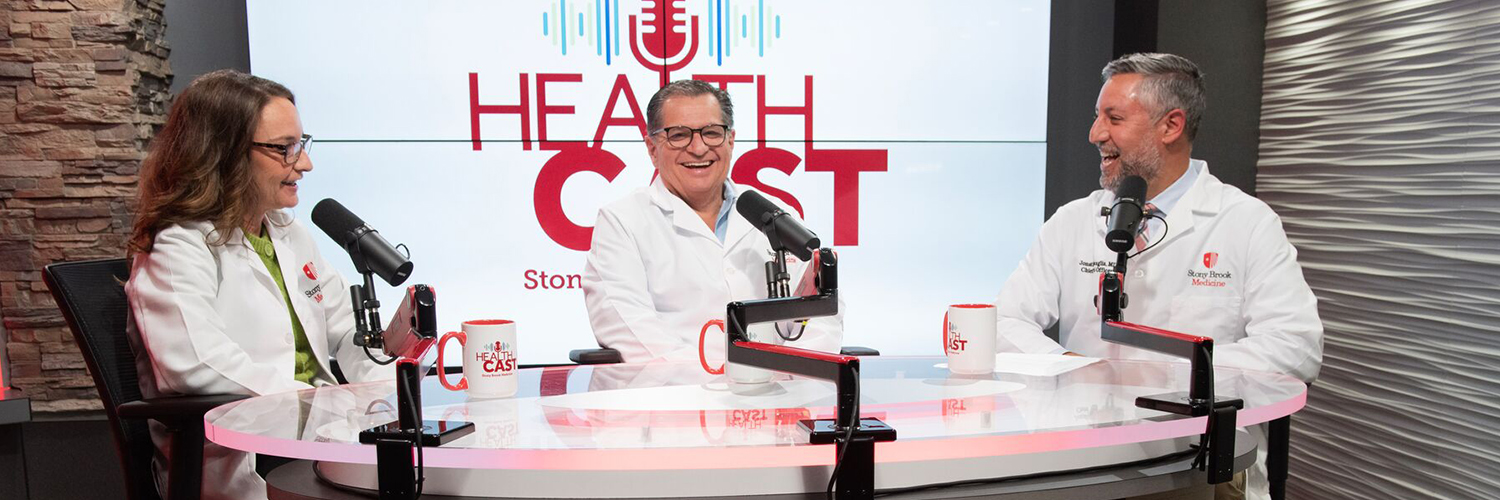
A mission trip is an organized effort where healthcare professionals dedicate their time and skills to provide care to underserved populations. Stony Brook providers have been participating in mission trips for years. In this episode, Dr. Vito Alamia and Dr. Julie Welischar discuss their most recent trip to Ecuador with Operation International’s Women’s Health Team.
The Experts
What You’ll Hear in This Episode
- 00:00 Opening and Introductions
- 1:42 Dr. Alamia’s experience on mission trips through Operation International
- 2:41 How locations and services provided are identified
- 5:03 Dr. Welischar’s experience in Ecuador
- 6:00 Military presence
- 7:56 The Women’s Health team
- 10:47 Overcoming and embracing challenges
- 12:31 Patient story
- 16:04 Education
- 18:04 What inspires Dr. Alamia and Dr. Welischar to do this?
- 20:04 How to get involved with a mission trip
- 20:50 Looking ahead – next mission trip
- 21:27 Closing Remarks
Full Transcript
00:00 Opening and Introductions
Description of Video Studio: News desk with Stony Brook Medicine logo on the front. A big screen is behind seated experts with the Healthcast logo (red uppercase lettering with a microphone at the top of the “L”). Music plays as the announcer introduces the episode.
Announcer
Welcome to Healthcast, where leaders and experts from Stony Brook medicine come together to discuss a range of topics from leadership and strategic planning to patient care and the inner workings of a successful healthcare system.
Jonathan Buscaglia, MD
Hello and welcome to Healthcast. I’m your host today, Dr. Jonathan Buscaglia and I’m joined by Dr. Vito Alamia and Dr. Julie Welischar. We’re going to be talking today about some of the incredible mission trips that Stony Brook providers have participated in over the years, and more specifically, the most recent trip Vito and Julie went on in Ecuador.
Before we get started, I’d like to ask you both to introduce yourselves to our listeners and our viewers. Vito?
Vito Alamia Jr., MD
Yeah, my name is Vito Alamia, I’m a practicing OBGYN. I’ve been practicing out on the East End for over 25 years. I was actually a Stony Brook resident and medical student. I’ve been through the system for a long time and I started doing mission trips about 20, 23 years ago.
Jonathan Buscaglia, MD
Wow. Great. And Julie?
Julie A. Welischar, MD
I’m Julie Welischar. I, too, graduated from Stony Brook. I was a resident under Vito – well he was leaving and I was coming on. And I’ve been in practice here, private practice, and then joined Stony Brook Community Medical in 2018, been here for about 22 years.
1:42 Dr. Alamia’s Experience on Mission Trips Through Operation International
Jonathan Buscaglia, MD
Now, for a little background, a mission trip is an organized effort where healthcare professionals volunteer their time and skills to provide care to underserved populations.
These trips often aim to address critical health needs, improve health outcomes and save lives. So, Vito, let’s start with you. Tell us a little bit about some of the background on these mission trips that you’ve taken on over the years. You mentioned 24. Is that what you said?
Vito Alamia Jr., MD
So I started in 2003, and I’ve been doing, except for COVID, I have done at least one a year since then.
I got involved with an organization called Operation International, which is a Strictly Surgical Mission. So it’s non-denominational and our focus is to provide free surgical care for people in the most need. And we literally traveled the globe to provide the care.
2:41 How Locations and Services Provided are Identified
We take donations and we buy the equipment, and then we literally carry them with us wherever we go. So we’ll take 40 bags of surgical supplies, set up shop in one of the countries, and then, you know, basically start an operating room from scratch. We bring all the people that are, you know, required and get it done.
Jonathan Buscaglia, MD
So how do you choose which country you’re going to go to? And also, how do you choose what surgical services that country is most in need of?
I mean, both of you are OBGYN physicians, surgeons. So tell me a little bit more about that, that selection process.
Vito Alamia Jr., MD
So the team that I usually travel with is called Team New York. It’s a group of two general surgeons, a plastic surgeon, gynecologist, and those are the services that we provide. And then what the organization does is it looks for sites where the need is good, but also when I say good, I mean, you know, really important because they have no care. But also there’s facilities where we could operate out of. There’s physicians there that we could train and also could prescreen the patients before we get there as well as do aftercare after we leave.
And then we, when we first get to the site, will see a couple of hundred patients and make an OR list and then go from there.
Jonathan Buscaglia, MD
So just a quick follow up. Over the years, have you gotten to a place and then sort of said, in addition to general surgery OBGYN, plastic surgery, there’s other needs we want to expand or bring on? Or has it been that sort of core group of specialties that you described right from the beginning in most countries?
Vito Alamia Jr., MD
So as an organization, Operation International had team New York only. And then over the years we’ve added on other specialties. So we have a pediatric team, a neurosurgery team, we have a dentistry team, an ENT. team, a plastics team. And so what Team New York will do is go to a site, see what the need is. And then if it’s a site that we could send teams back to, we’ll send the team based on the needs that the local population has.
Jonathan Buscaglia, MD
So they go ahead of time and make an assessment…
Vito Alamia Jr., MD
We do like a pilot mission and that’s kind of what we did in Ecuador. So we do a pilot mission. We assess the hospital, we assess the doctors and then leave the supplies that we bring there. And then hopefully, if it’s a good site, we can have other teams go back.
5:03 Dr. Welischar’s Experience in Ecuador
Jonathan Buscaglia, MD
Okay, great. So, Julie, this was your first mission, right? And Ecuador was your first introduction to a mission – tell us about it.
Julie A. Welischar, MD
Well, it was incredible. I loved going and I loved working on these cases with Vito. It was a different experience than I had initially had in my mind because when we first landed, there’s a bunch of people greeting us. And I’m like, where are these people from?
And all of a sudden the military is behind us and they’re flanking us. And I’m like, all right, what do we do here? So I was kind of taken aback by that level of security that was needed.
But I am so blessed to have been part of this mission. It has changed my life.
6:00 Military Presence
Jonathan Buscaglia, MD
So the military presence was for security purposes? Can you tell me a little bit about that in Ecuador? I know that there were some concerns about the safety of the volunteer physicians. So, yeah. Talk a little bit about.
Julie A. Welischar, MD
I never felt in any danger. I thought we were well secured.
But in January, right before we left, they had increased the threat level at Ecuador to level four and do not travel. And I had seen it and I sort of like paused and I was like, I don’t know what I’m doing. And then I spoke to my friend who’s an orthopedic, and he does Blanca’s House there. And he’s taken his wife, he’s taken his daughter. He said, Julie, don’t worry, it’s totally fine. I’m like, okay, I’ll go.
Jonathan Buscaglia, MD
And Blanca’s House, just for reference, is another missionary group.
Julie A. Welischar, MD
It’s another group and I believe they do mostly orthopedics. And so I said, okay, great. But then when I got my feet on the ground and behind me was the military, I was like, oh boy, this is going to get interesting. It was a little scary, but nonetheless, a great trip.
Vito Alamia Jr., MD
So this particular site I decided to go to because the need was so great, and it turns out that there were a couple of other surgical missions that started to go there and then aborted at the last minute and didn’t show up. Part of the reason was that in this particular part of Guayaquil, the Colombian and Mexican cartels basically control the area.
And there’s a high rate of crime and there’s also a high rate of kidnaping. And so a few years ago, they had kidnaped a family physician and his wife and, you know, held them for ransom and things like that. And so the level of security was basically to deal with that.
7:56 The Women’s Health Team
Jonathan Buscaglia, MD
Wow. Fascinating. Well, let’s change gears a little bit and talk about the team. So tell me, Vito, about the team that was assembled for the trip to Ecuador, maybe a little bit more. You talked about some of the specialties. What kind of cases and things like that were you guys doing there?
Vito Alamia Jr., MD
Yeah. So specifically, the team that went to Ecuador is a women’s health team. I started the women’s health team. This will be our second trip. The first time we went to Ghana and then this was our second trip to Ecuador.
So it’s women’s-based focused. So we had four gynecologists. We had a breast surgeon who does a lot of oncology. We took a general surgeon with us as well, and then we brought three nurse anesthetics so that we could have our own anesthesia in each of the rooms that we were working out of.
And then we brought three recovery room nurses. We brought four nurses to scrub and also to circulate. And then we brought a team of teachers, basically. We had a nurse educator and another teacher who brought all the equipment to do neonatal resuscitation. And we trained and there was a whole lot of education there, yeah. So it was a double mission – surgery and education.
Jonathan Buscaglia, MD
Yeah. So when you have this whole team with you, I would imagine that you’re incorporating some of the staff that work in the hospital already into the team, like as you’re taking care of a patient who has GYN needs, for example.
Julie A. Welischar, MD
So I didn’t have anything really in regards to selecting who went on this mission trip being the first, you know, person.
Jonathan Buscaglia, MD
But I mean, you worked only with the team that you brought with you from the States or did you work closely with some of the staff that are actually working at that hospital in Ecuador on a daily basis?
Julie A. Welischar, MD
On this trip we functioned with the team that we brought, for the most part. There was some input from the local physicians there. They would see our patients postoperatively overnight. So we did, you know, work with them. But in the ORs we worked with our team that came with us.
Vito Alamia Jr., MD
And also, specifically, there were anesthesia people that were working at the hospital that, you know, learned from our nurse anesthetist. There were scrub nurses that were also in the room, kind of rotating with us, seeing how we scrub and things like that.
In this particular mission, there wasn’t a lot of physician support. A lot of times there is, but we were there to teach, but in this particular mission, there was mostly just the care of the people that were there.
10:47 Overcoming and Embracing Challenges
Jonathan Buscaglia, MD
So you talked a little bit, Julie, about the security and the presence of the military. And that in and of itself, I’m sure is a little bit of a challenge, but tell me about what you saw as challenging working day to day, you know, in the hospital compared to perhaps what we have in the United States and the fortunate scenario we’re in.
What was it like? What were the challenges in the OR, for example, and that sort of stuff.
Julie A. Welischar, MD
So in general, if you don’t bring it with you, you don’t really have access to use it. So you sort of have to think on your feet if you get in a situation where you need to think quickly, you might not have a powder that we have here in the OR to stop a bleeder or whenever. There was none of that.
So you sort of had to figure it out and go back to the basics, go back to the fundamentals of surgery. And I really enjoyed that, I didn’t find it a challenge at all. I loved it. I thought it was fantastic.
Vito Alamia Jr., MD
And the other thing I think is, you know, kind of striking is when you go to these places, the disease process is so far along.
So, you know, the fibroids that you see in Ecuador or something would be once in a blue moon here. But in every single case, the uterus was huge or the prolapse was terrible. So you’re working on the hardest cases with a very limited amount of supplies. And, you know, if you don’t have your sutures, sorry, you have to use something else.
Jonathan Buscaglia, MD
The access to care is more challenging, so people are presenting with more advanced stage disease?
Vito Alamia Jr., MD
Exactly. That’s what I’m saying.
Julie A. Welischar, MD
Especially there. I think it’s largely because that hospital deals with a lot of trauma and not a lot of women’s health.
Vito Alamia Jr., MD
It’s low on the priority list, you know what I mean?
12:31 Patient Story
Jonathan Buscaglia, MD
Yeah, for sure. Tell me about maybe what you saw was one of the greatest successes while you were there. Anything stuck with you?
Julie A. Welischar, MD
I have a lot of stories. So when I had gotten there, as I mentioned earlier, you know, I was a little bit not shaken up, but I was just a little bit on guard.
And we had done Monday’s cases and then there was this one woman, Daniella, and she was our Tuesday case. She was probably my favorite case because she had a large fibroid and she had only one day to have her child care in place. And her husband had taken the day off and he wasn’t going to get another day off.
And so we went, we were tired, we were going to reschedule the case till tomorrow. And I went over to her and I said, what’s the matter? And she’s like, “my children, they’re twelve, eight and four. They’re going to be left home alone.” And she started to cry. And so I looked at Vito and decided to keep the team there.
And up until that point, I hadn’t had the aha moment of why… I was sort of like almost not regretting, but I was just I didn’t have that aha moment like this is so great, I need to do it again. And everybody had told me, once you do this, you’re hooked.
And I was like, it’s Monday night and I haven’t been bit yet. So it’s Tuesday and we ended up doing her case and we kept the team late and it was a little bit challenging from that perspective because we had to all leave together. We went together and we had to leave together. Because of the security.
So we did her case and the next morning when we made rounds, she had written a letter to Vito and I, and I wish I had brought it, but I’ll bring it another time. And it was just so endearing and so touching that, you know, something so simple in my life had such an enormous magnitude in her life. And I was hooked.
Oh and the tattoo. So we walk in and we do rounds, and she has a picture of a uterus and her ovaries, and she pulls up her phone and in Spanish she communicates with one of the physicians that we were working with. And she said she’s going to get a tattoo of Julie and Vito next to a uterus on her arm.
And she’s actually saying, “can I get a tattoo?” She asked permission. She was really cute, but she was really, really grateful. And that moment changed my whole perspective.
Jonathan Buscaglia, MD
Yeah, that’s amazing.
Vito Alamia Jr., MD
She actually said she had tattoos of her three children, and, you know, she said this was as important as the three children to her.
Jonathan Buscaglia, MD
Wow. Yeah, that’s incredible. Just to think, I mean, you removed a large fibroid?
Julie A. Welischar, MD
She had a large fibroid and she was bleeding for four months straight and she was getting numerous blood transfusions. I mean, the uterus was up to here, and it was challenging and it was stuck.
So not only did we do the case late but it was a challenging case. And so she had been bleeding and she couldn’t work. They can’t function, they don’t have access. You know, in our world we would give them birth control and TSA and problem solved. They don’t have that there so this was enormously changing for her.
Jonathan Buscaglia, MD
That’s crazy. So you didn’t just do cases there, Vito, you also taught and you educated people. So tell us a little bit what that was like. What were the main things that you were teaching when you were there and how did you incorporate the education part of this mission into the we’re going to provide clinical service to people in need, part of the mission.
16:04 Education
Vito Alamia Jr., MD
So we had scheduled lectures every day. We scheduled them over the noon hour. Sometimes we ended up doing it at the end of the day because of the surgery load. But each of the physicians was assigned a topic to discuss. And then in a classroom that was nearby the operating room, all the nurses, residents, medical students, whatever attendings were at the hospital would join.
And in the lecture hall, we probably had between 60 and 80 people there. And we gave lectures on hypertensive crises in pregnancy, in postpartum hemorrhage, in breast cancer. The breast cancer surgeon gave that lecture as well as a menopause lecture, because it’s not something that they’re very educated about.
And then in addition, the nurse educator that we brought with us to individual classes every day for neonatal resuscitation, both the practical part and the lecture part. And to me, that is probably one of the most important parts of the trip because we trained 256 people to do neonatal resuscitation. And they literally had no idea how to do it. And, you know, you lose babies on a regular basis because they’re not trained. And so to me, this is a long standing improvement in the healthcare there.
18:04 What Inspires Dr. Alamia and Dr. Welischar to Do This?
Jonathan Buscaglia, MD
Yeah. Well, you sort of segue into my next question for both of you, which is, you know, we as physicians, we help people every single day, but this is different. So what really inspires you to give up a week or two of your personal lives and go there and do this?
Julie A. Welischar, MD
Well, it forever changes you and I’ve been meaning to do a mission for quite some time. I’ve been, you know, asking Vito and the dates never worked. And so you’re right, it’s a bit of a commitment on your end as a physician. The difference in the appreciation of care and just taking your gift and bringing it to people that are so deeply and profoundly grateful for you changing their life, there is nothing like it in the world.
I’m forever a changed person. It’s incredibly profound.
Vito Alamia Jr., MD
So I do it every year and I’ve been doing it for a long time. And it’s the thing that actually makes me grounded for the whole entire year. You know, I get to practice medicine for the reason I went into medicine, which is to help people without any billing issues, without any, you know, scheduling issues, without a million other responsibilities.
And I’m given the gift of being able to help people in the most need. And, you know, I can honestly say that, you know, in the 58 surgeries that we did, we really changed 58 people’s lives and made them better. You know, some of them are life saving, some of them, you know, people are able to get back to work and they’re always, always so grateful.
And to me, it’s like the most important thing about being a physician.
Jonathan Buscaglia, MD
Yeah. So if somebody is thinking about it and they’re on the fence, what would you say?
Vito Alamia Jr., MD
Buckle up. Definitely do it at least once to see what it feels like. It’s not easy. I mean, the conditions aren’t easy. The operating room isn’t easy. You know, the language barrier, the carrying of the equipment. It’s difficult, but it’s worth it. It’s really, really worth it.
20:04 How to Get Involved With a Mission Trip
Jonathan Buscaglia, MD
How can somebody get involved? You know, they know nothing about these missions. You mentioned what was the name of the agency that you sort of collaborated with?
Vito Alamia Jr., MD
So the name of the organization is Operation International. And now we have, like I mentioned, a bunch of teams. They actually have 19 different teams. And the best way to get involved is to email us.
Jonathan Buscaglia, MD
I assume they have a website that’s easily searchable and they can get some more information that way?
Vito Alamia Jr., MD
Yep, that’s exactly right. And you know, we do take people with specific skills. So I think, you know, it’s important to be able to offer something.
20:50 Looking Ahead – Next Mission Trip
Jonathan Buscaglia, MD
Right. Looking ahead, what’s on the horizon for these mission trips? Any particular areas of the world or specific countries that you guys are looking at?
Vito Alamia Jr., MD
Yeah, so I don’t think we’re going back to Ecuador. It was a little too high risk for the women’s health team. But I actually think we’re probably going to go to Kenya. There’s a site in Kenya that another team went to and had a very good response from the local people. There’s a huge GYN need, and I think that’s probably where the team is going to end up.
21:27 Closing Remarks
Jonathan Buscaglia, MD
That sounds great. Terrific. Well, I really enjoyed hearing from both of you guys and learning a little bit about these mission trips. That’s really fascinating. And you should both be just congratulated for the work that you’ve done and the sacrifice, and what it takes to give a part of your life to these people. It’s really amazing. And I hope that I can do one as well one day.
This is all the time that we have today. Thank you both for your expertise and your time. Thank you for the incredible work you do on these mission trips and the people that you’ve served around the world.
Vito, 24 times. Holy cow. And thank you to our listeners and our viewers, and be sure to subscribe and stay tuned for more episodes of Healthcast. Thank you.
Announcer
Stony Brook Medicine is Long Island’s premier academic medical center. We transform lives through scientific discovery, education and care, and we bring together innovative research, advanced education and extraordinary healthcare expertise to set the standard for how healthy communities thrive.
For more information, visit Stony Brook Medicine or follow us on social media.
*DISCLAIMER: The information provided in this podcast is for educational and informational purposes only and is not intended as a substitute for professional medical advice, diagnosis or treatment. If you think you may have a medical emergency, call your doctor or emergency services immediately.